
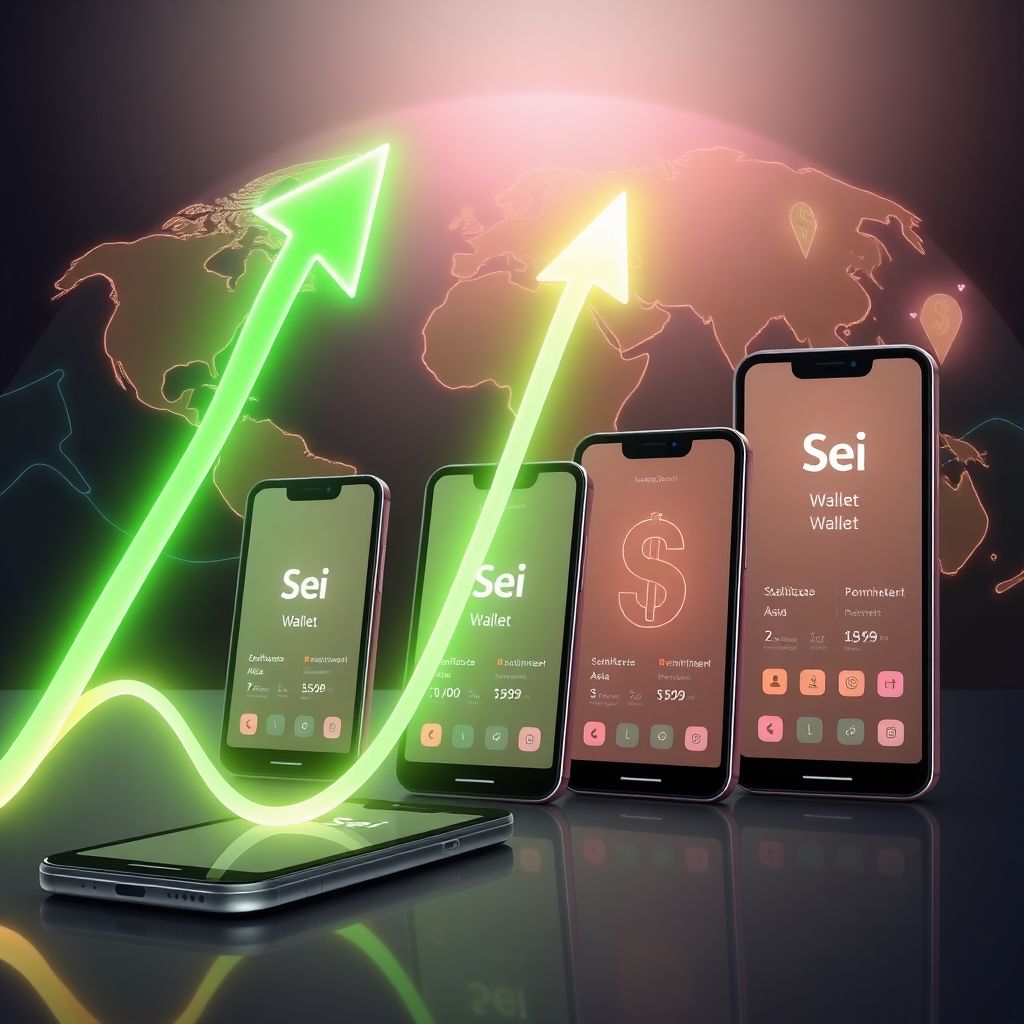
Sei token surges as Xiaomi deal brings pre-installed crypto wallets to millions of phones
The Sei token rallied on December 10 after the layer-1 blockchain announced a strategic integration with Xiaomi that will see a dedicated Sei crypto wallet pre-installed on new smartphones in key international markets. The move positions Sei at the center of one of the most ambitious attempts yet to bring blockchain technology directly to everyday mobile users.
While much of the broader crypto market traded in the red, Sei registered intraday gains following the announcement. Investors appear to be betting that a direct presence on Xiaomi devices could dramatically expand Sei’s user base and on-chain activity, especially in regions where mobile phones are the primary gateway to the internet and financial services.
Under the agreement, Xiaomi will embed a Sei-powered crypto wallet application into select new smartphones sold outside mainland China and the United States. The first wave of distribution is planned for Europe, Latin America, Southeast Asia, and Africa, regions where Xiaomi already enjoys strong brand recognition and price competitiveness.
According to market data, Xiaomi holds more than 36% of the smartphone market in Greece and over 24% in India, and sold upwards of 168 million devices in 2024, representing about 13% of total global smartphone shipments. By sitting on Xiaomi’s default app lineup, the Sei wallet will gain exposure to potentially tens of millions of new users each year.
Onboarding has been designed to be as simple as possible. New users will be able to set up their Sei wallet using familiar Google or Xiaomi account credentials, significantly lowering the friction that typically deters non-crypto natives from creating a wallet, managing seed phrases, and understanding private key security from day one.
The partnership, revealed by Sei Labs—the core development team behind the Sei blockchain—on December 10, 2025, goes beyond basic wallet functionality. The companies say the integration is being built as a full-fledged Web3 gateway that will support decentralized applications (dApps), peer-to-peer token transfers, and consumer-to-business crypto payments directly from the pre-installed app.
A crucial part of the roadmap is native stablecoin support. Sei and Xiaomi plan to enable stablecoin transactions using assets such as USDC on the Sei network, allowing users to send and spend digital dollars via their smartphone wallets. Stablecoin-based payments are expected to launch first in Hong Kong and across the European Union by the second quarter of 2026, pending local compliance and infrastructure readiness.
Jeff Feng, co-founder of Sei Labs, described the collaboration as a turning point for mainstream crypto adoption. He emphasized that embedding Sei’s high-throughput infrastructure into one of the world’s largest mobile ecosystems is intended not only to simplify onboarding, but to redefine how billions of people might interact with digital assets in routine activities such as payments, remittances, and digital commerce.
To catalyze this mobile-first push, Sei has earmarked $5 million for a Global Mobile Innovation Program. The fund will back developers and startups building consumer-focused blockchain applications tailored to smartphones and other connected devices. Priority will likely go to projects that can make tangible use of the Xiaomi wallet integration, from micropayment tools and loyalty apps to gaming, social finance, and creator-focused platforms.
Company projections suggest that the Xiaomi partnership could bring tens of millions of new users onto the Sei network each year if even a small fraction of Xiaomi buyers activate and use the pre-installed wallet. The rollout strategy is particularly focused on emerging markets, where traditional banking penetration is often low, but smartphone adoption is high and growing.
By targeting these regions, Sei is positioning its blockchain as financial infrastructure for populations that frequently rely on mobile money and informal financial networks. In such environments, a default crypto wallet on an affordable smartphone could double as a savings account, remittance tool, and payment app—without users ever needing to visit a bank branch.
For Xiaomi, the collaboration offers a way to differentiate its devices in a fiercely competitive Android market. Integrated crypto capabilities could appeal to younger, tech-savvy consumers as well as small businesses looking for low-cost digital payment alternatives. If successful, the integration could also lay the groundwork for a broader ecosystem of blockchain-based services tied to Xiaomi’s hardware and software platforms.
From Sei’s perspective, the partnership is a strategic bet on distribution. Many blockchain projects compete on speed and fees, but often struggle to get in front of real-world users. By going straight to the smartphone home screen, Sei is trying to bypass one of the industry’s biggest bottlenecks: the gap between technical infrastructure and everyday usability.
The focus on pre-installation is critical. Instead of requiring users to search app stores, compare wallet providers, and navigate confusing security warnings, the Sei wallet simply appears on the device out of the box. This “default presence” tactic mirrors how browsers and messaging apps gained dominance on mobile and desktop platforms over the last two decades.
There are also potential implications for remittances and cross-border payments. Many of the target regions for the rollout—such as Southeast Asia, Latin America, and parts of Africa—are major corridors for international money transfers. With stablecoin support on Sei, users could theoretically receive funds from abroad in minutes and hold them directly in their phone wallet, potentially at lower cost than traditional money transfer operators.
At the same time, the initiative will have to navigate regulatory, security, and user-education challenges. Integrating crypto wallets at the device level raises questions around local licensing, consumer protection, and compliance with evolving digital asset rules. Xiaomi and Sei will also need to ensure that non-technical users understand how to protect their funds, especially if they later move from custodial to self-custodial setups within the ecosystem.
For developers, the Global Mobile Innovation Program signals that Sei wants to become a preferred blockchain for mobile-first Web3 applications. By combining funding with guaranteed distribution through Xiaomi devices, Sei is attempting to create a virtuous cycle: more users attract more developers, while richer app ecosystems give users more reasons to engage with the wallet.
Market reaction to the news underscores how sensitive token prices can be to adoption-oriented partnerships, particularly those that tie blockchain networks to established consumer brands. Investors will now be watching key execution milestones: how quickly the wallet ships on new models, how many users activate it, what daily transaction volumes look like, and how many third-party apps integrate with Sei via the Xiaomi stack.
If the rollout proceeds as planned and stablecoin payments launch on schedule in Hong Kong and the EU, Sei could become a test case for large-scale, hardware-level crypto integrations. Success would likely encourage competing blockchains to pursue similar partnerships with other smartphone makers or mobile operating system providers, further blurring the line between Web2 devices and Web3 infrastructure.
In the short term, the Sei token’s price movement reflects optimism that the network is securing a significant foothold in the race for mainstream adoption. Over the longer term, the real measure of impact will be whether everyday Xiaomi users—most of whom have never interacted with on-chain finance—find the pre-installed Sei wallet intuitive, useful, and safe enough to incorporate into their daily financial habits.