
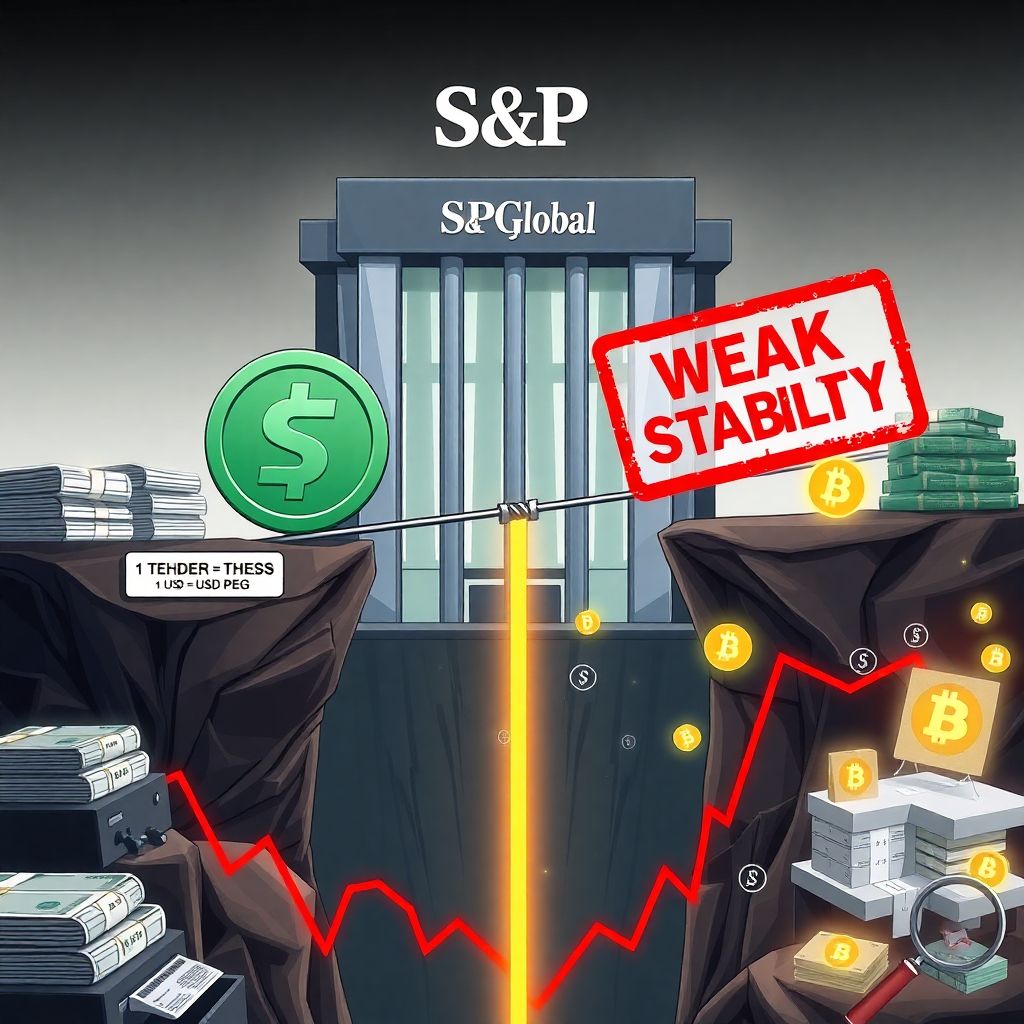
S&P Global Ratings has cut its view of Tether’s flagship stablecoin, USDT, warning that the token’s ability to hold a firm one‑to‑one peg with the U.S. dollar is now “weak.” The downgrade centers on the growing share of Bitcoin and other higher‑risk assets in Tether’s reserves, which S&P argues could leave USDT undercollateralized if markets turn sharply lower.
In its latest assessment, S&P said USDT’s stability could be compromised if the value of assets backing the token falls significantly. Because part of Tether’s reserves is held in volatile instruments such as Bitcoin, a steep drawdown in crypto markets could erode the cushion that is supposed to fully cover all outstanding USDT in circulation. In that scenario, the company might not have enough liquid, high‑quality assets to redeem every token at a full dollar.
The agency emphasized that its concern is not about USDT’s popularity or market share, but about the quality, transparency, and risk profile of the underlying collateral. A core point in the downgrade is the risk that reserves may not always be sufficient “at all times and under stressed market conditions.” If Bitcoin and other riskier holdings slump in tandem, reserve coverage could fall below 100%, opening the door to a loss of the peg.
S&P also flagged Tether’s disclosure practices as a key weakness. The ratings firm said that Tether does not publish sufficiently detailed or consistent information about key elements of its operation—such as who exactly holds its assets, which financial institutions it relies on, and how counterparty risks are managed. Limited clarity around custodians, trading partners, and bank account providers makes it harder for analysts and investors to independently verify the robustness of USDT’s backing.
The combination of market risk and disclosure gaps led S&P to shift its assessment of USDT’s ability to maintain a stable value into its lowest band. In practical terms, a “weak” stability rating means that, in S&P’s view, USDT is more vulnerable to stress events—such as a sudden market crash or a wave of redemptions—than higher‑rated stablecoins that hold mostly short‑term government securities and cash in well‑identified, regulated institutions.
Tether, for its part, has pushed back on the critique and publicly disagreed with the downgrade. The company argues that its reserves are more than sufficient and that it intentionally keeps a buffer above 100% to protect users. Tether has consistently claimed that the mix of highly liquid instruments—like U.S. Treasury bills—alongside other assets provides both yield and resilience. In its view, holding Bitcoin as part of the reserve is a strategic choice that reflects the asset’s long‑term potential and role in the broader crypto economy.
The heart of the disagreement lies in how risk is defined. S&P’s methodology prioritizes stability, liquidity, and transparency, favoring reserves dominated by cash and top‑tier government debt, with minimal exposure to volatile markets. Tether, conversely, leans on its track record of managing redemptions during previous crises and on the appreciation of some risk assets over time. From Tether’s standpoint, the market has already “voted with its feet,” given that USDT remains the largest stablecoin by capitalization and trading volume.
For users and institutions, the downgrade does not automatically mean USDT will lose its peg, but it does change the risk narrative. A stability assessment from a major ratings agency is often used by funds, trading firms, and corporate treasuries when setting internal risk limits. Some institutions may respond by reducing exposure to USDT, diversifying into other stablecoins, or tightening how and where they use it—as collateral, in lending programs, or for cross‑border transfers.
Retail users might not feel an immediate impact in day‑to‑day trading. On most exchanges, USDT pairs remain among the deepest and most liquid markets. However, the rating change underscores that not all stablecoins are created equal. Behind the simple promise of “1 USDT = 1 USD” sits a complex portfolio whose composition can shift over time. The more that portfolio depends on volatile holdings like Bitcoin, the more sensitive it becomes to drawdowns in crypto prices.
The concern about undercollateralization is especially acute during periods of market stress. If Bitcoin and other high‑beta assets in Tether’s reserves fall together, and if that happens just as redemptions spike—as traders rush to cash out—Tether would be forced to sell assets quickly. Fire‑sale conditions can further depress prices, creating a negative feedback loop. It is precisely these scenarios that a stability rating is designed to capture, even if they have not yet fully played out.
Transparency is another recurring theme. While Tether has improved its public reporting in recent years—publishing regular snapshots of its reserves—S&P’s comment that information on custodians and counterparties remains insufficient suggests that the bar, from a traditional finance perspective, is still not met. For ratings analysts used to scrutinizing detailed, audited balance sheets, limited visibility into where assets are parked and under what legal arrangements represents a material risk.
From a regulatory standpoint, the downgrade may add fuel to calls for tighter oversight of global stablecoins. Lawmakers and regulators in multiple jurisdictions have already expressed concern that large, dollar‑pegged tokens can behave like shadow banks, issuing digital IOUs without being subject to the same capital, liquidity, and disclosure rules as regulated financial institutions. A high‑profile rating cut on the world’s largest stablecoin is likely to be cited in future debates about licensing, reserve requirements, and supervision.
For the broader crypto market, the situation is a reminder that stablecoin risk is systemic. USDT sits at the center of spot trading, derivatives, DeFi liquidity pools, and cross‑platform arbitrage. Any loss of confidence in its peg—even if temporary—could ripple through prices, funding markets, and on‑chain protocols. Historical episodes where stablecoins stumbled have shown how quickly spreads widen and how traders rush into perceived safer alternatives or into fiat.
Investors and users who rely on USDT have several practical steps they can consider. First, they can diversify across multiple stablecoins with different reserve structures and regulatory footprints, reducing single‑issuer risk. Second, they can pay closer attention to reserve reports and third‑party analyses, noting changes in the share of volatile assets such as Bitcoin relative to cash and government securities. Third, they can align their exposure with their risk tolerance—using USDT for short‑term liquidity and trading, while holding longer‑term reserves in instruments with clearer legal protections.
At a strategic level, the S&P downgrade illustrates a wider tension between crypto‑native practices and traditional financial standards. Crypto issuers often optimize for yield and growth, mixing in assets like Bitcoin that can boost returns in bull markets. Traditional rating frameworks, by contrast, assume that a true “cash equivalent” must be boring: fully transparent, easily liquidated, and highly regulated. How stablecoin issuers choose to position themselves between these two poles will shape which tokens become preferred by conservative institutions versus speculative traders.
Whether the new “weak” rating leads to visible changes in Tether’s behavior remains to be seen. The company could respond by adjusting its reserve composition—reducing exposure to Bitcoin and other high‑risk assets—or by enhancing transparency around custodians and counterparties to address some of S&P’s specific critiques. Alternatively, it may opt to maintain its current strategy, betting that market demand and its existing user base will outweigh concerns raised by traditional credit analysts.
For now, the downgrade serves as a clear signal: maintaining a stable peg is not just a matter of technology or scale, but of conservative reserve management and verifiable disclosure. As stablecoins continue to power trading, payments, and on‑chain finance, how these issues are handled will determine which dollar‑pegged tokens are trusted not only by crypto traders, but also by the more cautious institutions still weighing whether—and how— to step into the digital asset world.