
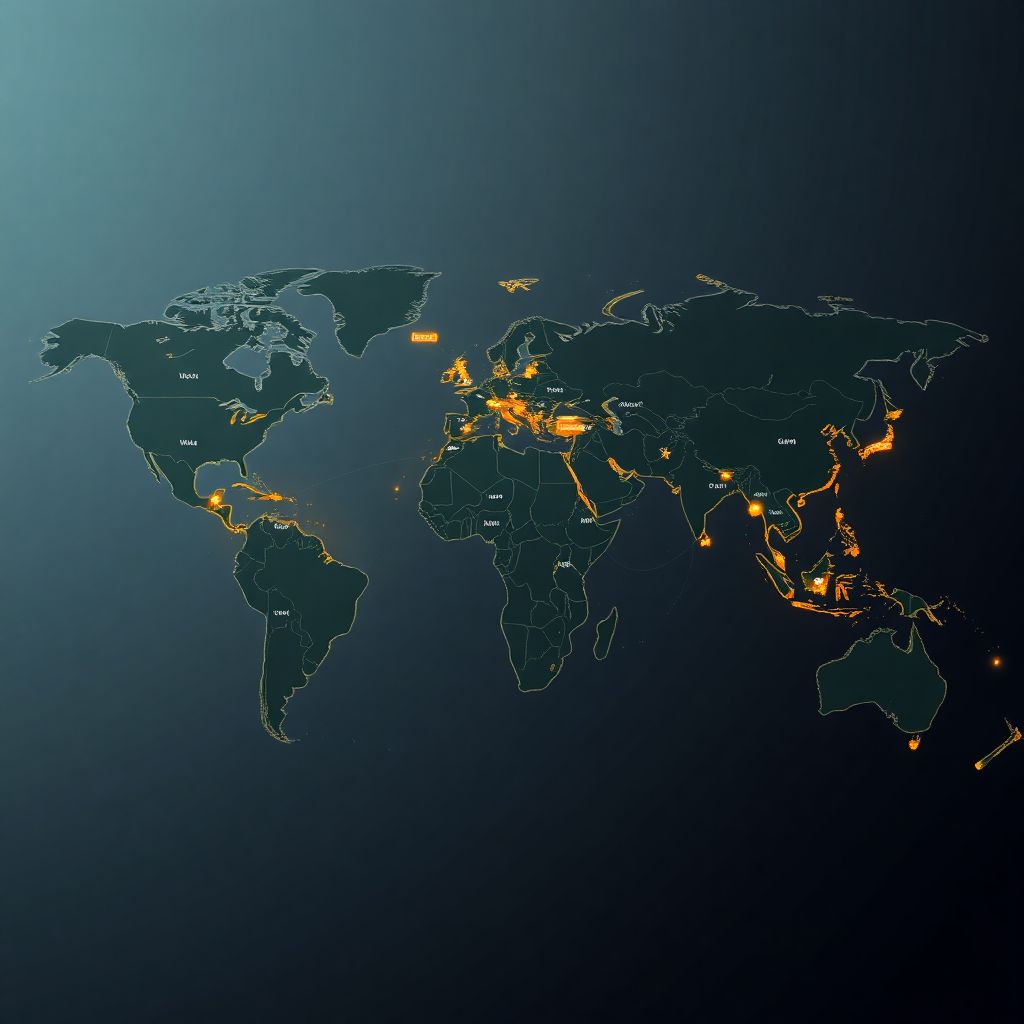
The Stablecoin Founder Map Doesn’t Match the Stablecoin Volume Map
Most people in crypto assume the biggest opportunity for stablecoins lies where financial capital is already concentrated: New York, San Francisco, London, Singapore. That assumption is increasingly wrong.
By 2025, global stablecoin transaction volume had surged past $28 trillion-more than Visa and Mastercard combined-yet the bulk of that economic activity is not happening in Wall Street trading desks or Silicon Valley fintech sandboxes. It’s happening in countries where many venture capital partners have never even stamped their passports.
At the same time, the founders and the money backing them are still overwhelmingly based in the U.S. and Europe. That mismatch-between where stablecoins are being built and where they are actually used-defines the next phase of this industry.
Where Stablecoins Are Built vs. Where They’re Used
On one map, you have the headquarters of the major stablecoin issuers, wallets, and on-ramps:
– U.S.: New York, San Francisco, Miami, Boston
– Europe: London, Paris, Berlin, Zurich
– A handful of hubs in Singapore, Hong Kong, Dubai
On another map-one based on actual transaction volume, peer-to-peer flows, and retail adoption-the hotspots look completely different:
– Latin America: Brazil, Argentina, Mexico, Venezuela, Colombia
– Africa: Nigeria, Kenya, Ghana, South Africa
– Asia: Turkey, India, Indonesia, the Philippines, Pakistan, Vietnam
– Eastern Europe and the CIS: Ukraine, Russia, parts of Central Asia
These regions see stablecoins not as speculative assets or institutional settlement rails, but as a lifeline: a way to escape devaluation, move money across borders, and access a dollar-like unit of account that local banks can’t reliably provide.
In Emerging Markets, Stablecoins Are the Product
In New York, a stablecoin is usually infrastructure: a convenient settlement asset between exchanges, a tool for market makers, or a building block in DeFi strategies. The end user doesn’t care if the payment is routed in USDC or USDT-they care that the trade clears.
In Lagos, Buenos Aires, or Istanbul, the stablecoin is the product. It directly solves a visible, painful problem:
– Currency collapse and inflation
When local currencies lose value by the week, stablecoins give people a way to store purchasing power in something closer to the U.S. dollar. For many, a dollar stablecoin is easier to access than an actual dollar bank account.
– Capital controls and payment frictions
Entrepreneurs, freelancers, and small exporters use stablecoins to send and receive payments that would otherwise be slow, heavily restricted, or eaten alive by FX spreads and bank fees.
– Informal financial systems
In places where large portions of the population are unbanked or underbanked, a stablecoin wallet on a cheap smartphone becomes the first real financial account someone ever controls.
– Diaspora and remittances
Migrant workers are increasingly paid in or through stablecoins, then convert locally-often faster and cheaper than via traditional money transfer operators.
In these markets, “crypto” is not NFTs, meme coins, or leverage protocols. It’s a quasi-dollar account and a cross-border payment rail wrapped into one.
Why Venture Capital Keeps Missing the Real Stablecoin Opportunity
Despite the usage explosion in emerging markets, the lion’s share of venture funding still flows into projects built for Western institutional or affluent retail users. There are several reasons for this disconnect:
1. Proximity bias
Investors back what and who they can physically meet. Founders in New York, London, or Berlin get more coffee meetings, more warm intros, and more term sheets than equally talented founders in Lagos or Karachi.
2. Comfort with institutional narratives
It is easier for a fund to pitch its LPs on “tokenized treasuries,” “on-chain prime brokerage,” or “institutional stablecoin settlement” than on a scrappy startup in an unstable economy serving unbanked users with low ticket sizes.
3. Country and regulatory risk aversion
Many emerging markets come with perceived political, regulatory, and currency risk. Founders operating there are often penalized with lower valuations or ignored altogether, even when product-market fit is clearer than in developed markets.
4. Data blindness
Much of the most interesting stablecoin usage happens off the radar of traditional crypto analytics-inside private wallets, OTC networks, WhatsApp groups, local fintech apps, and informal merchant circles. If a VC’s view of the world is limited to centralized exchange order books, they will inevitably misread where the demand really is.
5. The language and network gap
Local founders in Africa, Latin America, South Asia, or the Middle East may not have the same access to elite schools, accelerator networks, or fluent fundraising jargon. That doesn’t make their markets any less valuable-but it does make them easier to overlook.
The result: a growing number of Western-funded stablecoin projects are fighting for institutional mindshare, while some of the most compelling real-world use cases go chronically underfunded.
The Corridors That Will Create the Next Generation of Winners
If you look at real-world flows rather than pitch decks, a different set of “power corridors” emerges-routes where stablecoins are already doing serious economic work:
– US/EU → Latin America
Remote workers and freelancers getting paid in dollars, then swapping into local currency or spending directly from stablecoin wallets.
– Gulf States → South Asia and Africa
Migrant workers sending part of their wages home via stablecoins instead of traditional remittance services.
– Asia → Africa
Cross-border trade between Chinese, Indian, or Southeast Asian exporters and African importers leveraging stablecoins to avoid costly, slow correspondent banking.
– Regional flows within Africa and Latin America
Businesses operating across borders in weak-currency environments using stablecoins as a neutral, shared unit for invoicing and settlement.
These corridors are already at scale. Yet the companies dominating them are rarely the glossy, heavily-funded brands headquartered in financial capitals. They’re often:
– Local or regional wallets that integrate stablecoins quietly in the background
– OTC desks that cater to small businesses and high-volume individuals
– Payment aggregators that use stablecoins under the hood while presenting a familiar, fiat-facing UX to merchants
The next wave of breakout stablecoin companies is more likely to emerge from these corridors than from yet another institutional payments pilot in New York or London.
What Most Funds Get Wrong About Stablecoin Investing
Many funds anchor their stablecoin thesis around a few recurring themes:
– “Capturing yield” on reserves or tokenized T‑bills
– “Becoming the Stripe of crypto” for Web3-native businesses
– “Enterprise blockchain” use cases, B2B settlement layers, and bank partnerships
Those are not bad theses. Some will produce solid outcomes. But they miss the largest, fastest-growing segment: everyday people using a dollar-like asset as a savings tool and payment rail in economies where the financial system is broken or inaccessible.
A more complete stablecoin investment thesis would include:
– User-centric design for low-trust environments
Products for people who don’t trust banks, governments, or even big U.S. tech brands. That implies strong self-custody options, transparent proof of reserves, and fail-safes for unreliable internet or power.
– Deep local integrations
Partnerships with local cash-in/cash-out networks, mobile money operators, and merchants-rather than assuming users will start their journey on a global centralized exchange.
– Regulatory navigation across many small markets
A willingness to operate in dozens of fragmented, medium-sized jurisdictions instead of waiting for perfect clarity in one large Western market.
– Resilience to FX and on/off-ramp shocks
Risk systems that account for rapid policy changes, capital controls, and shifting banking relationships in emerging economies.
Funds that only look for U.S.-based founders building for U.S.-based institutions will systematically miss these opportunities.
What Founders in Emerging Markets Are Doing Differently
Founders on the ground in high-usage markets rarely talk in the same vocabulary as Western crypto startups. They don’t pitch themselves as “web3 super apps” or “yield-optimizing defi gateways.” Instead, they use language their users understand:
– “Dollar savings account on your phone”
– “Send money to your family in minutes”
– “Pay your suppliers in a stable currency”
A few distinctive traits tend to show up among successful emerging-market stablecoin builders:
1. Obsessive focus on on/off-ramps
They know the hardest part is not minting or moving stablecoins; it’s helping users go from cash to stablecoin and back again, cheaply and safely.
2. Hybrid models
They often blend Web2 and Web3: a familiar, KYC’d front-end with a crypto settlement engine behind the scenes. Users may not even know they are using stablecoins.
3. Multi-stablecoin strategy
Regulatory, liquidity, and perception issues push them to support multiple stablecoins (USDC, USDT, regional fiat stables, and sometimes even non-USD pegs) to avoid single-issuer risk.
4. Distribution via trusted offline networks
They leverage local agents, community leaders, small merchants, and existing financial intermediaries to build trust and drive adoption in places where online marketing alone won’t work.
Design Constraints in High-Usage Markets
Building for a Silicon Valley user who holds a few thousand dollars in stablecoins as part of their crypto portfolio is very different from building for a Nigerian shop owner who keeps their working capital in a stablecoin wallet.
Real usage in emerging markets forces some tough design constraints:
– Ultra-low fees
A few cents per transaction might be acceptable in New York. It’s not acceptable for micro-payments or payroll in low-income environments. That leads many products to favor cheaper L2s or alternative L1s over the most popular chains.
– Resilience to volatility in access, not just in price
The peg matters, but so does reliable access. If your bridge, on-ramp, or local exchange gets shut down, users can’t reach their money-even if the token is still worth $1 on paper.
– Off-line and low-bandwidth options
In many regions, connectivity is patchy. USSD-based interfaces, SMS-driven flows, and extremely light mobile apps can make or break adoption.
– Education baked into the product
Users might not understand private keys, public addresses, or gas fees. The best products hide complexity and educate gradually, rather than throwing users into a “web3-native” UX.
These realities rarely appear in Western-centric crypto product roadmaps, but they determine who wins in the markets where stablecoins actually move.
The Regulatory Paradox
One of the odd dynamics in stablecoins is that:
– Developed markets talk the most about regulation, yet
– Emerging markets often feel its impact the most dramatically.
A new rule in the U.S. about how stablecoin reserves must be held or reported may seem like a technical compliance story. But its ripple effects can shut off entire corridors if a bank partner pulls out, or a specific token is reclassified in a key jurisdiction.
Conversely, piecemeal crackdowns or ad-hoc restrictions in emerging markets can push usage further underground rather than eliminating it. In such environments, local entrepreneurs who understand the policy landscape-and can operate on the right side of the line-gain a durable edge.
Investors who ignore the regulatory context of these high-usage countries underestimate both risk and upside.
How Western Founders Can Actually Capture Real-World Demand
Western-based teams are not locked out of this opportunity, but they need to abandon the idea that simply deploying a token and an API automatically creates global product-market fit.
To build relevance in high-usage regions, they should:
– Partner locally rather than trying to “own” the user
Support regional wallets, fintechs, and payment companies that already have distribution and trust, instead of insisting on a fully owned, global consumer app.
– Expose primitives, not just finished UX
Offer reliable, regulated, and transparent stablecoin primitives (issuance, redemption, compliance tooling), and let local teams build the last mile.
– Adapt to non-dollar demand
In some regions, users want euro-, gold-, or even local-currency-pegged stablecoins alongside USD. A one-size-fits-all dollar product may not be enough.
– Invest in documentation and support for low-resource environments
Lightweight SDKs, offline-capable tools, and local-language documentation can be more impactful than another polished dashboard for U.S. institutions.
The winners will be those who treat emerging markets not as an afterthought or marketing slide, but as primary design constraints.
What This Means for the Next Decade of Stablecoins
The disconnect between the founder map and the volume map won’t last forever. Either:
– Capital and talent will follow the volume, and we will see more founders from Lagos, São Paulo, Nairobi, Istanbul, and Manila building category-defining companies; or
– Western teams will finally recalibrate their roadmaps around real-world use and build with emerging-market partners from day one.
In both scenarios, the center of gravity in stablecoins moves away from purely speculative or institutional narratives and toward pragmatic, everyday financial utility.
The core insight is simple:
– In the West, stablecoins are mostly infrastructure.
– In much of the rest of the world, stablecoins are already the bank.
For founders, investors, and policymakers, any serious stablecoin strategy must start from that reality. The map of who builds these systems will either expand to match where they’re truly used-or the next generation of billion-dollar stablecoin companies will be headquartered far from the traditional capitals of finance and tech.