
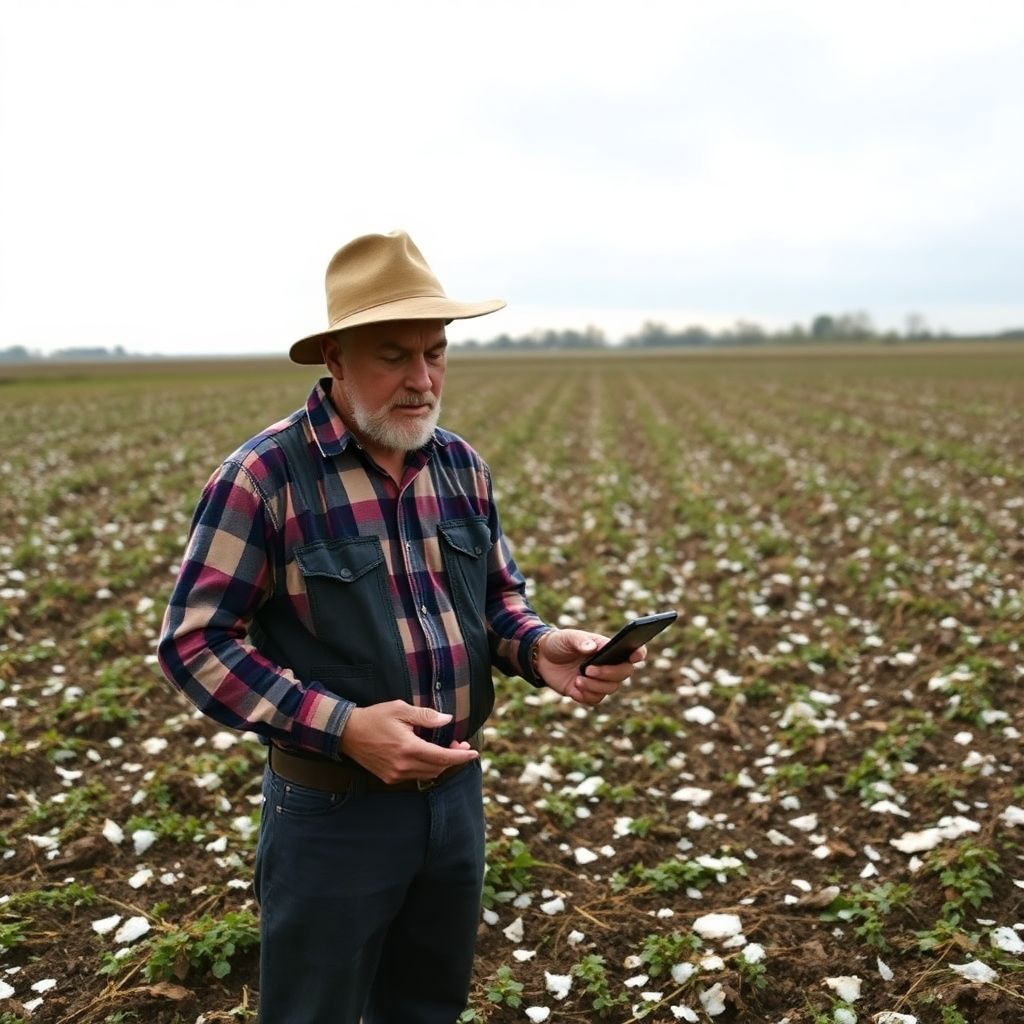
What if a farmer whose fields were just flattened by a hailstorm could see an insurance payout hit their phone before the clouds even cleared? Not in weeks, not in months-within seconds.
That vision is no longer science fiction. It sits at the intersection of three powerful trends: a worsening climate, increasingly fragile food systems, and the rise of programmable digital money in the form of stablecoins.
Climate chaos, slow relief
Across the globe, extreme weather has shifted from anomaly to routine. In 2024 alone, farmers in the United States lost more than $20 billion to wildfires, floods, hurricanes, hail, frost, and tornadoes. In Canada, over half of agricultural operations faced drought in 2022 and 2023, while more than a quarter battled flooding. One province, British Columbia, recorded almost $460 million in agricultural losses in a single year.
For producers in developing countries, the picture is even starker. Farmers in places like Kenya or Brazil often lack access to modern machinery, irrigation systems, and financial tools. When a harvest fails, they have fewer safety nets and less bargaining power. A single failed season can push a family into long-term poverty.
When a farm is wrecked by drought or flood, the immediate physical destruction is only part of the story. The real crisis begins when income stops. Every day without compensation means missed planting windows, unpaid workers, unused machinery, and mounting debts. Seeds aren’t bought, fields aren’t replanted, and the next harvest is put at risk.
Yet the safety net that should step in at this moment-insurance-often moves at a glacial pace. After catastrophic flooding in Pakistan in 2022, many smallholder farmers waited months for disaster aid to inch through local banks. By the time payments arrived, the planting season had come and gone. Some had already sold livestock, taken on predatory loans, or abandoned their land.
The core problem: a 20th-century system in a 21st-century crisis
Traditional insurance is built on manual, human-centered processes. Adjusters travel to damaged fields, inspect crops, file paperwork, argue over coverage, and eventually pass claims on to insurers and banks. Funds then need to travel through aging financial infrastructure that often bypasses remote or rural regions entirely.
This system is slow even in wealthy countries with robust institutions. In less developed economies, a claim can drag on for a year or longer. By that point, the original disaster has faded from headlines, but its economic scars have deepened.
The mismatch is glaring: climate disasters now unfold in minutes and hours, but the financial response dribbles out over months and years. To keep farms productive under accelerating climate volatility, the financial layer has to move at the speed of the weather, not the speed of paperwork.
Enter stablecoins: digital cash that never sleeps
One of the more unexpected tools that could close this gap is the stablecoin-a digital token designed to mirror the value of a government-issued currency such as the U.S. dollar. Unlike volatile cryptocurrencies whose prices swing wildly, stablecoins aim to maintain a steady value while retaining the speed and programmability of blockchain-based assets.
They offer several properties that make them uniquely suited to climate insurance:
– Instant settlement across borders: Stablecoins can be sent anywhere in the world in seconds or milliseconds, 24/7.
– Always on: There are no banking hours, holiday closures, or weekend delays.
– Minimal reliance on local banks: Recipients don’t need a bank account, only a smartphone and a digital wallet.
– Transparent by default: Transactions on public blockchains can be audited, which helps track where funds actually go.
For a farmer in a remote valley in Canada or a hillside village in El Salvador, this is transformative. Instead of waiting for a paper check or a bank transfer that might never arrive, compensation could be sent directly to a digital wallet installed on a basic smartphone.
Bridging the gap for the unbanked
In many agricultural economies, formal banking remains a luxury. El Salvador, for example, has close to 400,000 farmers, yet around 70% of the population is unbanked. Only a fraction of producers-roughly 32,000-have access to agricultural credit. For the remaining majority, traditional finance is effectively out of reach.
Stablecoins can turn a simple phone into a financial lifeline. With a wallet app, farmers can receive insurance payouts, store value more securely than in cash, and potentially pay suppliers or workers. This bypasses the structural barriers that have historically locked rural communities out of formal finance.
Aid groups have already tested this model in other crises. In conflict zones, where physical banks are destroyed or nonfunctional, stablecoin-based transfers have delivered emergency funds quickly and reliably. If digital currencies can thread their way into war-torn cities, they can certainly reach isolated farms.
Smart contracts: when code becomes the claims adjuster
The real breakthrough happens when stablecoins are combined with smart contracts-software programs that automatically execute predefined actions when specific conditions are met. In insurance, that concept is known as parametric coverage.
Under parametric insurance, payouts are not triggered by a human inspector confirming that “Field A lost X% of its yield.” Instead, they are linked to objective data points:
– Rainfall below a certain threshold for a specified number of days
– Wind speeds above a destructive level during a storm
– Temperatures dropping below or rising above crop-killing levels
– River levels exceeding a flood marker
Imagine a simple rule written into a smart contract: If rainfall in a given region falls below a preset amount for 30 consecutive days, the contract automatically releases stablecoin payouts to all registered farmers in that area. The data comes from trusted, neutral weather data providers-satellite services, meteorological agencies, or certified oracles that feed information to the blockchain.
No manual claims. No waiting for adjusters. No room for an insurer to “reinterpret” the policy months later. Once conditions are met, the payout is executed by code.
Companies are already piloting such systems, using stablecoins to deliver compensation for extreme weather events in minutes instead of weeks. This automation slashes administrative overhead, reduces the potential for corruption, and dramatically compresses the time between disaster and relief.
Why transparency matters as much as speed
Speed is only part of the equation. Trust is equally critical.
Every year, enormous sums allocated for climate resilience, disaster aid, and crop insurance vanish into opaque bureaucracies or are siphoned off by intermediaries. Farmers on the ground often receive a fraction of what was promised-if anything at all.
Stablecoin-based systems, by contrast, leave a visible trail. Each transaction is recorded on a blockchain, where it can be audited. That doesn’t mean every farmer’s identity must be public, but flows of funds-from insurer or donor to final recipient-can be verified.
Some climate-focused initiatives have already demonstrated how transparent digital payouts restore credibility. With verifiable, on-chain transfers, donors can see that their money is actually reaching farmers in vulnerable regions. Farmers, in turn, gain confidence that promised coverage will materialize reliably and fairly.
When transparency and speed come together, confidence in climate insurance can be rebuilt from the ground up.
Practical hurdles: it’s not just about technology
Of course, none of this is as simple as flipping a switch. Several real-world challenges need to be addressed for stablecoin-based climate insurance to work at scale:
1. Regulatory clarity
Governments are still grappling with how to classify and supervise stablecoins. For insurers and cooperatives, entering a gray legal area is risky. Clear, sensible regulation is essential so that payouts remain compliant, safe, and recognized by local authorities.
2. Digital literacy and access
Many farmers are not familiar with digital wallets or private keys. Training, user-friendly interfaces, and robust support systems are crucial. Offline or low-connectivity solutions may be necessary in remote locations.
3. Reliable data infrastructure
Parametric insurance depends on trustworthy, high-quality weather data. Gaps in meteorological coverage or manipulation of data sources could undermine the entire model.
4. Currency and volatility risks
While stablecoins are designed to track fiat currencies, their stability relies on underlying reserves and governance structures. Choosing well-managed stablecoins and ensuring transparent backing is essential.
5. Integration with local markets
Receiving stablecoins is only helpful if farmers can convert them to local currency, buy supplies, or pay workers. That requires a surrounding ecosystem of merchants, exchanges, and payment partners.
Designing farmer-first climate insurance
To truly benefit producers on the front lines of climate change, stablecoin-based systems must be designed with farmers, not just technologists or financial engineers.
Key principles could include:
– Simplicity: Payout rules expressed in clear, non-technical language, with predictable triggers and amounts.
– Affordability: Premiums subsidized or partially funded by governments, development agencies, or climate funds to keep coverage within reach of smallholders.
– Local participation: Farmer cooperatives involved in policy design, data validation, and dispute mechanisms.
– Modular products: Different tiers of coverage depending on crop type, region, and risk tolerance, instead of one-size-fits-all plans.
– Education and support: Ongoing training initiatives so producers understand how to enroll, claim, and use digital funds safely.
When farmers understand and trust the system, adoption can scale rapidly.
From reactive aid to proactive resilience
Today, much of climate-related funding arrives as emergency relief-reactive, unpredictable, and often too late. A globally networked system of parametric insurance, powered by stablecoins and smart contracts, would flip that model.
Instead of scrambling to raise money after each disaster, governments and organizations could pre-fund pools that automatically deploy when certain thresholds are breached. That provides:
– Predictability for farmers planning future seasons
– Faster stabilization of local food supplies
– Reduced pressure on humanitarian systems
– More efficient use of limited climate funds
Over time, such systems can be tied to broader adaptation strategies: drought-resistant seeds, improved irrigation, agroforestry, and soil management. Insurance payouts can become not just survival money, but capital for transformation.
A new financial layer for a hotter planet
As climate volatility accelerates, entire regions risk becoming uninsurable under traditional models. If premiums soar or coverage is withdrawn, farmers will be left to absorb growing risks alone. That threatens not just rural livelihoods, but global food security.
Stablecoins and smart contracts offer a way to rebuild the foundation of climate risk management. They do not magically stop droughts, floods, or storms. But they can ensure that when disaster strikes, financial support moves at digital speed, with unprecedented transparency and reach.
The question is no longer whether this technology can work in theory. Pilot programs already show it can. The challenge now is scaling it responsibly, with clear rules, farmer-centered design, and a strong focus on inclusion.
If disasters can wipe out a season’s work in a matter of minutes, there is no reason financial relief should crawl behind for months. In a warming world, climate insurance that pays out in seconds is not just a technical possibility-it may soon be a necessity.