
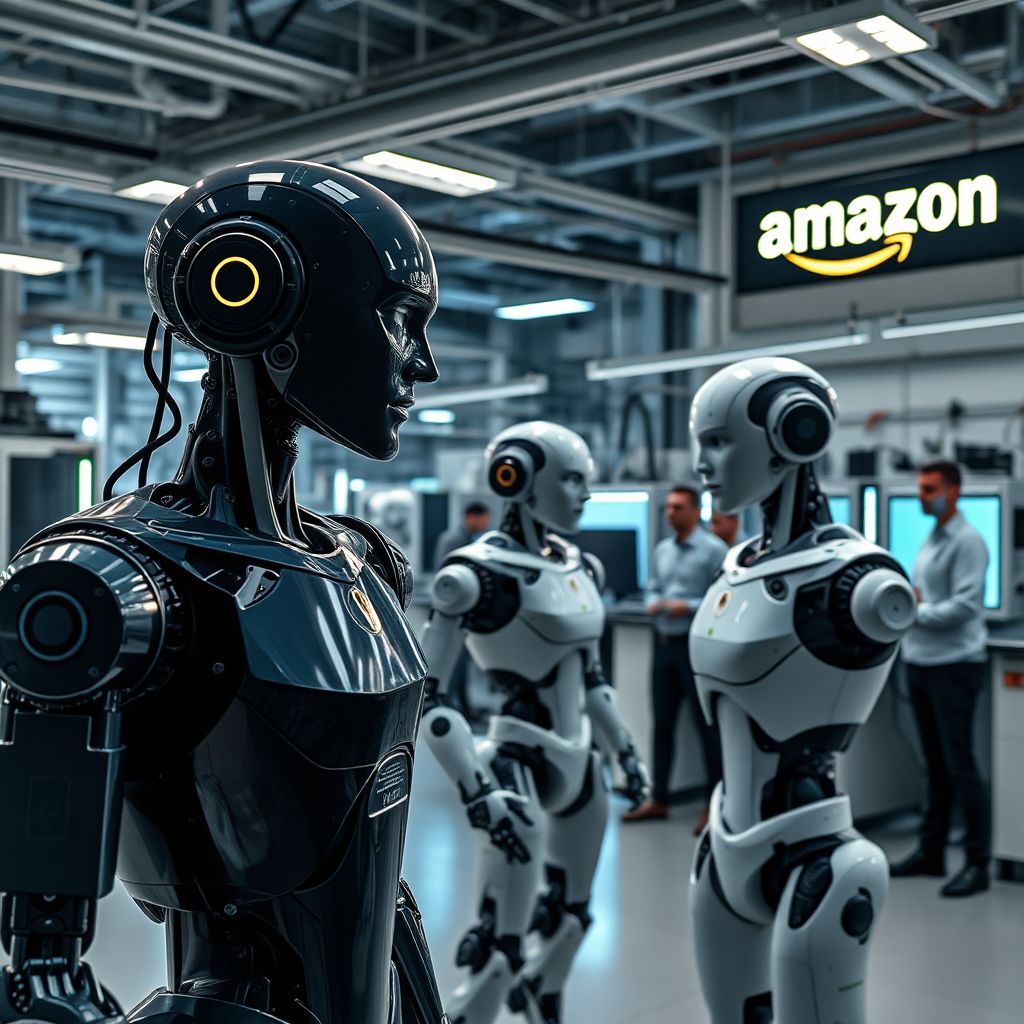
Tether, Nvidia and Amazon have joined forces to pour up to $1.4 billion into NEURA Robotics, a German company building advanced humanoid and collaborative robots. The fresh capital comes via a Series C funding round led by Tether and is being presented as one of the largest private investments ever made in the emerging fields of “physical AI” and humanoid robotics.
Founded in 2019 and based in Metzingen, Germany, NEURA Robotics focuses on creating robots that can safely share space and tasks with humans. Its portfolio already spans several product lines: humanoid robots, high‑precision robotic arms, autonomous mobile robots for logistics and industrial applications, and service robots tailored for collaborative work environments. The company’s core vision is to fuse artificial intelligence, sensor technology, and mechanical engineering into machines that can perceive, decide, and act with a high degree of autonomy.
Tether’s participation stands out not only for the sheer size of the round, but also for the strategic angle it brings. As the issuer of USDT, the world’s largest stablecoin by market capitalization, Tether is pushing NEURA to integrate crypto-native financial tools directly into its robotic platforms. NEURA plans to embed on‑device payment systems and edge AI capabilities, enabling robots to process data locally and, in time, potentially transact in digital assets without relying on traditional banking rails.
The round also includes heavyweight backing from Nvidia and Amazon, underscoring how seriously major technology players are now treating the convergence of robotics and AI. Nvidia’s involvement points to deep integration of high‑performance compute, GPU acceleration, and AI inference into NEURA’s systems. Amazon’s participation suggests a keen interest in automation for logistics, fulfillment, and cloud-connected robotics, where intelligent machines could dramatically reshape warehouses, factories, and customer service.
NEURA is positioning itself in the “physical AI” category-an emerging term used to describe AI systems that don’t just exist as software, but act directly in the physical world. Unlike purely virtual AI products, NEURA’s robots are designed to sense their environment in real time, understand complex contexts, and respond with precise physical actions. This approach targets sectors such as manufacturing, healthcare, logistics, hospitality, and even domestic services, where robots can augment or take over repetitive, dangerous, or highly precise tasks.
The introduction of crypto-enabled payment tools into this mix opens up a new layer of functionality. In the longer term, NEURA’s robots could be equipped to autonomously bill for services, settle cross‑border microtransactions via stablecoins, or participate in machine‑to‑machine commerce without human intermediaries. Imagine a fleet of autonomous service robots that not only perform tasks but also pay for spare parts, energy, or software updates using digital currencies in real time.
Edge AI is another central pillar of NEURA’s strategy. Instead of sending all data to distant servers, the company wants its robots to run sophisticated AI models directly on hardware located in the robot itself. This reduces latency, improves reliability in environments with poor connectivity, and offers stronger privacy guarantees because sensitive information does not need to leave the local device. For applications in hospitals, care homes, or secure industrial sites, this can be a decisive advantage.
From an industry perspective, the size of this financing round signals a maturation of humanoid robotics and collaborative automation. For years, humanoid robots were largely seen as research projects or marketing showpieces. NEURA’s ability to attract capital on this scale from global technology and finance leaders suggests that investors now see viable commercial use cases in the near and medium term-from co‑working robots on factory floors to human‑safe assistants in clinics and public spaces.
The involvement of major chip, cloud, and industrial players hints at a tightly integrated ecosystem forming around NEURA. Nvidia’s technology can supply the computational backbone for perception and decision‑making. Amazon can provide cloud infrastructure, data services, and potential deployment opportunities in logistics and retail. Strategic and institutional investors from finance and industry can help open doors to manufacturing, automotive, infrastructure, and public sector clients. This blend of capital and expertise greatly accelerates NEURA’s path from prototype to scaled deployment.
For Tether and the broader crypto sector, this deal represents a move beyond purely financial or trading-focused applications and into real‑world infrastructure. Stablecoins have already proven themselves as tools for fast, low‑cost transfers in digital markets. Embedding them into robotic systems extends that utility: robots could hold stablecoins on balance, receive payments for completed tasks, or pay each other and external services, effectively becoming economic agents in their own right.
If such a vision is realized, it could deepen the practical relevance of digital assets. Machine‑to‑machine payment networks would benefit from the programmability and 24/7 nature of crypto transactions, while stablecoins provide a relatively predictable unit of account. This dynamic aligns with a broader trend in which digital currencies shift from speculative instruments towards embedded infrastructure in automation, logistics, and industrial services.
At the same time, large‑scale funding for humanoid robotics raises questions about the future of work. NEURA’s focus is on collaborative robots that operate alongside humans rather than replacing them outright, but the gradual automation of physical tasks will inevitably change labor markets. Proponents argue that robots will eliminate dangerous, monotonous, or low‑value tasks and create new, higher‑skilled jobs in robot maintenance, supervision, software development, and systems integration. Critics worry about displacement in sectors such as warehousing, assembly, and basic services.
Regulation will be a crucial factor in how quickly and widely these systems are deployed. Safety standards for human‑robot interaction, liability in case of accidents, and rules for autonomous decision‑making in sensitive environments will need to evolve. On the financial side, embedding crypto payment tools into robotics will intersect with existing laws on money transmission, consumer protection, and cross‑border payments. Companies like NEURA and Tether will have to navigate both robotics regulations and financial compliance frameworks simultaneously.
There is also a privacy dimension to consider. Robots equipped with cameras, microphones, and a suite of sensors, combined with powerful edge AI, will be constantly gathering and interpreting data about people and environments. While local processing mitigates some risks, strong governance is necessary to ensure that data is handled responsibly, anonymized where possible, and not repurposed for intrusive surveillance or unauthorized profiling.
Technologically, the convergence of physical AI, crypto, and edge computing may lead to new architectural patterns. Robots could operate as nodes in decentralized networks, each with its own wallet, identity, and local intelligence, coordinating with others through secure protocols. This could support autonomous supply chains, where machines negotiate, contract, and settle with each other automatically, reducing friction and overhead in complex industrial operations.
In the near term, the impact of this funding is likely to be seen in accelerated product development and pilot deployments. NEURA can expand its engineering teams, invest in more advanced sensors and actuators, refine its AI models, and scale manufacturing capacity. Partnerships with large enterprises may lead to early real‑world trials in factories, warehouses, hospitals, and smart buildings, testing how humanoid and collaborative robots perform outside controlled lab conditions.
Ultimately, the $1.4 billion backing for NEURA Robotics is a clear indicator of where some of the world’s most influential technology and finance players believe the next wave of innovation is headed. As AI moves from the screen into the physical world, robots that can think, move, and transact could become a foundational layer of tomorrow’s infrastructure-blurring the boundaries between digital finance, automation, and everyday life.