
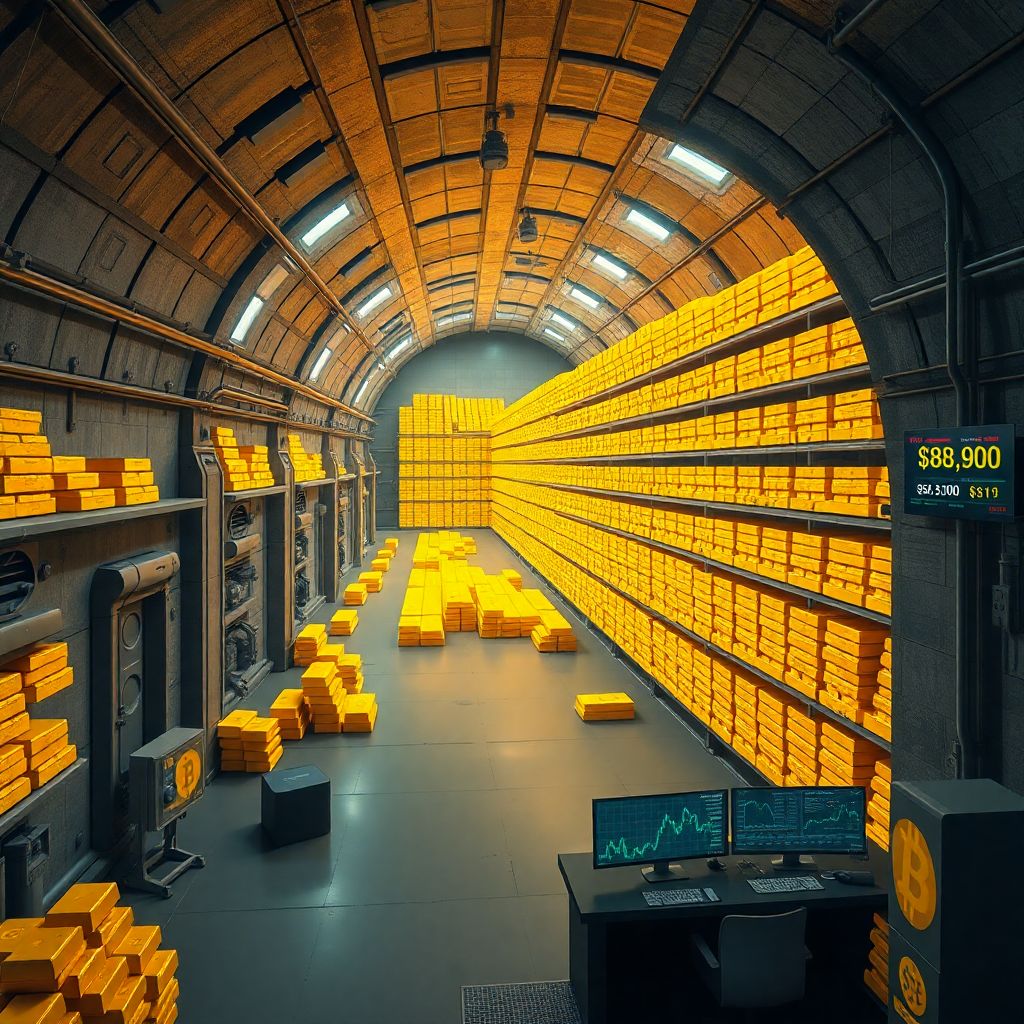
Tether quietly amassed 140 tons of physical gold worth around 23 billion dollars, building what its CEO describes as the largest privately held bullion stockpile outside the control of any government or bank. The stash is stored deep inside a former Cold War bunker in Switzerland, and grows by more than a ton of gold every week as the company continues to buy from refiners and dealers.
What began as a curiosity — a stablecoin issuer dabbling in bullion — has turned into a structural force in the gold market. Tether Holdings SA now owns a hoard significant enough that traditional bullion desks and liquidity providers must account for a single crypto company when modeling supply, demand, and spreads. According to prior disclosures, Tether has already accumulated well over 100 tons of metal in Swiss vaults, backing that up with reserves valued in the tens of billions of dollars.
The facility itself underlines the message Tether wants to send. Switzerland is dotted with hundreds of thousands of nuclear shelters, remnants of another era; one of those hardened structures now anchors the balance sheet of the world’s largest stablecoin. The high-security vault functions as both literal and symbolic infrastructure for Tether’s digital‑dollar empire, turning a once‑virtual business into something with a very tangible, very heavy footprint.
Tether executives present this as a deliberate macro strategy rather than a marketing stunt. In their view, gold is a hedge against the twin threats of fiat currency debasement and counterparty risk in the banking system. By holding a significant share of its reserves in bullion, the company says it is aligning itself with the same forces that have pushed gold prices into record territory, with some forecasts eyeing levels above 5,000 per ounce. The bunker, in that narrative, is a physical firewall in a world of increasingly synthetic money.
The scale of the operation is far from trivial. Sourcing roughly a billion dollars’ worth of physical gold each month from Swiss refiners and global dealers is a major logistical challenge. Bars must be fabricated, transported, assayed, and booked on Tether’s balance sheet, all while meeting regulatory and security standards. Yet Tether’s leadership insists the operational complexity is justified by the resilience it provides: a reserve component that does not depend on a bank’s promise, an issuer’s solvency, or a government’s policy.
For bullion traders, the rise of Tether as a steady, largely price‑insensitive buyer is already being felt. When a single participant consistently removes large quantities of metal from the market and locks it into deep storage, the “float” — the gold actually available to meet short‑term demand — tightens. In periods when exchange‑traded funds are accumulating metal and central banks are adding to reserves, Tether’s continuous purchases can contribute to wider spreads, thinner liquidity, and more pronounced moves during stress.
This concentration of gold in the hands of one private company is raising questions alongside admiration. Analysts who already scrutinize stablecoin reserves for opacity now see an additional layer of risk: what happens if a systemically important issuer controls a hoard of bullion large enough to influence local liquidity conditions? Critics argue that, without granular and frequent disclosures, part of the market may be placing blind trust in an entity that is becoming important not only to crypto, but to a corner of the physical gold ecosystem.
On the other side, many crypto‑native investors treat the bunker as a reassuring symbol. For years, users of stablecoins have asked what truly backs the digital tokens they trade and hold. In Tether’s case, gold bars stacked behind blast doors provide a simple, intuitively understandable answer: some portion of the value is anchored in a commodity that predates modern finance. For a sector born in code and running on distributed ledgers, that connection to a dense, real‑world asset carries reputational weight.
The timing of this gold buildup coincides with a broader moment of strength in digital assets. Bitcoin is trading just below its cycle highs, around 88,900 dollars, posting a roughly one percent increase over the last day. Ether is changing hands near 3,000 dollars, with gains in a similar one to one‑and‑a‑half percent range. USDT, Tether’s flagship stablecoin, continues to trade at its intended one‑dollar mark. Yet the signal coming from the vault is aimed less at defending that peg day‑to‑day and more at defining what “backing” means in an era when most dollar exposure exists only as database entries.
At a strategic level, Tether is making a clear bet: that in a future dominated by digital claims on money — stablecoins, bank tokens, and central bank digital currencies — market participants will place a premium on issuers that combine high‑yielding liquid assets with hard, non‑correlated stores of value. In other words, the company is wagering that old‑world metal can still purchase 21st‑century trust.
This move also amplifies the ongoing debate over what constitutes an ideal reserve mix for stablecoins. Many issuers rely heavily on short‑term government debt, reverse repos, and cash‑like instruments. Tether is leaning toward a more diversified model that includes not only Treasuries and money‑market exposure but also gold and, to a smaller extent, other real assets. Supporters argue this diversification reduces dependence on any single market or sovereign. Skeptics counter that physical assets, while stable in the long run, are less liquid and slower to mobilize in an extreme redemption scenario.
The physical nature of gold introduces operational risks that purely financial assets do not face. Insurance, transport security, audit procedures, and jurisdictional considerations all matter. A bunker in Switzerland may be geopolitically safer than many alternatives, but it still sits within a legal and regulatory framework that could evolve. Stablecoin users who take comfort in the existence of bullion must also trust that it can be accessed, verified, and, if needed, liquidated quickly enough to support redemption obligations in a crisis.
From a macro‑financial perspective, Tether’s gold strategy indirectly links the stability of a major crypto asset to conditions in the bullion market. A sharp repricing of gold, changes in refining capacity, or disruptions in physical supply chains could, in theory, affect the value of a portion of Tether’s reserves. While diversification offsets some of that risk, it also means stablecoin users are now exposed, however modestly, to commodities dynamics they may not fully appreciate.
The psychological effect, though, may be as important as the balance‑sheet mechanics. In a landscape scarred by exchange collapses, lending crises, and the failure of algorithmic stablecoins, visibly tying digital liabilities to a vault full of metal answers a basic human demand: to know there is “something there.” Even if only a share of reserves sits in that bunker, the image of armored doors and stacked bars operates as a narrative counterweight to fears about invisible rehypothecation and opaque leverage.
Tether’s gold hoard also fits into a broader trend of private entities adopting reserve strategies once associated mainly with states. Central banks historically bought and held gold as insurance against monetary and geopolitical shocks. Now, a private company serving as a de facto offshore dollar provider to the crypto industry is following a similar playbook. That blurring of lines between public and private, monetary and corporate, is one of the more striking developments in the maturing digital asset sector.
Looking forward, sustained accumulation at the pace of more than a ton per week could further entrench Tether as a structural player in the gold market. If other large stablecoin issuers or crypto institutions decide to emulate this approach, the impact on physical demand could magnify. In such a scenario, digital finance would not just mirror traditional markets; it would become a significant driver of flows in one of the world’s oldest monetary assets.
For now, the bunker in Switzerland stands as a concrete manifestation of a broader thesis: that in an age of proliferating digital claims, trust gravitates toward verifiable, finite, and politically neutral assets. Whether that thesis proves right will depend not only on gold’s performance, but on Tether’s continued willingness to open its books, withstand scrutiny, and show that the weight of 140 tons of metal truly translates into greater stability for the trillions of dollars in value that move through its tokens every year.