
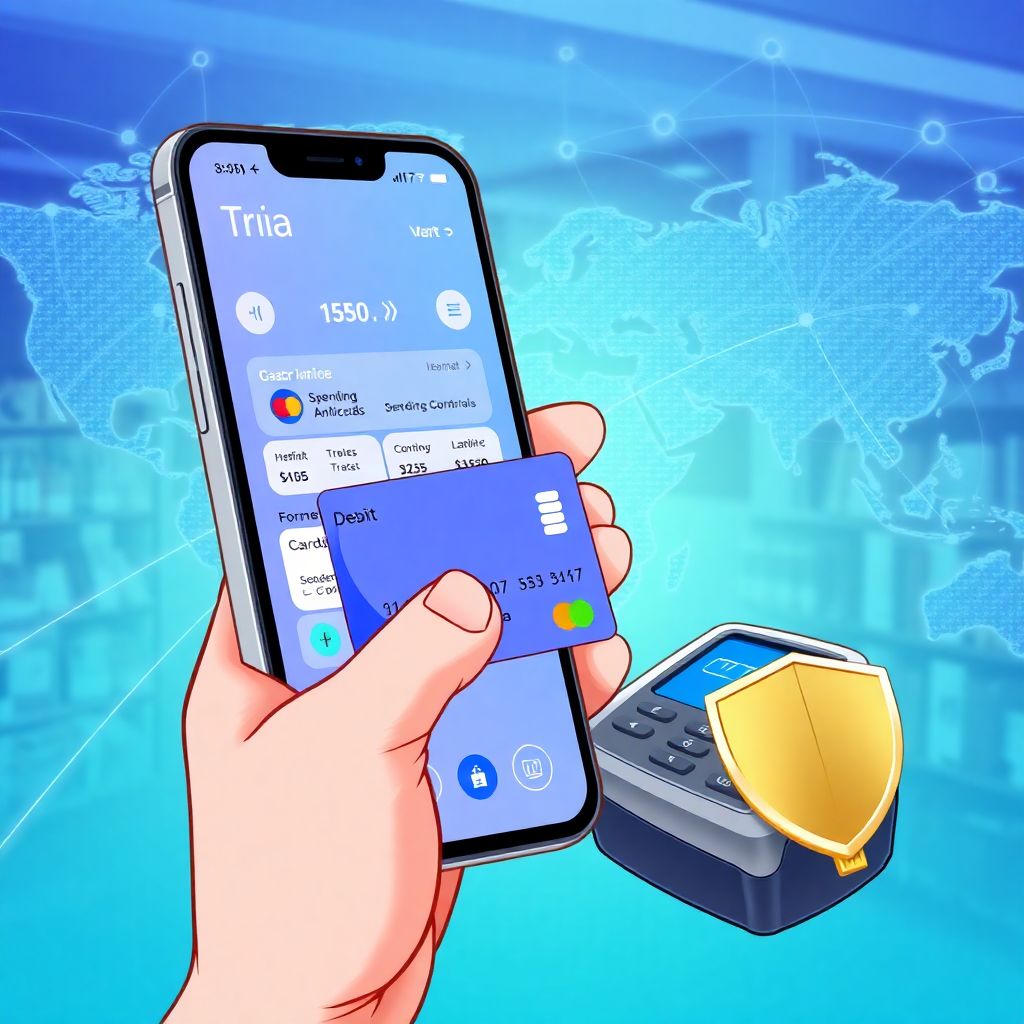
Tria’s $20m beta surge: how a self‑custodial neobank is turning onchain assets into everyday money
In just three months of closed beta, Tria, a self‑custodial neobank built on BestPath AVS, processed $20 million in onchain volume. That figure is not only striking for such an early product; it is roughly 13 times the volume achieved by EtherFi’s card over an equivalent period.
With more than 50,000 users, over 5,000 ambassadors, and real‑world payments live across 150+ countries, Tria is positioning itself as something more than “just another crypto card.” CEO Vijit Katta argues the company is building a new category: a global, self‑custodial bank that happens to run onchain.
From experiment to everyday card
A turning point came on November 19, when Tria crossed $1 million in daily spend for the first time. That milestone was not the result of a one‑off promotion alone. Usage had been climbing steadily as early adopters began making Tria their default payment card, not a niche side tool.
According to Katta, the growth has been powered by two core principles: simplicity and breadth. Most crypto cards, he says, still feel like bolt‑ons. They force users to move assets into special accounts, convert them ahead of time, or spend only from a narrow list of supported tokens and networks. That design makes them feel like workarounds, not like genuine replacements for traditional debit or credit cards.
Tria deliberately took the opposite approach. Users can top up with more than 1,000 different assets across multiple chains, retain full self‑custody of those funds, and then swipe or tap anywhere Visa or Mastercard is accepted in over 150 countries. To the cardholder, it behaves like a conventional global bank card. Behind the scenes, an entirely onchain infrastructure handles the complexity.
Holiday experiments that unlocked behavior
The first $1 million day coincided with deliberate growth experiments. During the holiday shopping season, Tria introduced “Tria Treasure,” a campaign where one purchase per day was randomly refunded.
This promotion was not structured as a typical “spend‑to‑earn” gimmick. Instead, it acted as a simple, tangible reward for actually using the card in real life. Katta notes that the initiative dramatically boosted both user activity and retention. People who had been dabbling with small test transactions started routing more of their everyday spending through Tria once they realized the system was reliable, fast, and occasionally rewarding.
The campaign revealed something important about user behavior: once friction is removed and the experience feels normal, onchain money stops being a speculative toy and starts behaving like a functional payment instrument.
Why everyday consumers are suddenly ready
For years, the idea that ordinary consumers would pay for groceries, flights, or digital subscriptions using onchain assets sounded far‑fetched. The pain points were obvious: bridges, gas tokens, confusing fees, chain switching, and fear of making a mistake.
Katta argues Tria’s traction shows that the barrier was not a lack of demand but the absence of a product that made the experience indistinguishable from traditional finance. With Tria, users simply top up and spend. The infrastructure layer, powered by BestPath AVS, handles all the cross‑chain routing, settlement, and execution in the background.
Once those operational headaches disappear, the benefits of onchain finance become much easier to appreciate. Fees can be lower than those of typical cards, foreign exchange spreads are often more transparent, and settlement can be faster and more programmable. In that environment, consumers begin seeing onchain assets not just as something to “hodl” but as something to actually use.
The hidden complexity of “bridge‑free, gasless” spending
Delivering that kind of simplicity on the surface required confronting some of the most difficult challenges in Web3 infrastructure. Tria had to orchestrate payments‑grade reliability while coordinating highly complex, multi‑step execution across fragmented chains — all without resorting to custodial shortcuts.
Each blockchain comes with its own quirks: different finality guarantees, varying fee models, liquidity gaps, and distinct failure modes. Most systems crack when forced to deal with several of these environments in a single flow. Tria needed to do the opposite: thrive in that multi‑chain reality, and still let users remain fully in control of their assets.
BestPath addresses this by pre‑computing optimal transaction routes and powering a permissionless solver marketplace. In that marketplace, independent “PathFinders” compete using relayers, liquidity routers, and fast‑finality layers. Routes are ranked in real time by cost, speed, and reliability. The user simply presses “pay” and sees an instant confirmation, while the optimal path is executed under the hood.
To maintain full self‑custody and still enable this level of automated, multi‑step execution, Tria relies on onchain permissioning combined with threshold signature (TSS)–based execution. This structure lets users grant tightly scoped, revocable permissions so the system can move assets as needed for a payment — without touching custodial bridges, prompting for gas, or repeatedly asking for token approvals.
The result: what looks like a straightforward card swipe is, in fact, a deeply coordinated interaction across several protocols and chains, kept invisible to the user.
Making self‑custody feel like a modern banking app
Self‑custody has historically intimidated mainstream users. Managing private keys, seed phrases, and wallet interfaces is a far cry from logging into a familiar mobile bank app. Tria’s design starts from that reality.
Katta insists Tria was conceived first and foremost as a modern neobank experience — clean dashboards, spending analytics, clear balances, and instant notifications. The “Web3” elements are intentionally backgrounded. The difference lies in who controls what: the user, not the platform, holds the cryptographic keys. Assets can be moved out at any time without waiting for support or asking for permission. There is no custodial pool and no omnibus account that can be frozen or rehypothecated.
Security and simplicity are treated as inseparable. Instead of burdening the user with low‑level technical decisions, Tria abstracts them away through secure defaults and automated back‑end logic. Users see spending limits, card controls, and risk alerts — the language they already understand from traditional banking — while the system deals with chain selection, route optimization, and fee management.
Engagement that looks more like a movement than a beta
For a product this early, Tria’s engagement metrics stand out. More than 50,000 users have already signed up, and over 5,000 have become ambassadors, helping test features, share feedback, and drive adoption.
This level of involvement has given the team a rare window into how people actually want to use onchain finance in daily life. Early patterns suggest that users are less interested in complex DeFi maneuvers and more in straightforward, high‑reliability spend: grocery bills, subscriptions, travel, and online shopping.
As these behaviors emerged, Tria adjusted its roadmap. Instead of focusing on niche, speculative features, the team prioritized stability, merchant compatibility, better fiat on‑ramps and off‑ramps, and smarter spend controls. In doing so, they began to resemble a traditional consumer bank in product priorities — just with a radically different infrastructure model.
A fundraising round that signals where the market is going
Tria’s recent capital raise underscored just how much investor interest there is in this new onchain banking category. The company saw $66.7 million in commitments for a relatively modest $1 million allocation, with more than 4,500 applicants vying to participate.
Such dramatic oversubscription suggests that market participants increasingly believe onchain finance will not remain confined to trading and speculation. Instead, they anticipate a wave of infrastructure and applications that will make Web3 rails invisible to end users — the same way TCP/IP is invisible to people browsing the internet today.
For investors, Tria is a test case: if a self‑custodial neobank can scale globally, sustain high engagement, and maintain regulatory and technical robustness, it will validate the thesis that consumer banking can be rebuilt from the ground up on programmable, open networks.
What sets Tria apart from earlier crypto cards and neobanks
Previous waves of crypto cards — from large centralized exchanges to early neobanks — followed a similar pattern. Users would deposit assets into a custodial account. The provider would handle conversion to fiat at the moment of purchase. Under the hood, the payment rails were mostly traditional, and users effectively held IOUs.
Katta argues that Tria breaks from this model in several fundamental ways:
– True self‑custody: Users keep control of their keys and assets. There is no omnibus custody layer that can be frozen, mismanaged, or hacked as a single point of failure.
– Native multi‑chain support: Instead of forcing assets onto one chain or one balance type, Tria dynamically sources liquidity and routes value from a broad universe of supported tokens and networks.
– Infrastructure, not workaround: The card is not a thin layer on top of traditional banking; it is a front‑end to an onchain execution layer designed from scratch for payments‑grade reliability.
– Economic transparency: Fees and spreads are more visible and often lower than traditional card products, particularly for cross‑border use.
In this view, Tria is closer to a next‑generation settlement and banking network than a “crypto debit card” in disguise.
Scaling globally without reverting to custody
The biggest strategic challenge ahead is scaling to millions of users worldwide while holding the line on self‑custody principles. Traditional global expansion in fintech has relied heavily on centralized control: local banking partners, pooled accounts, and risk managed at the platform level.
Tria’s approach flips that model. The company focuses on building robust onchain primitives and routing mechanisms, then integrates with card networks and local rails where necessary for user experience. Instead of concentrating risk in a few custodial entities, Tria distributes it across users’ own wallets and a decentralized set of execution pathways.
Maintaining this structure at scale will require more than technical innovation. It demands careful navigation of regulatory frameworks, proactive risk management, and education for users and partners who are accustomed to older models. But if successful, it would represent a blueprint for how global financial services can be delivered without reverting to the custodial patterns of the past century.
The next five years of consumer onchain finance
If Tria’s early traction is a sign of what is to come, onchain banking might be on the brink of becoming a mainstream category rather than a niche experiment. Over the next five years, several shifts are likely:
– Invisible chains: Most consumers will not know or care which chain their assets reside on. They will simply see balances and cards, while routing happens algorithmically in the background.
– Programmable money at the edges: Everyday payments will start to include programmable conditions — shared family budgets, embedded savings or yield, automated compliance checks — without users needing to write a single line of code.
– Hybrid financial stacks: Banks and fintechs may integrate onchain execution layers not as branding exercises, but as cost‑saving and speed‑enhancing infrastructure, adopting models pioneered by platforms like Tria.
– User‑controlled risk: Self‑custody will become more accessible through better UX, recovery mechanisms, and clear permissioning frameworks, allowing users to choose where they want custodial convenience and where they demand direct control.
In this landscape, the winners will likely be products that feel indistinguishable from the best consumer neobanks while quietly harnessing the advantages of open, programmable settlement rails.
Beyond payments: what a self‑custodial neobank can build next
While Tria is currently focused on everyday spending, a self‑custodial, cross‑chain banking platform opens the door to a broader suite of financial services. Over time, such a system could support:
– Automated savings and yield products that allocate user funds across onchain venues while preserving full transparency.
– Credit and lending that use onchain reputation and collateral, not opaque credit scoring, to determine terms.
– Shared accounts, business wallets, and treasury tools that work across multiple chains with bank‑like simplicity.
– Region‑specific products, such as local currency settlement or stablecoin rails, built without sacrificing global interoperability.
Each of these layers would build on the same core insight: that self‑custody and user control do not have to come at the expense of usability — so long as the hard problems of routing, security, and abstraction are solved once at the infrastructure level.
A glimpse of a user‑controlled financial future
Tria’s $20 million beta surge is less about the raw number and more about what it implies. Tens of thousands of users have shown that, given a seamless interface and real‑world utility, they are willing to route everyday spending through onchain rails — and to do so while keeping direct control of their assets.
If this pattern continues, the boundary between “crypto” and “finance” will keep fading. What remains is a simple question: can you use your money, globally, instantly, and on your own terms?
Tria is betting that the answer will be yes — and that self‑custodial neobanks will be the ones to prove it.