
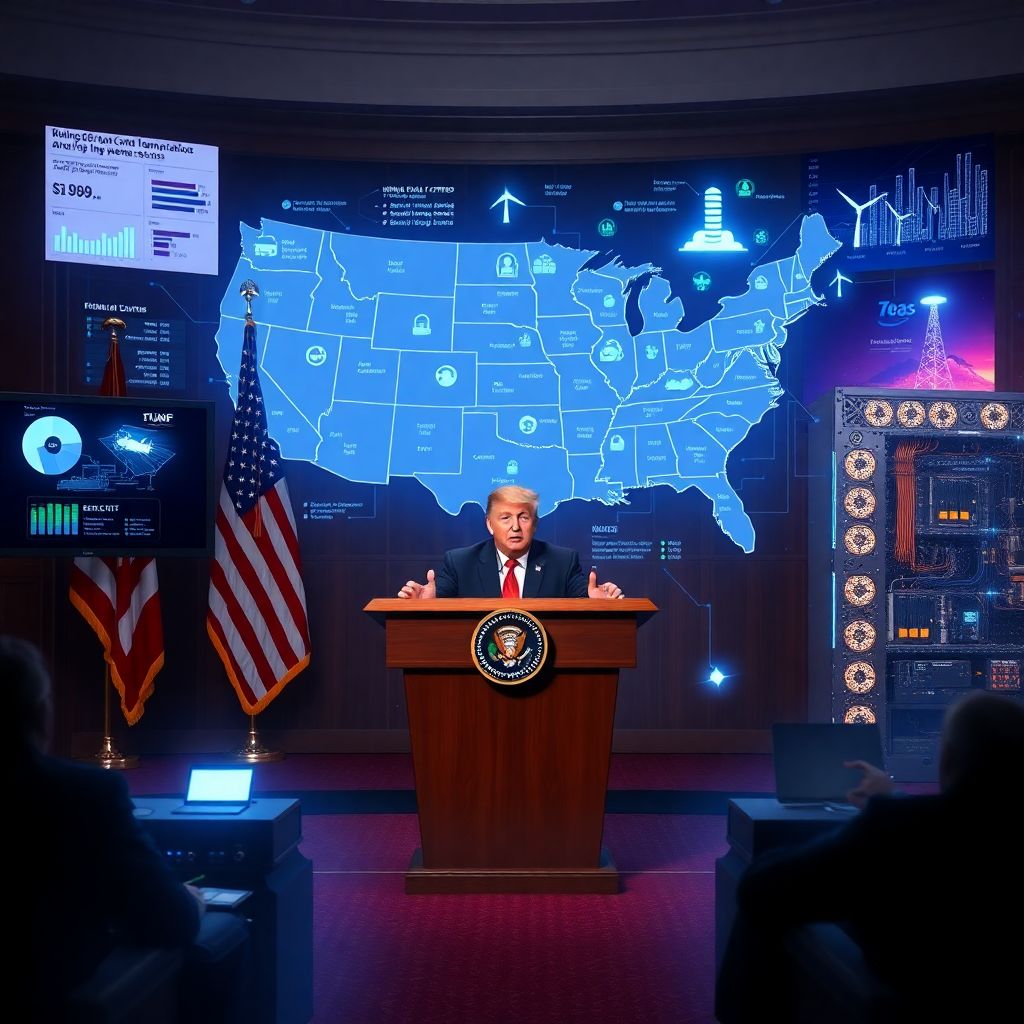
Trump is promising a massive build-out of U.S. power generation, vowing to bring 1,600 new power plants online within a year as part of a broader push to tame rising electricity costs driven in part by artificial intelligence. In a national address, he argued that this rapid expansion of capacity would push down power prices and anchor his wider economic program.
Positioning the move as a signature achievement, Trump said his administration had already overcome “serious problems” inherited from his predecessor and was now focused on the next wave of challenges. Chief among them, he said, is the surge in energy demand linked to AI training and large-scale data processing, which he framed as both an economic opportunity and an inflationary threat if left unchecked.
“Within the next 12 months, we will have opened 1,600 new electrical generating plants, a record,” Trump declared. He claimed that such a build-out would not only stabilize the grid but also trigger a broad decline in electricity prices. According to the president, cheaper power would ripple through the economy by lowering production and logistics costs, ultimately easing the price of consumer goods.
Throughout the address, Trump used charts and graphics to underscore his message. He highlighted what he described as declining prices for many everyday items and solid wage growth under his watch. At the same time, he singled out health insurance as an area where costs have continued to climb, placing blame squarely on Democrats and their health policy agenda.
He revisited the bruising 43-day government shutdown that stretched across October and November, asserting that Democrats, led by Senate Minority Leader Chuck Schumer, had forced the standoff. According to Trump, their primary goal was to secure an extension of pandemic-era health insurance subsidies for roughly 22 million Americans, benefits scheduled to lapse on December 31. The prolonged shutdown, he acknowledged, helped push his approval ratings to their lowest point of his first term before they later staged a modest rebound.
Despite that political damage, Trump urged Americans to stay the course and support what he portrayed as a turning point for the U.S. economy. He insisted that the country was “poised for an economic boom the likes of which the world has never seen,” provided that his proposed energy and industrial policies are enacted in full in the months ahead.
The pledge to add 1,600 generating facilities lands against the backdrop of mounting stress on the power grid, particularly in Texas, where the Electric Reliability Council of Texas (ERCOT) operates an isolated and already fragile system. ERCOT recently disclosed that requests for interconnections from large power users have soared to around 226 gigawatts, up from just 63 gigawatts at the end of last year. That spike reflects a wave of industrial-scale energy consumers trying to plug in.
Crucially, approximately 73% of those large-load requests now come from data centers, many of them designed for AI-scale workloads such as training large language models and running intensive cloud services. These facilities often operate around the clock, drawing enormous, steady volumes of electricity. As a result, they are reshaping power demand patterns far more dramatically than traditional office buildings or residential neighborhoods.
Trump linked his energy expansion plan directly to this trend, describing it as part of a long-term strategy to keep the U.S. at the forefront of emerging technologies. He argued that without a rapid increase in generation capacity, the cost of powering AI infrastructure could spill over into broader inflation, undermining American competitiveness just as other countries race to scale similar capabilities.
In his telling, the promised plants are not just about supply and demand; they are about national strength. Trump framed the initiative as a cornerstone of his vision to “fortify America’s economic engine,” saying that abundant, affordable power is a prerequisite for advanced manufacturing, AI development, next-generation cloud computing, and other high-tech industries that he sees as critical for future prosperity.
Yet the scale and timing of Trump’s commitment raise immediate questions. Bringing 1,600 power plants online in a 12-month window would be unprecedented in modern U.S. history, given permitting obstacles, financing needs, and construction timelines that typically stretch over several years. The administration has not publicly detailed what types of plants these would be—whether small gas-fired units, renewable projects that qualify as “plants,” modular nuclear reactors, or conversions and expansions of existing facilities.
That distinction matters. Different technologies come with sharply different timelines, regulatory hurdles, and impacts on both emissions and grid stability. Renewable projects such as solar and wind can sometimes be deployed more quickly, but they require transmission upgrades, storage solutions, or backup capacity to maintain reliability. Gas plants can be quicker to build and offer firm power, but they rely on robust fuel supply chains and face environmental pushback. Nuclear promises steady, carbon-free baseload, yet it remains the most complex and politically sensitive option.
ERCOT’s situation illustrates why those trade-offs are suddenly front and center. The Texas grid has already experienced high-profile reliability scares during extreme weather, most notably the devastating winter storm that resulted in widespread outages. Adding hundreds of gigawatts of potential demand—much of it from AI data centers that cannot easily shut down—without carefully planned new generation and transmission could increase the risk of blackouts and price spikes.
For AI developers and data center operators, energy is rapidly becoming one of the largest line items on the balance sheet. Training advanced AI models can consume more electricity than thousands of homes use in a year. As companies scale these systems, they are increasingly willing to sign long-term power purchase agreements, invest directly in generation, or cluster in regions where power is inexpensive and relatively clean. Trump’s speech tapped into those corporate anxieties, promising a policy environment geared toward abundant, low-cost electricity.
The broader public, however, is primarily concerned with reliability and affordability at home. Trump’s message sought to bridge that gap, arguing that a grid built to handle the demands of AI, heavy industry, and digital infrastructure will also deliver cheaper, more reliable power to households. He implied that the same upgrades needed for data centers—reinforced transmission lines, new plants, smarter grid management—would also protect everyday consumers from outages and price shocks.
Energy economists note that the rush of large-load interconnection requests, like those seen in ERCOT’s 226-gigawatt queue, does not mean all that demand will actually materialize. Many projects are speculative, hedging against future growth or contingent on financing and regulatory approvals. Even so, the numbers signal how dramatically the energy landscape could change if even a fraction of these AI and data center projects come to fruition.
There is also a political dimension to Trump’s framing. By tying health insurance costs and the shutdown battle to Democratic priorities, while juxtaposing that with his own promise of an unprecedented power build-out, he is drawing a sharp contrast between competing visions of economic management. One centers on expanding social safety nets; the other emphasizes infrastructure, industrial capacity, and energy abundance as the route to prosperity.
Looking ahead, one of the central questions is whether the U.S. can simultaneously decarbonize its power sector and satisfy the hunger for electricity from AI and other digital technologies. A large-scale expansion of fossil-fuel plants could ease short-term pressures but complicate climate commitments. A rush to renewables without adequate storage and grid modernization could leave operators exposed during periods of low wind or sun. Any credible plan must strike a balance between speed, reliability, cost, and environmental impact.
Trump’s pledge of 1,600 new plants is therefore not just a promise of more megawatts; it is a statement about priorities in an era when bytes and electrons are increasingly intertwined. As AI developers push the boundaries of computing, and as regions like Texas grapple with record-breaking interconnection queues, the debate over how to build the next generation of the U.S. grid is set to intensify. Whether his timeline proves realistic or not, the underlying collision between AI-driven demand and existing infrastructure has already arrived—and it is forcing policymakers, utilities, and technology companies alike to rethink what an “adequate” power system really means.