
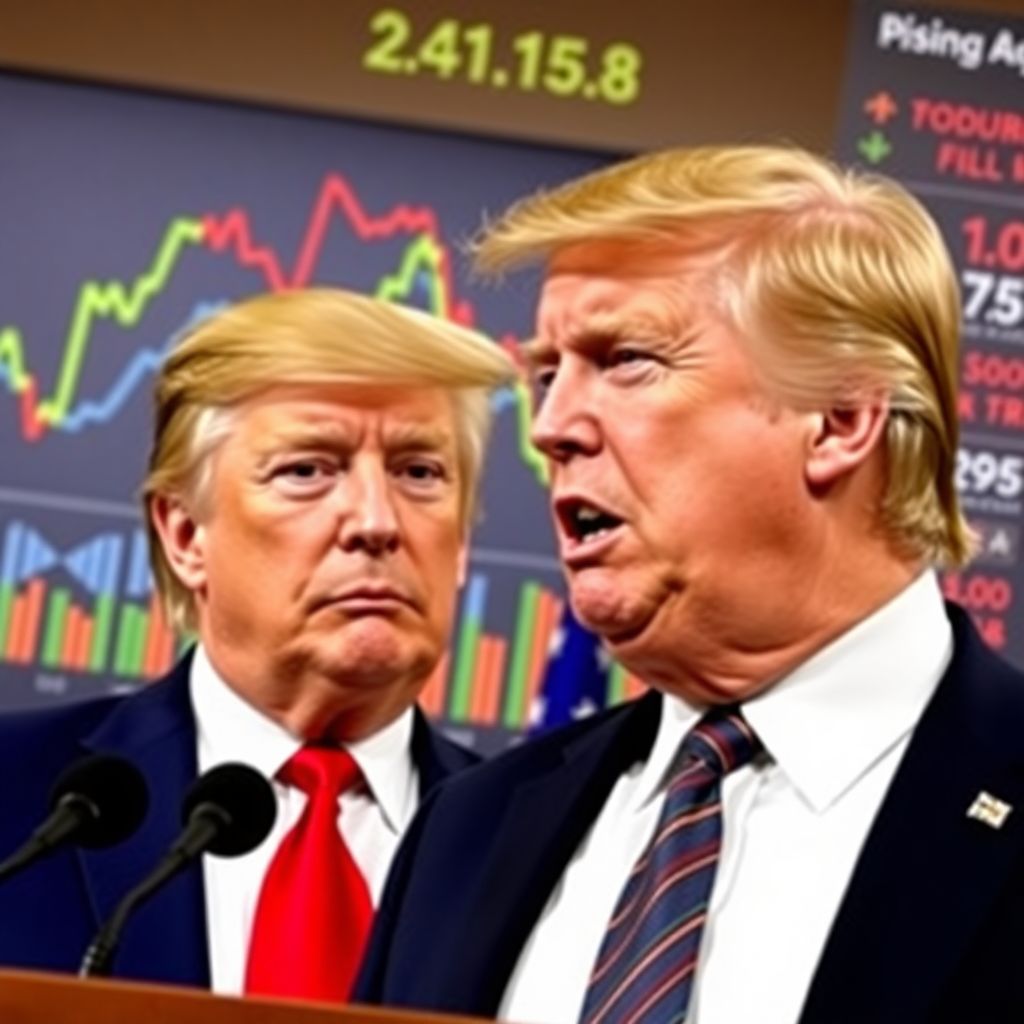
Trump steps up rate‑cut campaign as Powell resists amid rising inflation fears
U.S. President Donald Trump has dramatically escalated his pressure on Federal Reserve Chair Jerome Powell, publicly demanding that interest rates be slashed to 1% even as the central bank sticks to a higher‑for‑longer stance in the face of renewed inflation risks.
The clash comes just a day after the Fed left its benchmark federal funds rate unchanged in the 3.50%-3.75% range and signaled that, at most, one rate cut is likely in all of 2026. In its latest projections, the central bank also pointed to higher inflation ahead and warned that the Iran‑driven oil shock could complicate the path back to price stability.
Trump, however, is openly defying that guidance. In remarks reported Thursday, he renewed his calls for Powell to “drop rates immediately,” echoing an earlier post from March 12 in which he derisively labeled Powell “Too Late” and argued that waiting for the Fed’s next scheduled meeting would be a policy mistake. According to people familiar with the administration’s thinking, Trump wants the policy rate forced down toward 1% to counter slowing growth and choppy financial markets.
Powell holds firm as oil and tariffs fuel inflation
At its March 18 meeting, the Federal Open Market Committee voted to maintain rates and emphasized the high degree of uncertainty surrounding two key shocks: the economic fallout from the Iran war that began on February 28, and the lingering impact of Trump’s 15% global tariff regime on prices and trade flows.
Powell acknowledged that another rate hike is not the Fed’s base case but deliberately left the door open, stressing that policymakers “will need to assess how enduring this situation is” with respect to the global energy crunch. Elevated oil prices are already feeding through to headline inflation and inflation expectations, and the Fed is wary of cutting too soon and locking in a new wave of price increases.
Internal projections now point to a more stubborn inflation path. Many analysts expect the Fed’s updated outlook to show consumer price growth still hovering near 3% at the end of 2026. That would be well above the Fed’s 2% target and difficult to square with aggressive easing, especially while energy markets remain volatile and supply risks from the Middle East persist.
A looming stagflation trap
The collision between Trump’s political priorities and the Fed’s inflation concerns has created a textbook stagflation dilemma. On one side, the administration argues that lower borrowing costs are needed to prop up a decelerating economy, ease debt burdens, and shore up equity and housing markets that have turned sensitive to every geopolitical headline.
On the other side, the Fed is confronting the risk that cheaper money, layered on top of elevated oil prices and tariff‑driven cost pressures, will entrench inflation even as growth slows. That is the essence of a stagflation trap: too much stimulus fans prices, not output, while tighter policy helps tame inflation but deepens the slowdown in demand.
Trump’s own personnel decisions have added nuance to the debate. His nomination of Kevin Warsh to succeed Powell when the current term expires in May had been viewed as a signal that a more dovish, market‑friendly Fed could be on the horizon. Yet the Iran conflict and its repercussions for energy and global trade may derail that smoother transition, forcing any incoming chair to confront a policy environment dominated by hard choices rather than easy stimulus.
Markets price in a “no‑cut” year
Despite Trump’s rhetoric, financial markets largely side with the Fed’s caution. Fed funds futures indicate that traders expect, at best, a single 25‑basis‑point cut in 2026, and a growing share of Wall Street economists now see a real possibility that the central bank will not lower rates at all this year.
Data derived from FedWatch tools put the odds of no change at the current meeting above 99%, underscoring how little credibility markets currently assign to the idea of a rapid pivot to 1%. Analysts at major forecasting firms have moved their baseline scenarios toward a one‑cut or zero‑cut outcome, citing both elevated headline inflation driven by oil and the stickiness of core PCE inflation.
Lydia Boussour, chief U.S. economist at Oxford Economics, has noted that given stronger‑than‑expected readings for both headline and core inflation gauges, the firm now assumes just one modest cut in 2026, while cautioning that “it is entirely plausible the Fed won’t implement any rate cuts this year.” That view stands in stark contrast to Trump’s insistence that aggressive easing is necessary and overdue.
Oil shock erases inflation breathing room
The Iran conflict has upended the disinflationary tailwinds that had given the Fed some freedom to consider modest cuts earlier in the year. Brent crude has vaulted above $110 per barrel, and Iranian strikes on key Gulf energy infrastructure have widened, heightening fears of prolonged supply disruptions and price spikes.
Earlier declines in energy prices had offset part of the inflationary impact of Trump’s tariff measures, effectively giving the Fed a buffer. That cushion has now evaporated. With fuel, transportation, and input costs rising, businesses are passing more of those increases on to consumers, and lower‑income households are feeling the squeeze most acutely.
This loss of room to maneuver explains why Powell and his colleagues are so reluctant to move in the direction Trump wants. A premature cut that sparks a renewed surge in inflation expectations could force the Fed into even more painful tightening later, potentially leading to a deeper recession than a slower, more patient approach would entail.
Crypto markets caught between two narratives
Digital asset markets are trading this policy and geopolitical tug‑of‑war in real time. Bitcoin, which briefly pushed into the mid‑$73,000s last week, has fallen back below the $70,000 mark. Ethereum, after mounting its own rally, has drifted into the low‑$2,200s.
Investors are struggling to decide which story will define this cycle. If Powell eventually bows to political pressure and allows real yields to decline, Bitcoin could regain its status as a hedge against stagflation and currency debasement, with higher nominal prices reflecting declining faith in fiat policy. But if the Fed stands firm and keeps rates elevated while the oil shock weighs on growth, crypto may trade less like “digital gold” and more like a high‑beta risk asset, vulnerable to liquidity drains across both traditional finance and digital markets.
In that second scenario, higher‑for‑longer policy combined with geopolitical stress could force leveraged players to unwind positions, exacerbate volatility, and tighten conditions across decentralized finance as well as centralized exchanges. The current price action suggests markets are not yet convinced that an easy‑money environment is imminent.
Political pressure versus central bank independence
Beyond the immediate market moves, the confrontation raises deeper questions about the independence of the Federal Reserve. Trump’s willingness to publicly single out Powell, mock his timing, and demand specific policy outcomes revives concerns about political interference in monetary policy that surfaced during his prior term as president.
Formal independence allows the Fed to make decisions based on its dual mandate-maximum employment and stable prices-without being swayed by the electoral calendar or short‑term political imperatives. If the White House is perceived as dictating interest‑rate decisions, long‑term inflation expectations could become less anchored, as households and businesses conclude that price stability always takes a back seat to growth or asset prices.
For now, Powell has maintained a disciplined message, consistently reiterating that the Fed will be guided by data rather than by external pressure. But the louder and more frequent the political attacks become, the greater the risk that markets start to question how long that firewall can hold-especially if growth weakens more sharply or financial stress rises in the months ahead.
The growth trade‑off: stimulus now or stability later?
Trump’s argument rests on the view that the U.S. economy is already slowing enough to warrant urgent support. Higher borrowing costs are weighing on interest‑sensitive sectors such as housing, autos, and some areas of business investment. Coupled with rising energy prices and tariffs, that pressure is starting to show in consumer sentiment and corporate earnings guidance.
Advocates of quicker cuts warn that waiting too long could tip the economy into a more pronounced downturn, with job losses that might have been avoidable. From this perspective, the inflation risk from modest easing is manageable, while the cost of an unnecessarily severe recession would be far higher, both economically and politically.
The Fed, however, is focused on a different time horizon. If inflation proves sticky and policy loosens too early, the central bank may be forced to re‑tighten later, unsettling markets and eroding confidence in its ability to navigate the cycle. In that sense, Powell’s reluctance is less about dismissing growth risks and more about trying to avoid a boom‑bust pattern driven by stop‑go policy shifts.
What a stagflation scenario would look like
If Trump were to get his way and rates fell rapidly, while oil and tariff pressures kept prices elevated, the U.S. could slide into something resembling the stagflationary episodes of the 1970s. Growth would remain weak as real incomes were eroded by higher living costs, yet inflation would stay too high for comfort.
In such an environment, traditional portfolios often struggle: bonds can lose value as inflation expectations creep up, while equities face margin compression and slower demand. Hard assets, including commodities and potentially Bitcoin, could benefit in nominal terms, but volatility would likely be extreme.
Avoiding that outcome is one reason the Fed is so cautious. The institution has spent more than a decade trying to re‑anchor inflation expectations after the global financial crisis and the pandemic; letting them drift upward again would risk undoing much of that work and making future recessions harder to fight.
The road ahead: three plausible paths
Looking forward, three broad scenarios are emerging:
1. Fed holds firm, no cuts in 2026. Inflation remains stubborn near 3%, oil prices stay elevated, and the Fed opts to preserve credibility by keeping rates roughly where they are. Growth slows but avoids a deep recession. Political criticism intensifies, but institutional independence holds.
2. Measured easing, one or two cuts. Geopolitical tensions stabilize enough to ease energy prices, inflation edges lower, and the Fed delivers one or two quarter‑point cuts late in the year. Trump doesn’t get 1%, but markets get modest relief and a clearer path to eventual normalization.
3. Political pressure prevails, aggressive cuts. Growth data deteriorate sharply, markets wobble, and the White House’s campaign against Powell gains traction. The Fed cuts more quickly despite elevated inflation readings, betting that recession risk outweighs the danger of reigniting price pressures. This is the most favorable scenario for short‑term asset prices, but also the riskiest for long‑term stability.
Which path materializes will depend on the trajectory of the Iran conflict, the behavior of oil markets, the persistence of tariff‑related price pressures, and the resilience of U.S. consumers and businesses.
Implications for investors and policymakers
For investors, the message is clear: policy uncertainty is now a central driver of risk. Equities, bonds, and crypto assets are all reacting not only to economic data, but also to every headline about Trump’s comments and Powell’s responses. Positioning around inflation hedges, interest‑sensitive sectors, and dollar exposure will need to reflect the possibility of multiple, conflicting narratives playing out over the next year.
For policymakers, the episode underscores how constrained the Fed’s toolkit can become when inflation is above target and geopolitics distort supply. Monetary policy alone cannot resolve an oil shock or undo the impact of tariffs; at best, it can smooth the adjustment. That reality makes the current confrontation between the White House and the Fed less about personalities and more about the fundamental limits of what interest‑rate policy can achieve in an economy buffeted by global shocks.
As Trump continues to demand deep rate cuts and Powell sticks to a cautious stance, the battle over the cost of money is likely to remain one of the defining economic stories of 2026-shaping everything from household finances to crypto valuations and the broader credibility of U.S. economic governance.