
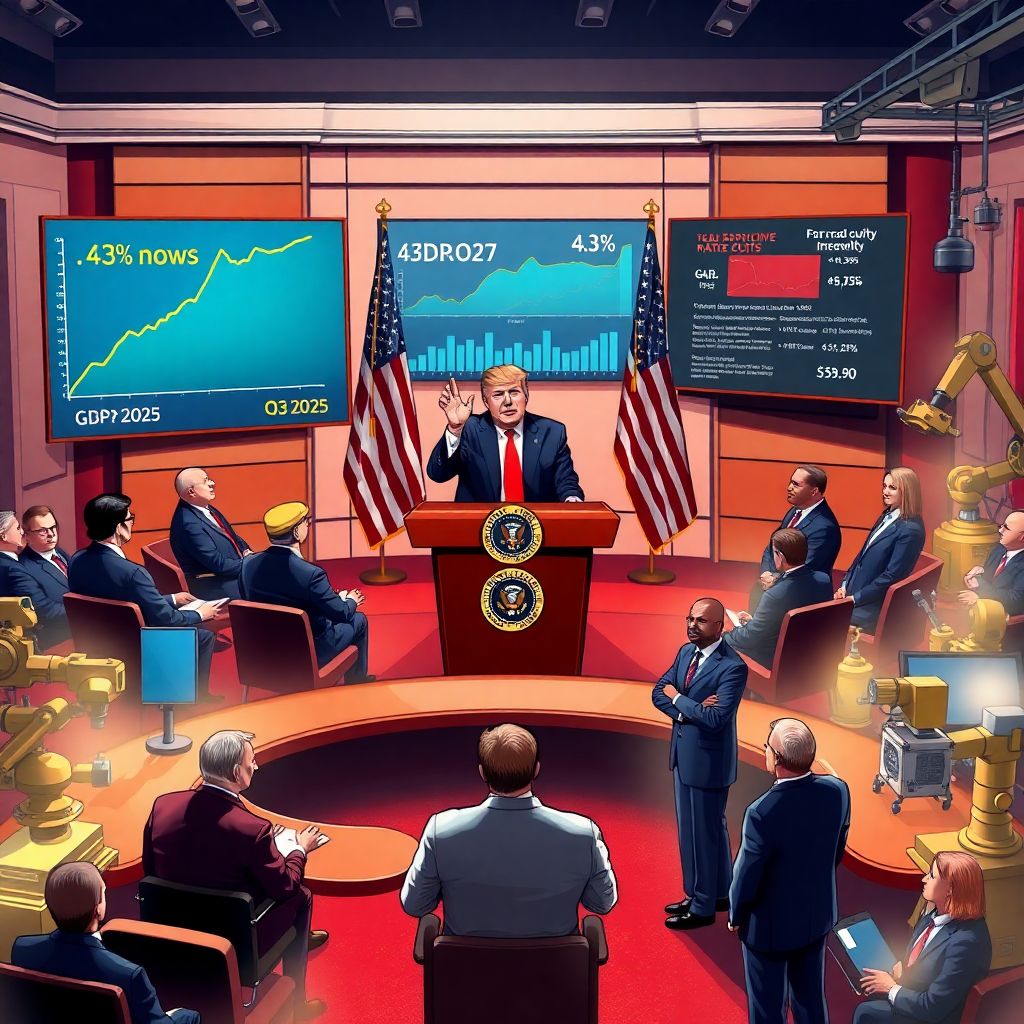
President Trump is renewing his push for aggressive interest rate cuts, seizing on surprisingly strong U.S. economic growth as justification for a rapid shift in Federal Reserve policy.
After the government reported a 4.3% annualized increase in gross domestic product for the third quarter of 2025 — far above the 3.3% widely expected by economists — Trump argued that the performance proves the economy can handle, and even deserves, significantly lower borrowing costs. In his public remarks, he framed the data as evidence that the Fed should be “rewarding” strong growth with cheaper credit rather than keeping rates elevated.
The president’s comments sharpen an already clear divide between the White House and the central bank. While Trump is calling for an easier stance to “unlock” further expansion, the Federal Reserve continues to signal that its priority is keeping inflation under control after several years of above-target price pressures. Fed officials have cautioned against easing policy too quickly, warning that doing so could reignite inflation just as it appears to be stabilizing.
Trump, however, is presenting the 4.3% GDP figure as a turning point. In his view, a high-growth environment is precisely when interest rates should come down, not stay restrictive. He contends that persisting with relatively high rates during a period of robust output and strong labor markets risks squandering the economy’s potential and discouraging investment by businesses and consumers.
Backing the president’s argument is Kevin Hassett, former director of the National Economic Council and one of Trump’s most prominent economic allies. In recent television interviews, Hassett has criticized what he describes as the Fed’s sluggish response to changing conditions, saying policymakers have been “behind the curve” and too cautious about adapting to new sources of growth.
Central to Hassett’s case is a surge in productivity, especially in industries rapidly adopting artificial intelligence and advanced automation. According to him, AI-driven efficiencies are enabling companies to produce more with the same or fewer inputs, effectively raising output without proportionately increasing costs. That, he argues, is a powerful counterweight to inflationary pressures and a key reason the Fed can safely cut rates without stoking runaway prices.
Hassett has portrayed AI as a structural shift rather than a passing trend. In his assessment, productivity enhancements from machine learning, data analytics, and automated decision-making are boosting corporate margins, restraining unit labor costs, and expanding supply capacity. When supply can rise quickly to meet demand, inflation tends to remain contained even when growth is brisk, strengthening the argument for easier monetary policy.
Trade policy is another pillar of Hassett’s defense of lower rates. He points to tariffs, renegotiated trade agreements, and tighter scrutiny of imports as factors that, in his view, have narrowed the trade deficit and supported domestic production. By redirecting demand toward U.S.-made goods and bolstering certain manufacturing sectors, he believes these policies have contributed to the 4.3% GDP outcome and help justify a more growth-oriented stance from the Fed.
According to this line of reasoning, a combination of AI-enabled productivity gains and trade realignment has created a rare environment: faster growth with limited inflation risk. In such circumstances, Trump and his allies insist, holding rates too high amounts to a policy mistake that could dampen hiring, discourage capital spending, and undercut the very expansion the Fed is meant to safeguard.
The debate is taking place against a politically sensitive backdrop: looming changes at the top of the Federal Reserve. Jerome Powell’s term as Fed Chair is set to expire in May 2026, and attention in Washington and on Wall Street is already turning to who might lead the central bank next. Trump is expected to nominate a successor who is more closely aligned with his preference for lower interest rates and a looser monetary regime.
Kevin Hassett has emerged as one of the names frequently mentioned in connection with the upcoming vacancy. His public support for rate cuts and his alignment with Trump’s economic messaging make him a plausible contender in the eyes of many observers. His track record in the previous administration, particularly his role in promoting tax reforms and deregulation, further cements his status as a trusted adviser within Trump’s economic circle.
Yet Hassett has also been careful to acknowledge the importance of the Fed’s institutional independence. He has emphasized that any chair — including himself, if he were chosen — must respect the Federal Open Market Committee’s data-driven process. In his public comments, he has argued that decisions should rest on hard economic evidence, such as growth and productivity data, rather than on worst-case speculation about future inflation that may never materialize.
This tension sits at the heart of the current policy fight: how to balance the central bank’s need to act independently with a president’s desire to shape economic conditions, especially heading into a new political and business cycle. Trump’s critics warn that direct pressure on the Fed can erode investor confidence and make it harder for the institution to respond credibly to future crises. Supporters counter that elected leaders are right to challenge what they see as overly conservative or outdated economic models.
For investors and corporations, the outcome of this argument is far from academic. Interest rates influence everything from mortgage payments and car loans to corporate bond yields and equity valuations. A pronounced shift toward faster and deeper rate cuts could ignite rallies in interest-sensitive sectors such as real estate, technology, and consumer discretionary, while compressing returns for savers and tightening margins for banks that rely on higher rates.
At the same time, the 4.3% GDP reading itself is prompting a broader rethink about the U.S. economy’s underlying capacity. If such growth can be sustained without sparking a new inflation wave, it would suggest that the “speed limit” of the economy — the pace at which it can grow without overheating — may be higher than previously assumed. AI adoption, reshored supply chains, and heavy investment in infrastructure and energy could collectively be lifting that limit.
However, not all economists agree with Trump and Hassett’s interpretation. Some argue that even with AI gains, inflation risks remain significant. Wage growth, housing costs, and service-sector prices could still keep upward pressure on inflation, especially if demand accelerates further in response to lower rates. From this perspective, cutting too quickly might recreate the conditions that led to stubborn price increases in earlier years, forcing the Fed to reverse course abruptly later on.
There is also concern about the message a politically driven rate cut campaign sends internationally. Global investors monitor U.S. monetary policy closely, and any perception that the central bank is bowing to political demands can affect the dollar, capital flows, and the relative attractiveness of U.S. assets. A loss of confidence could raise long-term borrowing costs, offsetting some of the benefits of lower short-term policy rates.
Looking ahead, the trajectory of U.S. monetary policy will hinge on three interlocking factors: incoming economic data, the internal dynamics of the Federal Open Market Committee, and the choice of the next Fed chair. If growth remains strong while inflation continues to cool, pressure for cuts — from markets as well as from the White House — will likely intensify. Conversely, any renewed flare-up in prices would bolster the Fed’s case for caution and undercut Trump’s demands.
Market participants are already positioning for various scenarios. Some anticipate a series of moderate rate reductions spread over several meetings, designed to gradually ease financial conditions while preserving the Fed’s anti-inflation credibility. Others expect a sharper pivot if the new leadership is more openly dovish and willing to reinterpret the inflation target or place greater emphasis on employment and growth.
For households and businesses, the stakes are straightforward. Lower rates can ease debt burdens, support housing demand, and encourage expansion plans. But the benefits are durable only if they are not followed by yet another cycle of overheating and forced tightening. The policy challenge, for both the outgoing and incoming Fed leadership, is to judge how much of the recent strength stems from genuine, lasting productivity improvements — such as those linked to AI — and how much reflects more temporary forces like fiscal stimulus or inventory swings.
As Trump intensifies his public campaign and the clock ticks down on Powell’s term, the intersection of politics, technology-driven growth, and central banking is becoming one of the defining economic stories of the period. The answer to whether the Fed should move quickly to cut rates, or hold the line to secure its inflation victory, will shape not only the trajectory of this expansion but also the credibility architecture that underpins U.S. economic policy for years to come.