
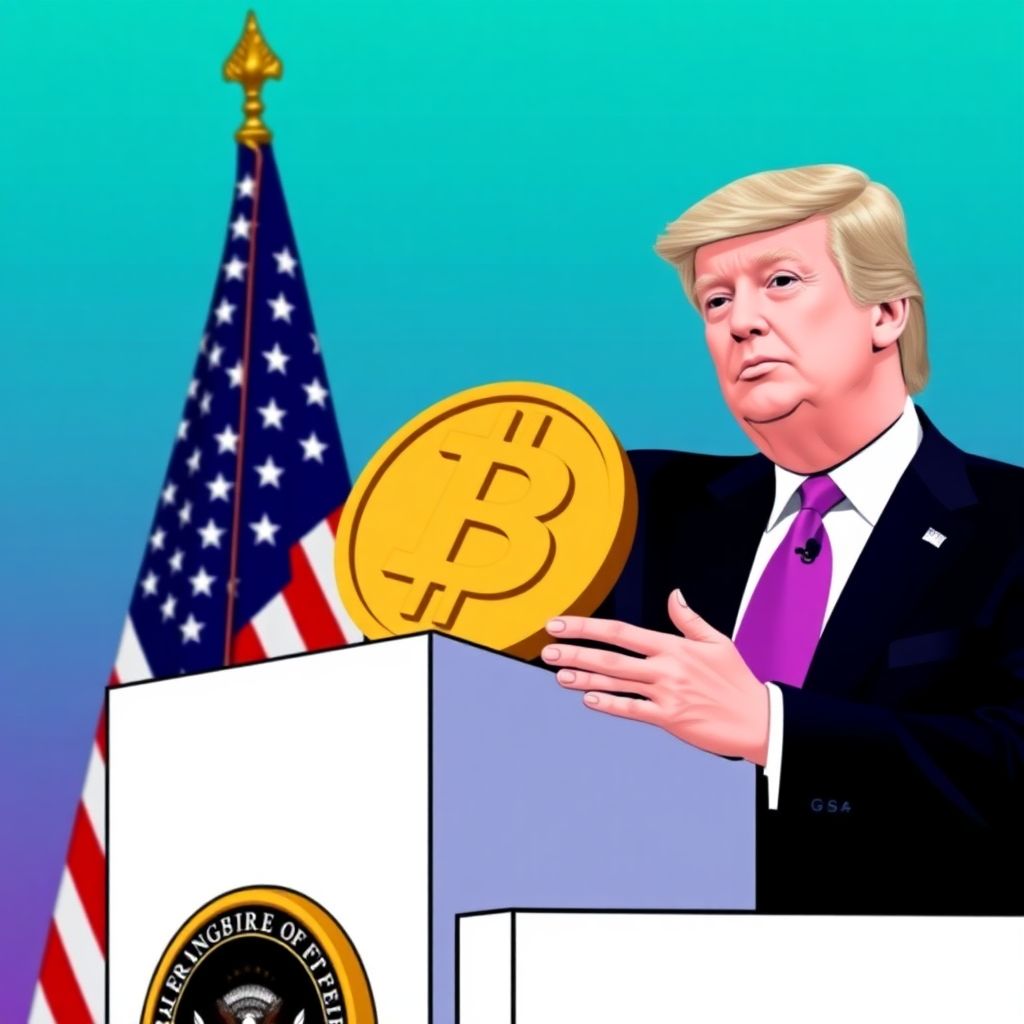
Trump Aims to Establish U.S. as Global Leader in Bitcoin and Crypto Innovation
Former President Donald Trump has laid out an ambitious vision to position the United States as the dominant force in the cryptocurrency world, particularly focusing on Bitcoin. Speaking at the America Business Forum in Miami, Florida, Trump outlined his plan to make the U.S. the unrivaled leader in digital assets, asserting that strategic investment in crypto is essential for maintaining global economic supremacy and countering competition from nations like China.
Declaring his intention to transform the U.S. into the “Bitcoin superpower,” Trump emphasized the importance of embracing blockchain technology and digital currencies. He argued that the flourishing crypto ecosystem would not only drive innovation and job creation but also help reduce dependency on the U.S. dollar by encouraging broader participation in decentralized finance.
“We are making the United States the crypto capital of the world,” Trump told a crowd of entrepreneurs and business leaders. “We already lead in artificial intelligence, and now we’re going to lead in crypto too.”
Trump’s remarks come at a time when countries across the globe are competing to establish dominance in the digital asset sector. Highlighting China as a prime rival, he warned that if the U.S. fails to act decisively on crypto, it risks falling behind. “China is moving fast,” he said. “If we don’t get this right, they will take the lead. It’s a massive industry, and we can’t afford to miss out.”
China’s attitude toward cryptocurrencies has evolved in recent years. While the government once imposed sweeping bans on crypto trading and mining, it has gradually shown interest in stablecoins and blockchain applications, especially through partnerships in Hong Kong. Efforts are underway in China to develop yuan-backed stablecoins to challenge the U.S. dollar’s overwhelming influence in global markets.
Meanwhile, the U.S. dollar continues to dominate the stablecoin sector, accounting for over 90% of the market’s capitalization. Analysts at JPMorgan recently projected that rising global adoption of stablecoins could generate an additional $1.4 trillion in demand for the dollar by 2027, reinforcing its financial supremacy—at least for now.
During his speech, Trump also took credit for reversing what he described as the Biden administration’s “war on crypto.” He accused federal regulators under President Biden of stifling innovation and aggressively targeting major crypto firms, including Binance, Coinbase, and Ripple. Trump claimed that his own administration had taken bold action to protect and promote the industry.
“I signed historic executive orders to end the federal government’s assault on crypto,” he said. “Crypto was under siege. It’s not anymore.”
One of Trump’s key initiatives includes the creation of a Strategic Bitcoin Reserve and a national stockpile of digital assets. These measures, he argues, are essential for securing the U.S.’s position in the next era of digital finance.
Currently, the U.S. government holds approximately 326,588 BTC, valued at around $33.69 billion. These assets were largely acquired through law enforcement seizures and forfeitures rather than direct purchases. This amount represents roughly 1.55% of Bitcoin’s total supply, making the U.S. the largest state holder of BTC globally.
China follows as the second-largest government holder, with 190,000 BTC, also mostly accumulated through confiscations. However, unlike the U.S., China has taken a more cautious and centralized approach to digital currencies, focusing on its own digital yuan and experimenting with blockchain infrastructure.
The United States is also home to the highest number of Bitcoin-holding corporations. As of early November, 123 American companies were known to hold BTC, with leading firms such as Strategy, MARA Holdings, and XXI topping the list. In comparison, Canada and the United Kingdom trail behind, with 43 and 23 BTC-holding firms respectively.
In terms of overall crypto adoption, the U.S. ranks second globally, according to the Chainalysis 2025 Global Crypto Adoption Index. India leads the rankings, but the U.S. maintains strong infrastructure, institutional interest, and public awareness surrounding digital assets.
Despite the dominance of the dollar in the stablecoin market, many experts believe that broader government support and regulatory clarity could give the U.S. a significant edge in the race toward crypto leadership. Trump’s pro-crypto stance may serve as a rallying cry for both public and private sector actors interested in expanding the nation’s influence in this transformative space.
In addition to national reserves, Trump has advocated for increased integration of blockchain in government operations, from digital identity systems to secure voting mechanisms. He envisions a future where smart contracts and decentralized platforms enhance transparency and efficiency in public services.
Moreover, his vision extends to energy and infrastructure. Trump has previously hinted at using Bitcoin mining as a strategic tool to bolster domestic energy production, especially in underutilized regions. By incentivizing clean and efficient mining practices, the U.S. could potentially leverage its vast energy resources to attract crypto businesses and tech talent.
On the education front, Trump has proposed initiatives to integrate blockchain and crypto literacy into school curriculums and university programs. He believes fostering a digitally literate workforce is essential for sustaining leadership in the global tech race.
Finally, with institutional investors increasingly turning to Bitcoin and Ethereum, Trump’s push for a national digital asset strategy may accelerate the development of a U.S.-based regulatory framework. Such a framework would provide legal clarity, promote innovation, and protect consumers—three factors that are crucial for scaling the crypto industry.
By aligning national policy with the evolving crypto landscape, Trump’s vision is not just about dominance, but about future-proofing the U.S. economy in a rapidly digitizing world. Whether or not his proposals are realized, they mark a significant shift in how political leaders view the role of cryptocurrency in national strategy.