
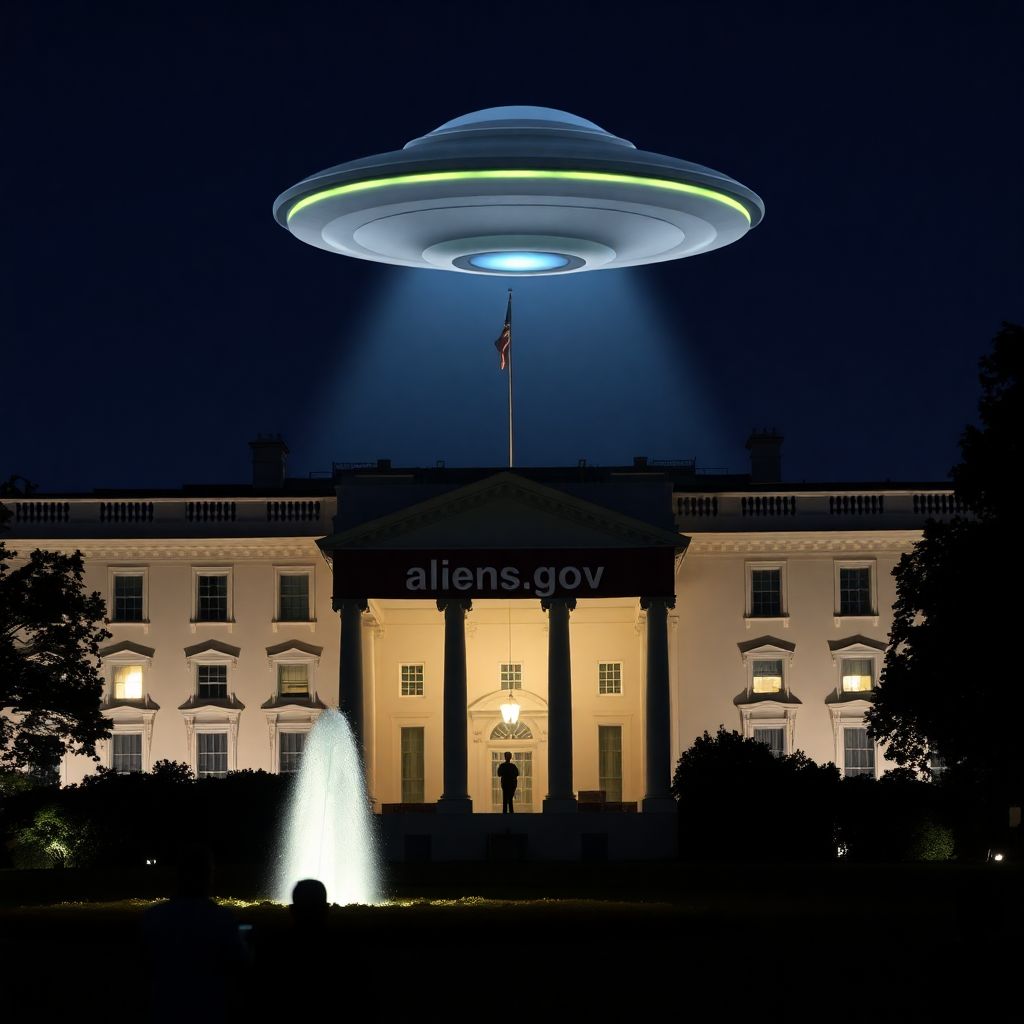
Trump White House Registers Aliens.gov: Is UFO Disclosure Really Coming?
In the early hours of Wednesday morning, the Executive Office of the President quietly claimed a new corner of the internet: aliens.gov. Public records show the domain was registered a little after 6:30 a.m., with no fanfare, no press release, and-so far-no website attached to it.
For now, the address leads nowhere. Type it into a browser and you’ll be greeted with nothing-no landing page, no teaser, no “coming soon” graphic. Just an empty government domain that, given the current political climate and recent presidential promises, is anything but subtle in its naming.
The registration was first spotted by an automated domain-tracking tool that monitors new government web addresses. After the bot logged the change, tech reporters noticed the unusual name and traced it back to the Executive Office of the President. That confirmation has fueled a fresh wave of speculation: is this a gimmick, an internal project, or the first visible step toward the large-scale UFO and UAP disclosure Donald Trump has publicly promised?
Tied to Trump’s Pledge to Release UFO Files
The timing isn’t random. The aliens.gov registration landed roughly a month after Trump took to his social platform to vow that he would order the Pentagon and other federal agencies to identify and release every available government file related to:
– Extraterrestrial life
– Unidentified Aerial Phenomena (UAP)
– Unidentified Flying Objects (UFOs)
In that post, Trump framed the move as a sweeping transparency initiative, suggesting that the public had waited long enough for answers about decades of sightings, military encounters, and classified investigations.
That pledge itself didn’t appear in a vacuum. It followed a now widely shared moment featuring former President Barack Obama, who, in a podcast interview, acknowledged that U.S. military and intelligence services have recorded objects in the sky that defy easy explanation-craft with flight characteristics that don’t match any publicly known technology. Obama didn’t say they were aliens, but he firmly stated that there is real data and imagery behind at least some of the reports.
Trump’s response, by contrast, was more blunt: he linked that viral Obama moment to a promise of broad declassification. Against that backdrop, the sudden appearance of a government-owned domain literally called aliens.gov feels far from accidental.
Silence From the White House
Officially, however, the administration has said nothing.
So far there has been:
– No briefing from the press secretary
– No executive order detailing a release plan
– No public-facing content attached to the domain
Journalists have requested comment from the White House, asking what aliens.gov is meant to be used for, who is overseeing it, and whether it is linked to any formal disclosure directive. As of now, there has been no answer, no clarification, and no attempt to tamp down the speculation.
In Washington, silence can mean anything-from careful planning to bureaucratic inertia. But when the subject is “aliens” and the domain ends in .gov, public imagination fills the vacuum very quickly.
What Could Aliens.gov Actually Be For?
While the name sounds almost too on-the-nose, there are several plausible explanations for why the government would lock down aliens.gov right now:
1. Central Disclosure Hub
It could be intended as a future public portal where declassified UFO and UAP documents, videos, and reports are published in a more accessible, searchable way. That would mirror how the government has handled other major transparency pushes, such as declassification of historical intelligence files or pandemic-related data.
2. Public Information and Myth-Busting
The domain might be designed for public education, offering vetted information about:
– What UAP actually are (and aren’t)
– How official investigations work
– What has been confirmed versus debunked
In other words, it could be a tool to counter disinformation and conspiracy theories by giving people a single, authoritative source.
3. Preemptive Branding and Control
Sometimes agencies register high-interest domains simply to prevent others from using them. Given how emotionally and politically charged the UFO topic has become, officials may want to ensure that anything that looks like a government “aliens” portal is, in fact, under government control.
4. Internal or Classified Use Initially
It’s possible the site could first operate on a restricted basis-housing internal tools, secure upload systems, or interagency coordination platforms-before any public-facing content appears. The public usually only sees the final layer, not the infrastructure beneath.
5. A Political or PR Stage Piece
The domain may be intended for a high-visibility rollout tied to a speech, a signed order, or a specific date-something designed not just as a transparency effort, but as a headline-driving political moment.
Until aliens.gov goes live with real content, all of these remain informed guesses.
How This Fits Into the Government’s UAP Evolution
Over the last several years, the U.S. government has moved from flat denials to cautious acknowledgment that something unusual is in the skies:
– The Pentagon has confirmed multiple UAP videos captured by military pilots.
– Congress has held public and closed-door hearings on UAP, pressing the intelligence community for answers.
– A dedicated office has been established to analyze UAP reports and coordinate across branches of the military and intelligence agencies.
This slow, bureaucratic shift away from ridicule and secrecy has laid the groundwork for a more organized public release of information. A dedicated government domain centered explicitly on “aliens” would be a dramatic, but not entirely illogical, next step in that evolution.
The Obama Moment That Pushed the Topic Mainstream
Barack Obama’s widely circulated remarks were a turning point. In the interview, he dismissed the idea that the government is hiding physical alien bodies in a secret facility, but openly confirmed that serious data on unexplained aerial objects exists, and that those objects have exhibited behavior that is difficult to match with known aeronautical capabilities.
Coming from a former president, spoken in a casual format rather than in a classified briefing, the comments landed differently. They validated long-standing concerns that behind closed doors, U.S. officials take at least some UAP cases very seriously.
Trump, who has often framed himself as a breaker of norms and a champion of “telling it like it is,” seized on that moment to promise what previous presidents have repeatedly sidestepped: a broad, definitive release of files. In that light, aliens.gov could be seen as the infrastructure for following through-at least symbolically-on that promise.
Skepticism: Is This More Show Than Substance?
Despite the hype, seasoned observers of government transparency are cautious. Registering a domain is cheap, fast, and largely symbolic; it does not automatically signal a real policy shift.
Several reasons to remain skeptical:
– Past administrations have promised more openness on UFOs, only to deliver limited document releases heavily redacted for “national security” reasons.
– Agencies often move slowly when it comes to declassification, especially in areas that might touch sensitive sensors, weapons systems, or foreign surveillance programs.
– A catchy domain name is easy politics; meaningful disclosure requires grinding, unglamorous interagency work.
Until there is a concrete executive order, an explicit timeline, or actual files appearing on a government platform, aliens.gov could be anything-from a serious transparency tool in the making to a political prop that never fully materializes.
What a Real UFO File Dump Would Look Like
If Trump’s directive is carried out in earnest and aliens.gov becomes the front door of UFO transparency, the public might expect:
– Declassified intelligence reports on historic and modern sightings
– Military cockpit videos and sensor data with sensitive details removed
– Analytical summaries explaining what experts believe the objects might be
– Clear labels separating confirmed hoaxes, misidentifications, and still-unexplained cases
– Regular updates as new incidents are investigated and assessed
Crucially, any major dump of files would likely be staged in phases. Agencies typically start with older, lower-sensitivity material, then move forward cautiously to more recent cases once they have established what can be safely shared.
Why the Government Cares About Controlling the Narrative
Beyond the spectacle, there are serious reasons Washington wants to control how UFO and UAP information is framed:
– National security: Some UAP events may involve advanced foreign drones or surveillance platforms. Publicly acknowledging too much could reveal what U.S. systems can and cannot detect.
– Public perception and panic: Abrupt, poorly framed disclosures on sensitive topics can fuel panic, conspiracy theories, or mistrust. A managed rollout through a central portal allows careful messaging.
– Technological secrecy: Certain “unexplained” events might be tied to classified U.S. projects or experimental aircraft. Admitting too much could compromise those programs.
A domain like aliens.gov offers a tightly controlled stage where officials can selectively release information, shape context, and respond to public fascination without completely losing control of the story.
The Political Dimension
The UFO debate is no longer just for fringe audiences; it has become a talking point in mainstream politics. For a candidate or administration, being seen as the one that “finally told the truth about aliens” can be powerful branding.
At the same time, there’s risk:
– Overpromising and under-delivering could backfire with voters who want real answers.
– If disclosed information contradicts earlier government denials, it may deepen distrust.
– Rival politicians can attack any move on UAP as either irresponsible fearmongering or ineffective grandstanding.
Aliens.gov, therefore, sits at the intersection of policy, secrecy, and political theater. Until it goes live, no one knows which of those will dominate.
What to Watch for Next
In the coming weeks and months, a few key developments will signal whether aliens.gov is the beginning of something significant or just an empty digital gesture:
– A formal directive ordering agencies to declassify specified UAP/UFO materials
– Any official mention of aliens.gov in speeches, briefings, or policy documents
– The appearance of even a basic holding page explaining the site’s intended purpose
– Budget or staffing moves that indicate a new, dedicated disclosure effort
Until then, all that’s certain is this: the Executive Office of the President has claimed one of the most loaded domain names imaginable. It points to a blank page, but it carries decades of speculation, secrecy, and cultural obsession behind six simple letters: aliens.gov. Whether that address becomes a historic portal of disclosure or just another curiosity in the government’s digital archive now depends on what-if anything-the White House decides to publish there.