
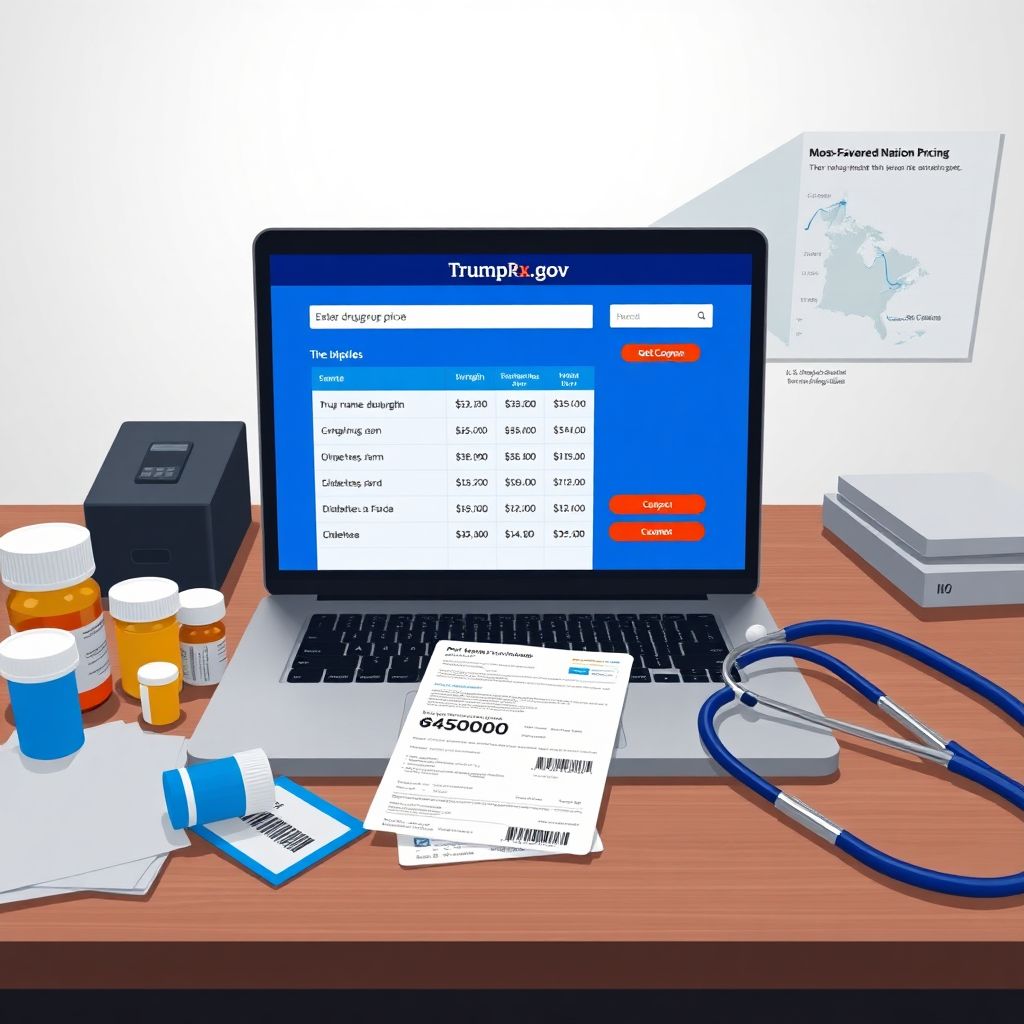
President Trump’s TrumpRx Plan to Cut Drug Costs: How It Works and Whether You Should Trust It
TrumpRx.gov, a new federal platform promoted by President Donald Trump, has gone live with an ambitious promise: to dramatically lower prescription drug prices in the United States by benchmarking them to what other wealthy countries pay. The initiative is framed as a “most-favored-nation” pricing tool and is being pitched as a way to pull back the curtain on opaque pricing and sidestep the middlemen who help keep U.S. prices among the highest in the world.
What TrumpRx Claims to Do
The TrumpRx website functions as a cash-pay marketplace for prescription medications, particularly high-demand drugs such as GLP‑1 weight-loss and diabetes treatments. Instead of routing users through traditional insurance and pharmacy benefit manager (PBM) channels, the platform focuses on:
– Showing discounted cash prices for a wide range of medications
– Allowing users to search by drug name, strength, and form
– Generating printable or digital coupons or vouchers
– Directing patients to participating manufacturers or pharmacies to actually complete the purchase
There is no requirement to create an account, and users are not asked to submit insurance information. The White House is presenting this as a transparency-centric model that strips out rebates, spread pricing, and behind-the-scenes negotiations that often inflate what patients ultimately pay at the counter.
The “Most-Favored-Nation” Idea Explained
At the heart of TrumpRx is the concept of tying U.S. drug prices to those paid in other developed nations. Under a most‑favored‑nation approach, drug makers participating on the platform agree, in principle, to offer Americans prices that are close to—or capped by—the lowest levels they charge in comparable countries such as those in Europe or Canada.
In practice, that means a drug that sells for a fraction of the U.S. price overseas could be offered on TrumpRx at a significantly lower cash rate, bypassing the traditional insurance-based pricing system. The administration is betting that public access to these numbers will put pressure on pharmaceutical manufacturers to narrow the gap between U.S. and international prices more broadly.
How the Platform Works for Patients
For individuals, TrumpRx is designed to be straightforward:
1. Search for your medication – You enter the drug name, dosage, and in some cases whether you’re looking for brand-name or generic.
2. Review cash prices – The site displays participating offers, often substantially below the list price or what you might see without a discount card at the pharmacy.
3. Get a coupon or code – You can download, print, or save a digital coupon, or in some cases receive a unique identifier that the pharmacy or manufacturer will honor.
4. Fill the prescription – You bring the prescription from your doctor and the coupon to a participating pharmacy, or follow instructions for mail-order or direct-from-manufacturer purchases.
Insurance is not involved in the transaction, so the discount applies to your out-of-pocket cash payment. That may benefit people who are uninsured, underinsured, or stuck with high deductibles and copays. However, it also means these purchases typically will not count toward your insurance deductible or out-of-pocket maximum.
Who Might Benefit Most
TrumpRx is likely to be especially relevant for:
– Uninsured patients who currently pay full retail prices
– People with high deductible health plans who must spend thousands before coverage kicks in
– Patients taking expensive GLP‑1 drugs for diabetes or weight management, where list prices can run well over a thousand dollars per month
– Medications with weak insurance coverage or frequent prior-authorization denials
For these groups, a transparent cash price that undercuts typical pharmacy charges can represent real savings, at least in the short term.
What Makes TrumpRx Different From Other Discount Programs
Drug discount cards and cash‑pay platforms are not new. Private services already negotiate reduced rates with pharmacies and share part of the savings with consumers. What distinguishes TrumpRx is:
– Government backing – It is framed as a federal initiative, not a private coupon program.
– Policy leverage – By connecting offers to the most‑favored‑nation concept, it uses international price comparisons as a negotiating tool.
– Focus on manufacturers – In many cases, discounts come directly from pharmaceutical companies rather than only at the pharmacy level, potentially reducing middleman markups.
– No account creation – Many private programs collect user data in exchange for savings; TrumpRx is presented as a more minimal, open-access search tool.
That said, the underlying mechanics—discounted cash prices and coupon codes—will feel familiar to anyone who has used a prescription savings card.
Is TrumpRx Legitimate or a Political Stunt?
The platform is real in the sense that it exists, is government‑branded, and connects users to genuine discount offers. The key question is not whether the site itself is a scam, but whether it can deliver on its sweeping promise to “slash” U.S. drug costs in a lasting, system‑wide way.
There are several reasons to approach TrumpRx with cautious realism:
– Voluntary participation by drug makers – Pharmaceutical companies must opt in to offer lower prices. Those that don’t participate can continue to charge existing rates through conventional channels.
– Limited scope – Not all drugs, pharmacies, or insurers are part of the initiative. Savings may be concentrated in a subset of medications, especially those the administration chooses to highlight.
– Legal and policy challenges – Aggressive efforts to tie U.S. prices to foreign benchmarks have faced intense pushback and lawsuits in the past; long‑term implementation is uncertain.
– Election‑year timing – Launching a high‑profile cost‑cutting tool during a political season inevitably raises questions about how much is policy reform and how much is messaging.
In short, TrumpRx appears to be a genuine attempt to test a government‑backed cash‑discount model, but it is not a magic switch that instantly aligns all U.S. drug prices with those of Europe or Canada.
Potential Advantages for Consumers
If you set aside the politics and look purely at functionality, TrumpRx may offer several concrete benefits to patients:
– Immediate transparency – You can see cash prices without logging in or sharing personal data.
– Alternative to insurance pricing – If your copay is higher than the TrumpRx cash price, you can choose the cheaper path.
– Leverage for negotiation – Knowing that a lower cash price exists can give you more confidence when discussing options with your prescriber or pharmacy.
– Access to newer therapies – For drugs like GLP‑1 agonists, which can be hard to obtain at an affordable rate, even modest discounts can translate into meaningful monthly savings.
However, the platform is a tool, not a replacement for medical or financial advice. Patients still need to compare options carefully.
Key Limitations and Risks
Despite the promise, TrumpRx comes with notable constraints:
– May not be the absolute lowest price – Competing discount cards, manufacturer assistance programs, or local pharmacy deals might still beat TrumpRx for certain drugs.
– No insurance credit – Purchases through TrumpRx generally will not count toward your plan deductible or out‑of‑pocket cap, which can matter for people with chronic conditions and high annual spending.
– Pharmacy participation varies – Not all pharmacies may be contracted to honor specific coupons; availability may differ by region.
– Policy longevity is uncertain – A change in administration or successful court challenges could alter or scale back the program.
Patients should treat TrumpRx as one option in a broader shopping strategy, not as the only channel to consider.
How to Use TrumpRx Safely and Smartly
If you are thinking of trying TrumpRx, a few practical steps can help you get the most from it:
1. Confirm the exact medication – Ask your prescriber to write the prescription using the form, dose, and quantity you find priced on TrumpRx, if appropriate for your treatment.
2. Compare multiple options – Check what your insurance copay would be, what local pharmacies charge without insurance, and what other discount programs offer for the same drug.
3. Call the pharmacy first – Before you show up, ask whether they accept the particular TrumpRx coupon and what your final cash price will be after all fees.
4. Keep your doctor in the loop – If you switch from one version of a drug to another (for example, brand to generic, or a different GLP‑1 formulation), do it only with your prescriber’s approval.
5. Track your total costs – If you manage multiple chronic medications, remember that lower per‑script prices may or may not outweigh the value of meeting your insurance deductible.
Approaching the platform with this kind of discipline will help you avoid surprises at the counter.
What This Means for Big Pharma and Middlemen
One of the administration’s explicit goals is to apply pressure on the pharmaceutical supply chain—particularly PBMs and insurers whose rebate and spread-pricing models are often blamed for keeping list prices artificially high. By publicizing international reference prices and offering direct manufacturer discounts, TrumpRx aims to:
– Undermine the leverage of PBMs who profit from complex rebate arrangements
– Demonstrate that lower cash prices are possible even without insurance
– Force manufacturers to defend why U.S. list prices are multiples of those abroad
Whether this experiment will succeed is unclear. Drug makers could choose to offer narrow, selective discounts on a limited set of drugs to blunt political criticism while maintaining their core pricing structures elsewhere. Middlemen, for their part, are likely to argue that they already deliver savings to patients through negotiated formularies and that cherry‑picked cash deals do not fix structural issues.
Could TrumpRx Lower Prices System‑Wide?
The broader impact of TrumpRx depends on scale and persistence. If enough patients migrate to lower‑priced cash deals, manufacturers and PBMs could be pressured to adjust pricing strategies more broadly. However, there are strong reasons to be cautious:
– High‑cost specialty drugs and biologics, which drive a large share of spending, may be harder to discount meaningfully without jeopardizing manufacturer revenue.
– Employers and large insurers still control the main flow of prescription spending; as long as they rely on PBMs and rebate structures, the system may resist fundamental change.
– Some savings may be offset if manufacturers raise prices elsewhere or limit discounted supply to maintain margins.
In other words, TrumpRx could function more as a pressure valve and proof-of-concept than as a complete overhaul of U.S. drug pricing.
How to Evaluate Whether TrumpRx Is Right for You
When deciding if TrumpRx is worth using, focus less on the politics and more on measurable outcomes:
– Does the TrumpRx price beat what you pay now? If yes, it may be worthwhile, especially for one‑off or intermittent prescriptions.
– Are you close to meeting your deductible? If you are, using insurance might be smarter in the long run even if the cash price is slightly lower today.
– Is the drug long‑term or short‑term? For chronic therapies, you need to think over a full year’s cost, not just a single fill.
– Do you have alternatives? Generics, therapeutic substitutes, or different drug classes may be much cheaper even without this platform.
A “legit” program is one that not only exists but consistently delivers real savings and is supported by clear, understandable rules. TrumpRx meets the first test. The second will only be answered as more patients try it and the market responds.
Bottom Line: Is TrumpRx Legit?
TrumpRx is a real, government-branded tool that offers genuine discounted cash prices on certain prescription medications, including popular and expensive GLP‑1 drugs. It is not a phishing site or a fly‑by‑night operation; it is part of a broader policy effort to publicize international reference prices and challenge traditional middlemen in the drug supply chain.
However, it is also a limited, politically charged experiment—not a comprehensive cure for America’s high drug costs. Its effectiveness will vary by medication, pharmacy, and patient situation. For some people, it will provide meaningful savings; for others, traditional insurance, manufacturer assistance, or competing discount programs may still be better options.
If you approach TrumpRx with realistic expectations, compare prices carefully, and coordinate with your healthcare provider, it can be a useful addition to your toolbox for managing prescription costs—but it should not be mistaken for a total solution to the U.S. drug pricing crisis.