
How Trump’s New Immigration Order Could Supercharge Stablecoins and Bitcoin ATMs
When Donald Trump’s own business empire found conventional banks closing their doors, the family famously turned to crypto-friendly institutions and alternative rails. A similar dynamic is now emerging for millions of undocumented immigrants in the United States-only this time, it is the federal government nudging them toward financial alternatives.
On May 19, President Trump signed an executive order billed as an effort “to restore integrity to America’s financial system.” Framed as a national security measure, the directive instructs agencies such as the Treasury Department and federal banking regulators to consider new rules that would tighten fraud screening and risk controls around providing financial services to undocumented immigrants.
Policy analysts say that, in practice, this could mean tougher identification standards at banks, enhanced scrutiny of accounts suspected of being used by people without legal status, and new compliance obligations for institutions that serve immigrant-heavy communities. The result: more friction, more account closures, and fewer on-ramps to the traditional banking system for some of the country’s most vulnerable residents.
For people who rely on paychecks, remittances, and cash businesses to support families across borders, that pressure will not make their financial activity disappear-it will push it somewhere else. And increasingly, “somewhere else” means stablecoins, peer‑to‑peer crypto transfers, and even Bitcoin ATMs.
From Off‑Ramps to an “Escape Hatch”
The crypto markets have long marketed themselves as an “escape hatch” from politicized finance-railways that can move value without the permission of banks. When retail platforms started de‑banking politically exposed figures and controversial enterprises, some of those users turned to stablecoins and offshore exchanges. The Trump Organization itself, cut off by some Wall Street names in the wake of the January 6 fallout, found friendlier partners in the digital asset industry.
Now, a similar logic is being applied at scale to undocumented immigrants, many of whom already live on the margins of finance. If banks respond to the order by raising compliance costs, they may quietly close or deny accounts that look “high risk,” even if no wrongdoing is alleged. Migrant workers who previously kept a checking account for direct deposits or remittances may be steered back to cash, money orders, and high‑fee transmitters.
Crypto-especially dollar‑pegged stablecoins like USDC and USDT-steps into that gap. Where a bank might demand extensive documentation, a non‑custodial crypto wallet demands only a smartphone and an internet connection. Instead of queuing at a remittance counter, users can send a tokenized dollar across borders in minutes.
For advocates of digital assets, the executive order effectively accelerates a transition that was already under way: undocumented migrants using crypto as a parallel rails system, outside the line of sight of traditional banks.
A Shadow Banking System, Built on Stablecoins
The executive order’s critics describe the likely outcome as the growth of a “shadow banking system”-informal, lightly regulated networks that mimic core functions of banks without the same oversight. In the 20th century, that often meant cash, hawala networks, and under‑the‑table lenders. In the 21st century, it increasingly means stablecoins and on‑off ramps that sit just outside federal supervision.
Stablecoins are particularly attractive in this context:
– They track the value of the U.S. dollar, reducing price volatility that makes Bitcoin or other tokens risky for day‑to‑day spending.
– They can be accessed via low‑cost smartphone apps rather than formal bank branches.
– They can move across borders 24/7, bypassing correspondent banking systems and traditional remittance rails.
An undocumented construction worker who is nervous about bank scrutiny but still needs to send $300 home every two weeks might discover that receiving a paycheck in cash, converting a portion of it through a Bitcoin ATM or local OTC broker, and then sending stablecoins to family abroad is cheaper and less invasive than traditional methods. On the receiving end, relatives can either hold the stablecoins as a dollar‑denominated savings vehicle or cash out using local P2P markets.
The more traditional finance becomes hostile or inaccessible, the more rational it becomes to rely on these parallel systems. In that sense, the executive order aimed at “restoring integrity” may end up normalizing a de facto two‑tier monetary system: one on the books, one in the shadows.
Why Bitcoin ATMs Stand to Benefit
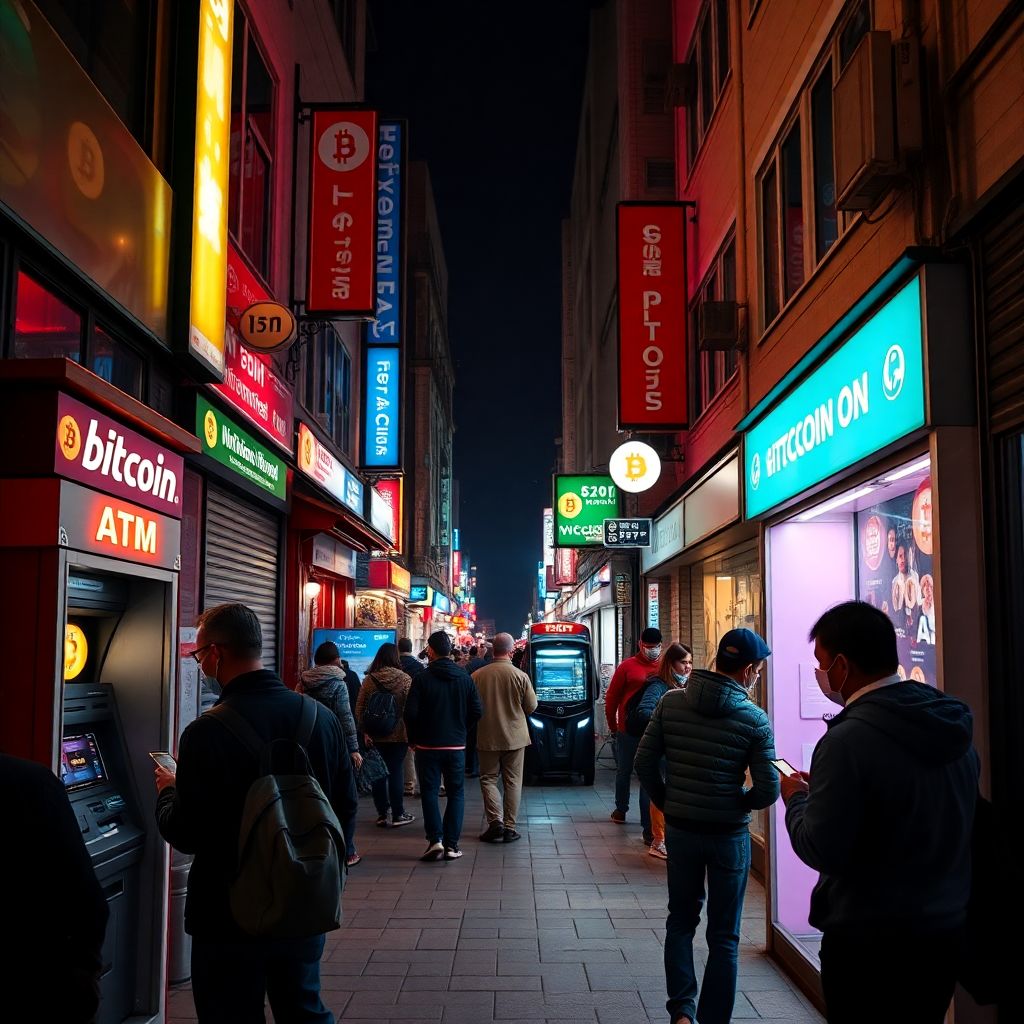
Bitcoin ATMs (BTMs) are another likely winner. These kiosks-often tucked into convenience stores, laundromats, and bodegas-allow users to buy or sell crypto with cash, with varying levels of identity checks depending on local rules and transaction size.
For undocumented immigrants who may be wary of handing over extensive personal information to banks, BTMs present a middle ground:
– They accept physical cash, which many migrants are already paid in.
– They provide a direct route into digital assets without requiring a conventional bank account or credit card.
– They are embedded in neighborhoods where immigrants live and work, often supported by bilingual operators and staff.
If banks tighten onboarding and monitoring in response to the order, demand for cash‑to‑crypto channels will rise. BTM operators can adjust their offerings to highlight stablecoins alongside Bitcoin, marketing themselves as community financial tools: a way to move money, save in dollars, and bypass intrusive questioning.
Regulators have already been uneasy about BTMs, viewing them as ripe for abuse by money launderers and fraudsters. But the new policy may ironically deepen their importance as a lifeline for people excluded from banks by government design.
The Human Side of Regulatory Risk
For many undocumented immigrants, the threat isn’t only that a bank might deny them an account in the first place. It’s that existing accounts could be frozen or closed abruptly if the bank flags unusual activity or feels uneasy about documentation. That can mean paychecks locked up, rent payments bouncing, and families left with no access to savings.
The executive order, by highlighting national security and fraud concerns, gives institutions a political cover to over‑comply. Facing potential penalties for inadvertently serving sanctioned individuals or facilitating identity fraud, banks are likely to err on the side of cutting ties. Even customers who are fully compliant with tax obligations and local rules may find themselves swept up by automated risk models.
Crypto, for all its volatility and regulatory uncertainty, offers something that looks like control. A non‑custodial wallet cannot be frozen by a compliance officer. A private key does not demand a Social Security number. For a population that experiences frequent identity checks, workplace raids, and legal precarity, that sense of control is powerful-even if it comes with new risks of theft, scams, and user error.
New Risks, New Dependencies
The shift toward a stablecoin‑and‑BTM‑driven financial ecosystem for undocumented migrants is not without serious drawbacks.
First, it pushes vulnerable populations into a landscape where consumer protections are weak or nonexistent. If a user is tricked into sending their stablecoins to a scammer, there is no chargeback, no customer service hotline, no FDIC insurance. For people living paycheck to paycheck, a single mistake can be catastrophic.
Second, it increases dependence on private issuers and infrastructure operators. Stablecoins are only as good as the entities backing them; if a major issuer faces legal action, de‑pegging, or asset freezes, the “dollars” held by migrant users could evaporate in practice, even if they remain visible on‑chain. Similarly, Bitcoin ATM operators may adjust fees aggressively or change verification rules under regulatory pressure, suddenly raising costs.
Third, it likely will not remain truly in the shadows for long. As crypto flows linked to excluded populations grow, law enforcement and regulators will intensify efforts to monitor and regulate key chokepoints: stablecoin issuers, major exchanges, ATM operators, and on‑off ramps. The very communities that migrated to crypto to escape scrutiny may find themselves once again in the crosshairs.
The Irony of “Integrity”
There is a profound irony embedded in the executive order. In the name of safeguarding the U.S. financial system from fraud and illicit finance, the government is nudging millions of people out of the most traceable, surveilled channels and into systems that are harder to regulate and supervise.
Banks operate under stringent know‑your‑customer and anti‑money‑laundering regimes. Transactions are documented, patterns are analyzed, and suspicious activity must be reported. By contrast, while blockchains are transparent at a technical level, the human identities behind wallets can be opaque, especially when users rely on informal cash‑based entry points.
In other words, rather than bringing money flows into the light, the policy may push them into a complex web of P2P trades, proxy accounts, and foreign exchanges-all harder for U.S. regulators to observe and police.
What Communities Are Likely to Do Next
In practical terms, immigrant communities are unlikely to abandon conventional remittance channels overnight. Western Union, bank transfers, and money service businesses are deeply entrenched and familiar. But they will increasingly be supplemented by crypto‑based methods when friction rises.
We can expect to see:
– More informal “crypto remittance agents” who help people convert cash into stablecoins and transmit them abroad for a fee.
– Local stores and service providers exploring the acceptance of crypto payments, particularly dollar‑pegged tokens, as a hedge against account closures.
– Education campaigns, both formal and informal, around how to use wallets safely, avoid scams, and manage private keys.
For those with some technological literacy, the move toward stablecoins can actually improve financial resilience: cheaper cross‑border transfers, 24/7 access, and the ability to save in a dollar‑like asset even in countries with unstable currencies. For others, it will create a confusing, risky parallel economy layered on top of an already precarious existence.
Policy Choices That Will Shape the Outcome
How transformative the order will be for the stablecoin and BTM economy ultimately depends on how aggressively regulators implement it. There is a spectrum of possible outcomes:
– A narrow interpretation that mostly clarifies existing rules and nudges banks to tighten documentation standards at the margins.
– A sweeping crackdown that leads to widespread de‑risking, making it nearly impossible for undocumented immigrants to maintain accounts or access basic services.
In the first scenario, crypto adoption among undocumented communities grows steadily but remains one tool among many. In the second, the shift could be rapid, with stablecoins and Bitcoin ATMs becoming central pillars of how migrant workers earn, save, and send money.
Regulators could also choose a middle path: pairing stricter rules for banks with clearer guidance for crypto on‑ramps, including identity requirements for stablecoin issuers and ATM operators. That would not eliminate the move toward alternative rails-but it would bring more of it within a known regulatory perimeter, reducing some systemic risk.
A Future of Parallel Rails
Regardless of the exact trajectory, the direction of travel is clear. The more the official financial system is weaponized as a tool of immigration control, the more excluded populations will seek parallel rails. Stablecoins and crypto infrastructure are well‑positioned to supply those rails, not out of ideological alignment but because they are designed to be permissionless and globally accessible.
In that sense, Trump’s immigration‑driven push for banking “integrity” could end up being one of the most powerful growth catalysts for the stablecoin economy and Bitcoin ATM industry. As banks close doors, code opens new ones-and millions of people, caught between political agendas and economic necessity, will walk through them.