
US Politics Today: How Trump’s Iran Blockade Is Rippling Through Oil, Inflation, and Your Wallet
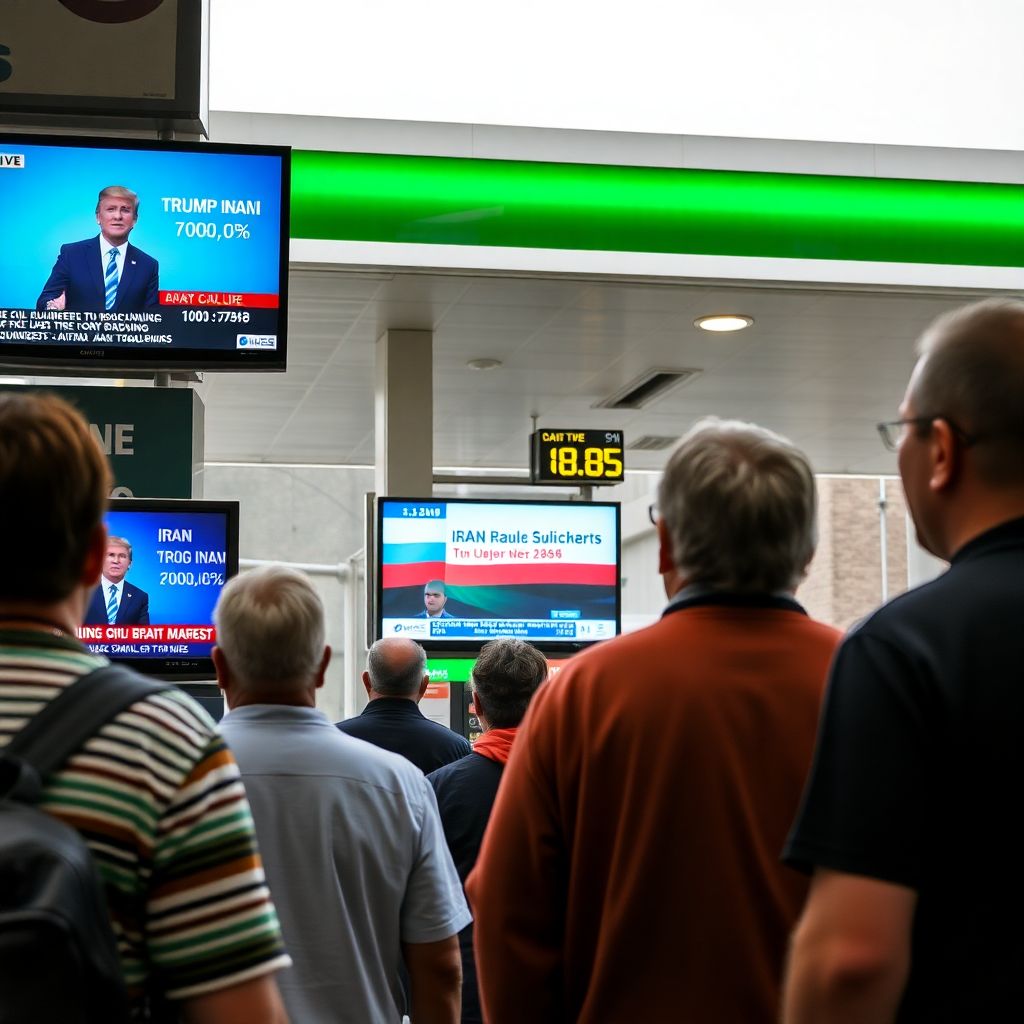
The most immediate political story hitting Americans’ pocketbooks is no longer a distant diplomatic drama-it is now a live economic event. At 10 AM ET on Monday, the US Navy’s blockade of Iranian ports formally went into effect, cutting off a major channel of crude exports and jolting global energy markets. Brent crude climbed above 103 dollars a barrel, US benchmark WTI passed 104 dollars, and the average price of gasoline in the United States held above 4.12 dollars a gallon. All of this is unfolding just as March inflation data confirmed a jump to 3.3 percent, the highest reading since 2024.
The stated goal of the blockade is clear: deprive Tehran of oil revenue and increase pressure on the Iranian government. Iran earned roughly 45 billion dollars from oil exports last year, a sum that accounts for about 13 percent of its entire economy. Blocking that flow is meant to tighten the financial vise on Iran. But the same move is also tightening conditions at home, where American households are already navigating what many economists describe as the most severe energy shock since the 1970s.
Analysts warn that the current spike may not be the ceiling. Trita Parsi of the Quincy Institute cautioned that pulling additional Iranian barrels off the market could eventually drive oil prices toward 150 dollars per barrel if the disruption persists or escalates. Karen Young at the Middle East Institute underscored that there is no quick fix on the horizon, noting that it may be “a long time” before energy prices retreat meaningfully. In other words, what began as a foreign policy lever is rapidly taking shape as a prolonged domestic cost-of-living problem.
The blockade’s risks go far beyond the sticker shock at gas stations. China, Iran’s largest buyer of crude, sits at the center of this unfolding energy realignment. A broad ban on tankers transporting Iranian oil raises the possibility of direct friction with Beijing at a moment when relations are already fragile and Trump is slated to visit China next month. If China decides to push back-through workarounds, shadow fleets, or diplomatic confrontation-the economic and geopolitical stakes could escalate significantly, adding another layer of uncertainty for markets.
For American consumers, the transmission mechanism from foreign ports to household budgets is already visible. Pump prices are the most obvious indicator, but they are only the first wave. Natural gas and petroleum are core inputs for fertilizer, meaning higher energy costs typically push fertilizer prices up with a delay of roughly six to eight weeks. That, in turn, feeds into the cost of growing crops and raising livestock, ultimately lifting grocery bills. Packaging, which relies heavily on plastics, and transportation, which is powered largely by diesel and gasoline, also become more expensive. Heating bills, warehouse operations, and even some manufacturing processes carry an energy component that has not yet fully filtered into final consumer prices. The March CPI figure of 3.3 percent captures only the initial tremors of this shock.
Economic research firms are already bracing for a second wave of inflation. Pre-release projections from Oxford Economics suggested that headline CPI could climb above 4 percent in April as higher energy costs fan out across a broader basket of goods and services. That scenario would not merely be a blip on a chart-it would translate into a measurable erosion of real wages, shrinking the purchasing power of paychecks and deepening financial stress for lower- and middle-income families who spend a larger share of their income on essentials like fuel and food.
The Federal Reserve is now caught on the horns of a familiar but more dangerous dilemma. The central bank left interest rates unchanged at its last meeting and has effectively removed rate cuts from its 2026 roadmap. Under normal circumstances, the Fed prefers to “look through” energy-driven price spikes, treating them as temporary and focusing instead on core inflation measures that strip out food and energy. The logic is that energy shocks often reverse after supply adjusts and speculative pressure eases.
This time, however, the calculus is different. The blockade introduces a political and military dimension that breaks the usual pattern of short-lived energy disruptions. If the ceasefire tied to the Iran conflict expires on April 22 without an extension-and the blockade is tightened rather than eased-the risk is a more persistent energy shock. In that case, the Fed could be staring at a classic stagflation scenario: inflation driven higher by energy and supply costs at the same time that growth slows due to higher input prices, weaker consumer spending, and softening business investment.
In a stagflationary environment, the Fed’s tools become blunt and politically fraught. Raising rates to tame inflation could further choke growth and push unemployment higher. Leaving rates steady in the hope that the shock passes may allow inflation expectations to drift upward, undermining credibility and hurting households with fixed incomes or modest savings. For investors, this creates a challenging backdrop: traditional “safe” assets may not keep up with inflation, while risk assets face volatility from both economic uncertainty and policy ambiguity.
The implications extend beyond the energy and bond markets into equities, currencies, and digital assets. Each escalation in the Iran confrontation has produced a near-instantaneous reaction across asset classes: oil prices jump, equity indices wobble, and crypto markets swing sharply as traders reassess risk, inflation hedges, and geopolitical turbulence. Many investors are now watching the blockade less as a singular event and more as a barometer of whether Tehran will feel compelled to return to negotiations before the April 22 ceasefire deadline-or whether the region tips back into full-scale hostilities.
Diplomatically, the path out of the crisis is hazy. Talks over Iran’s nuclear program that last convened in Islamabad ended without a durable framework, and the current blockade is both a pressure tactic and a potential trigger for further escalation. There is no clear roadmap to either a permanent resolution or a stable extension of the ceasefire. That uncertainty acts like a constant background hum in financial markets, keeping risk premia elevated and sentiment fragile.
For American households, though, the question is less about diplomatic choreography and more about daily arithmetic. Higher gas prices ripple through household budgets in several ways. Commuters who drive long distances face a direct increase in monthly transportation costs. Families in suburbs or rural areas, where public transit is limited, are particularly exposed. Delivery surcharges for everything from groceries to furniture can creep upward as fuel costs rise, while airlines pass through higher jet fuel prices in the form of more expensive tickets. Even leisure activities-road trips, sporting events, food delivery-quietly become more expensive when energy prices surge.
The hit is not evenly distributed. Lower-income households, which already spend a significant share of their income on essentials, have less room to absorb unexpected increases in gas and food prices. Renters, who may rely heavily on driving for work and everyday errands, often lack the option to invest in energy efficiency upgrades that homeowners can pursue, such as improved insulation or solar panels. For these groups, even modest increases in fuel prices can force trade-offs: fewer discretionary purchases, delayed medical visits, or mounting credit card balances.
Certain industries also stand out as especially vulnerable. Long-haul trucking, freight logistics, airlines, and agriculture face direct cost pressures from more expensive fuel. Trucking companies may hike shipping rates, which can show up in higher prices for consumer goods. Airlines might respond by adjusting routes, trimming capacity, or layering on additional fees. In agriculture, higher fertilizer and fuel costs can squeeze margins for farmers, especially smaller operators, forcing some to scale back production or delay investments in equipment and technology, which can finally translate into higher prices at the grocery store.
Energy-intensive manufacturers in sectors such as chemicals, cement, metals, and plastics are likely to see their cost structures shift quickly, particularly if oil remains above 100 dollars for an extended period. Some companies may attempt to pass these costs along to customers; others may absorb them temporarily to protect market share, eroding profits. Over time, this can influence hiring decisions, wage growth, and the pace of new projects-factors that feed back into regional job markets and local economies.
Investors and savers are wrestling with a different set of questions. If inflation rises while growth slows, where should capital go? Historically, energy stocks and certain commodities have performed relatively well in inflationary, geopolitically unstable environments. On the other hand, sectors dependent on cheap energy and strong consumer demand may struggle. Tech and growth-oriented stocks, which are more sensitive to interest rate expectations and discount-rate shifts, can become more volatile as markets debate how far and how fast the Fed might respond.
Crypto markets sit at a complicated intersection of these forces. Some participants frame major cryptocurrencies as a hedge against inflation and geopolitical instability, expecting them to benefit from fears about fiat currencies and central bank policy. Others see them as high-risk assets that tend to fall when investors rush into cash and traditional safe havens during crises. The reality in recent episodes has often been a mix: sharp, correlated moves across equities and crypto during headline shocks, followed by divergence as traders reassess narratives about digital assets as alternative stores of value or speculative instruments.
On the political front, Trump’s blockade strategy is poised to become a defining domestic issue, not just a foreign policy chapter. With gas prices back above 4 dollars-a psychological threshold for many voters-energy costs may move to the center of campaign rhetoric, joining debates over inflation, wages, and the broader cost of living. Supporters of the blockade are likely to frame it as a necessary display of strength and leverage against Iran. Critics will emphasize the squeeze on American households and small businesses, arguing that the policy externalizes its costs onto ordinary citizens.
What should households be watching between now and the April 22 ceasefire deadline? First, any sign of a diplomatic opening that could ease tensions and create room for a phased rollback of the blockade. Second, movements in oil futures markets, which often react ahead of spot prices and can signal whether traders expect the shock to deepen or stabilize. Third, messaging from the Federal Reserve and key policymakers about how they plan to respond if inflation continues to rise in tandem with slowing growth indicators such as retail sales, industrial production, or job creation.
In the meantime, there are practical steps individuals can take to buffer the impact. Reviewing commuting patterns, consolidating trips, or exploring carpooling can yield immediate fuel savings. Households might choose to bring forward energy-efficiency upgrades-such as switching to LED lighting, sealing drafts, or servicing HVAC systems-to reduce utility bills. Reworking budgets to prioritize essentials, trimming high-interest debt where possible, and building a small cash cushion can increase resilience if prices climb further or if the job market softens in response to higher costs for businesses.
The blockade of Iranian ports began as a geopolitical lever aimed at shifting calculations in Tehran. Its effects, however, are being felt in American lives in very concrete ways: at the gas pump, in grocery aisles, on monthly utility statements, and in retirement accounts. Whether this becomes a short-lived shock or the opening chapter of a prolonged period of elevated inflation and slower growth will hinge on what happens before and after April 22-and on how policymakers in Washington and beyond decide to balance security objectives with the economic strain bearing down on households.