
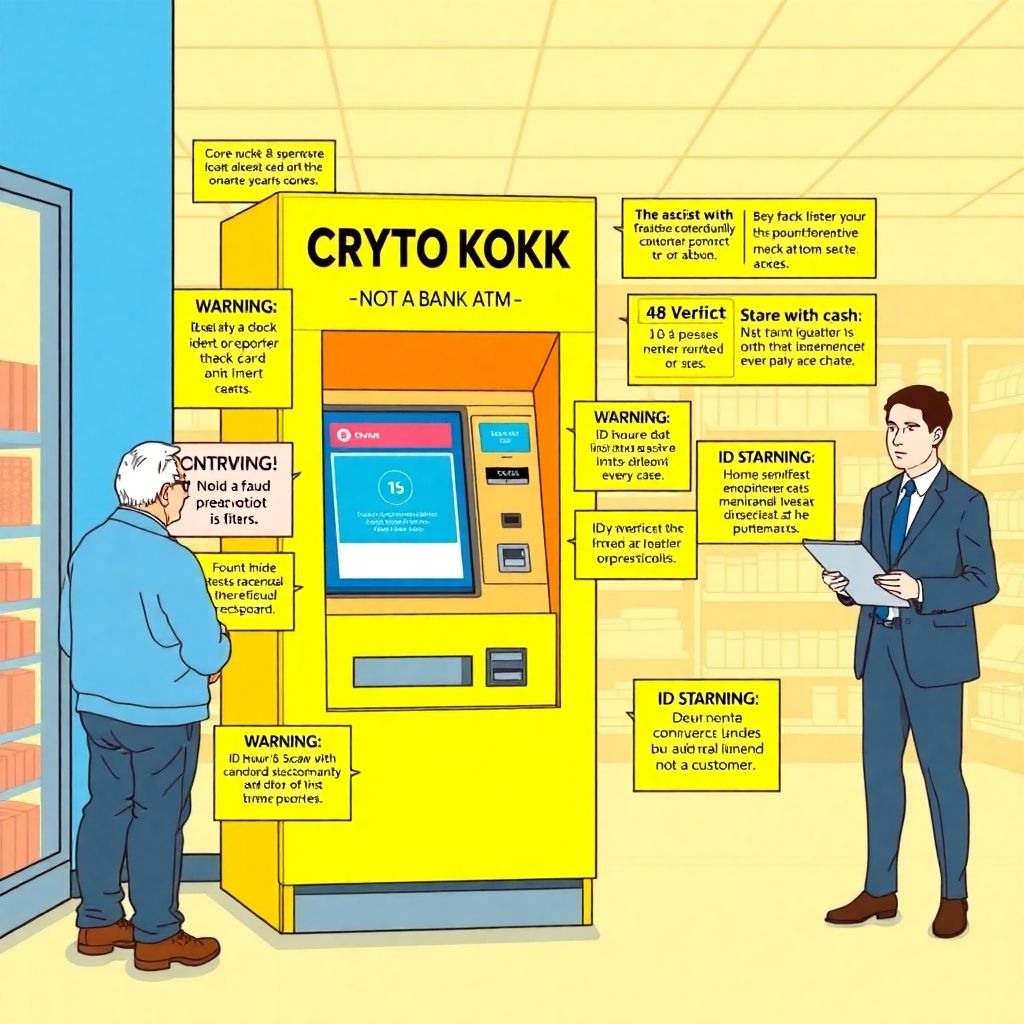
Crypto kiosk oversight is moving rapidly in Virginia, with a new bill tightening rules around the machines now sitting on the governor’s desk for approval. The proposed law would reshape how crypto kiosks – often marketed as “crypto ATMs” – operate across the state, introducing licensing, transaction limits, identity checks and a specific 48-hour fraud prevention hold aimed at protecting consumers from scams.
Under the legislation, all crypto kiosk operators would be required to obtain a state license, register their machines and pay associated fees. The bill establishes a formal regulatory framework where none existed before, turning what has been a largely unregulated niche into a supervised part of Virginia’s financial services landscape. The goal is to create a transparent system in which the state can identify kiosk operators, monitor activity and intervene more easily when fraud occurs.
A key provision restricts how these machines can be marketed. Operators would be barred from labeling their devices as “ATMs” or using traditional ATM-style branding and terminology. Lawmakers argue that this distinction is essential because the machines do not function like normal cash-dispensing bank terminals. Instead of withdrawing money from a bank account, users insert cash to purchase cryptocurrency that is then transferred to a digital wallet or an exchange account, a process many consumers still do not fully understand.
Delegate Michelle Maldonado, who introduced the bill, pointed to a series of fraud cases across Virginia that highlighted the risks. In one instance from Southwest Virginia, a victim lost 15,000 dollars after being tricked into feeding cash into a kiosk under false pretenses. Similar incidents have been reported in Fairfax County and other parts of the state. These cases, she argued, underscore how easily scammers can exploit confusion around crypto kiosks.
Current estimates suggest scams account for roughly 7% of all activity processed through crypto kiosks. While that share may appear modest, lawmakers see it as an early warning sign. Maldonado emphasized that crypto transactions are difficult – and often impossible – to reverse once funds are pushed into the blockchain ecosystem. Once the tokens are sent into an exchange or transferred to a scammer’s wallet, victims have virtually no recourse.
To address this, the bill lays out several layers of consumer protection. Operators would have to impose daily and monthly transaction caps to limit how much a customer can send through the machines within a specific period. All transactions, regardless of size, must include identity verification, ending the practice of low-threshold anonymous purchases at many kiosks. This measure aims both to deter bad actors and to make it easier to trace suspicious activity when it occurs.
One of the most notable safeguards is a 48-hour hold for new users. For first-time customers using a kiosk, transactions would not be fully released immediately. Instead, there would be a two-day window during which the funds could be halted or reversed if there is evidence of fraud or if the customer reports a suspected scam. Policymakers believe this delay could be critical in stopping losses when victims realize they have been misled shortly after a transaction.
The law would also mandate clear, visible warnings on every machine. These notices must alert users to common scam tactics, such as callers claiming to be law enforcement, government agencies, utility companies or romantic partners demanding payment via crypto kiosks. By confronting users with these warnings in real time, regulators hope some will pause and question suspicious instructions before inserting cash.
In addition, the bill requires operators to maintain mechanisms for issuing refunds when possible. While not all crypto transfers can be reversed, the legislation insists that when funds remain under the operator’s control or fall within the 48-hour hold period, consumers should have access to a straightforward process for recovering money sent under fraudulent circumstances. The state registration system will track who runs each kiosk, giving regulators a clearer path to enforcement.
Maldonado stressed that many users genuinely mistake crypto kiosks for traditional ATMs because the machines look and feel the same. They are often installed in convenience stores, gas stations and retail locations, with familiar touchscreens and cash slots. Yet the underlying service is entirely different: instead of withdrawing from a bank account that benefits from deposit insurance and banking regulation, users are converting cash into digital assets that typically lack comparable protections. This confusion makes it easier for scammers to instruct victims to “go to the nearest ATM” when in fact they mean a crypto kiosk.
Advocates for older adults have strongly supported the bill. AARP Virginia described the protections as urgently needed, warning that unregulated crypto kiosks have become a convenient tool for criminals preying on seniors. Older residents are disproportionately targeted with schemes involving bogus tax debts, supposed legal threats, tech-support impersonations and fabricated romantic relationships. In many of these scams, the fraudster pressures the victim to make payment through a nearby crypto machine, presenting it as a fast, anonymous way to resolve a fabricated crisis.
The organization pointed out that older adults often come from a banking culture built around physical branches, regulated ATMs and paper receipts. The shift to a digital asset purchased from a kiosk, sent somewhere on the blockchain and largely irreversible, can be difficult to grasp in the heat of a high-pressure scam. The new requirements for warnings, holds and ID checks aim to introduce friction into that process, giving at-risk consumers more time and more information before finalizing a transaction.
Maldonado has framed the legislation as a forward-looking response rather than a crackdown triggered by a massive wave of losses. With scam activity currently estimated at about 7% of kiosk business, she argued that policymakers still have time to act before misuse becomes entrenched. The purpose of the law, she said, is to put “guardrails and safeguards” in place early so that the problem does not escalate as the number of machines increases.
If the governor signs the bill, Virginia would join a growing number of jurisdictions working to bring crypto kiosks into a clearer regulatory perimeter. As these machines spread across shopping centers, gas stations and small businesses nationwide, states are grappling with how to balance innovation and access to digital assets with the need to protect consumers who may not fully understand what they are buying.
Beyond the immediate rules, the Virginia proposal highlights a broader trend: governments are beginning to treat physical crypto infrastructure – kiosks, point-of-sale systems and payment terminals – more like traditional financial services. Licensing, disclosure requirements and transaction monitoring, once reserved for banks and money transmitters, are being extended to firms operating at the intersection of cash and crypto.
For responsible kiosk operators, the new framework could offer long-term advantages. With licensing and clear consumer safeguards in place, reputable companies can differentiate themselves from fly-by-night actors and build trust with regulators and the public. Higher compliance standards may raise operating costs, but they can also create a more stable, predictable environment for businesses willing to invest in security and transparency.
For consumers, especially those new to digital assets, the legislation could change how crypto kiosks are perceived and used. Instead of anonymous, no-questions-asked cash machines, they would increasingly resemble regulated financial touchpoints, where identity checks, warnings and transaction caps are the norm. That may make impulse, high-risk or scam-driven transactions less likely, while still allowing legitimate users to buy crypto with cash.
The bill also raises important questions about education. Regulation alone cannot eliminate fraud, particularly in an area as complex and fast-moving as cryptocurrency. However, the visibility of state-mandated warnings on kiosks and the public debate around the law may spur broader awareness campaigns. Schools, senior centers, employers and financial counselors may increasingly incorporate guidance on crypto scams and kiosk safety into their outreach.
Other states will be watching Virginia’s implementation closely if the bill becomes law. Data gathered from the registration system, reports of attempted scams blocked by the 48-hour hold, and feedback from operators and consumers could shape similar efforts elsewhere. If the measures significantly reduce fraud without stifling legitimate use, they may become a template for national best practices in crypto kiosk oversight.
In the longer term, the Virginia initiative reflects a maturing attitude toward crypto within public policy. Rather than treating digital assets solely as speculative investments or as fringe payment tools, lawmakers are beginning to focus on the everyday touchpoints where ordinary people encounter crypto: kiosks in local stores, online exchanges integrated with banking apps, and payment options in retail environments. Regulation of these access points, rather than crypto technology itself, may prove to be one of the most effective ways to protect the public.
For now, the next step is decisive but procedural: the governor’s signature. Once that hurdle is cleared, kiosk operators will face a transition period to secure licenses, update machine interfaces with warnings, implement identity checks and configure systems to accommodate transaction caps and the 48-hour hold for new customers. Consumers, particularly in areas with high kiosk density, can expect to see noticeable changes in how these machines work and what information they present at the point of use.
As the number of crypto kiosks continues to grow, Virginia’s move underscores a central message to both industry and users: convenience and access cannot come at the expense of basic safeguards. By reframing these machines from unregulated “crypto ATMs” into licensed, monitored financial devices, the state is betting that a more controlled environment will slow scammers, preserve consumer confidence and set a standard for how physical crypto infrastructure should operate in a modern regulatory system.