
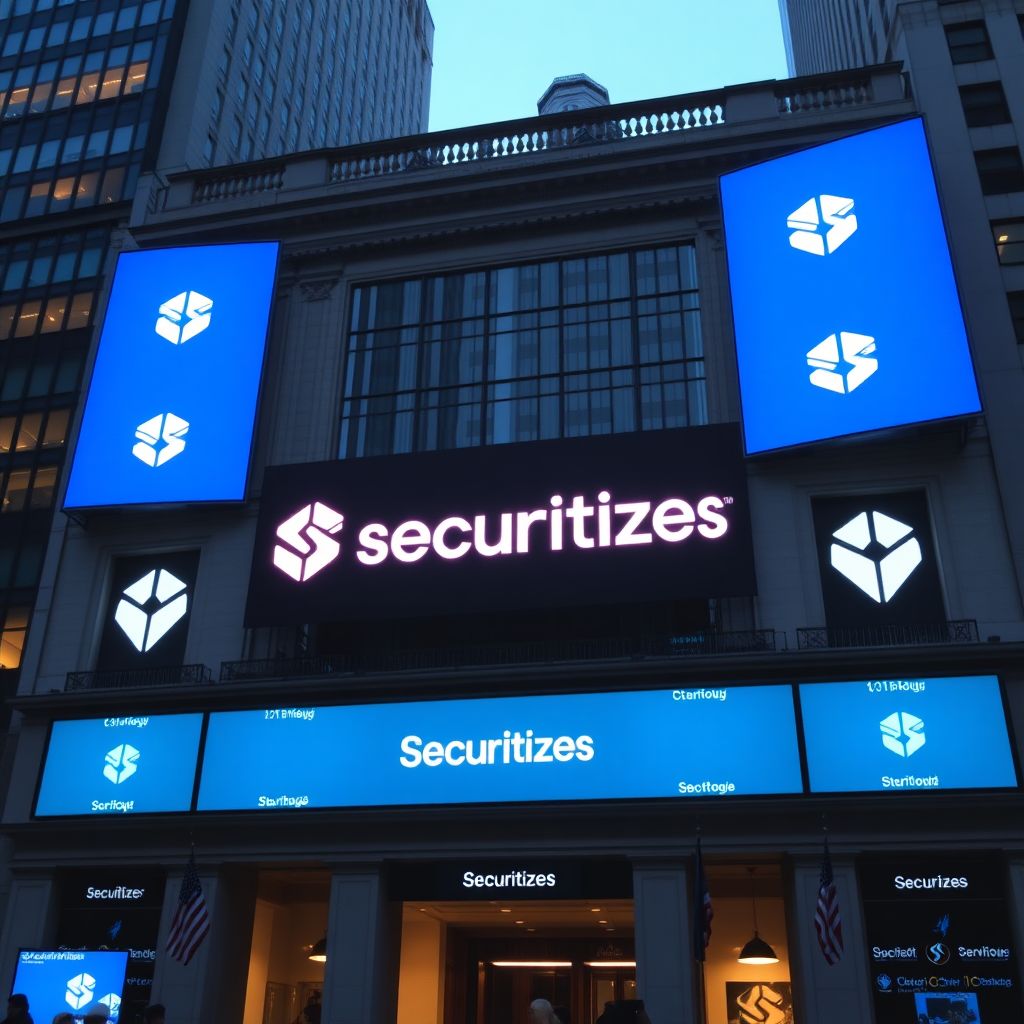
Wall Street’s Next Big Tokenization Trial: Securitize Steps Onto the Public Stage
Whether Wall Street’s enthusiasm for asset tokenization can turn into sustained investor demand for companies building this infrastructure will be tested in the coming days, as Securitize prepares for its public market debut.
Securitize, a BlackRock-backed platform focused on issuing and managing digital versions of real-world assets, plans to list on the New York Stock Exchange under the ticker “SECZ.” The move will follow the completion of its merger with a special purpose acquisition company (SPAC) supported by Cantor Fitzgerald, known as Cantor Equity Partners II.
The deal cleared a key hurdle this week. Holders of less than 30% of Cantor Equity Partners II’s common shares chose to redeem their stock, a relatively low redemption rate by recent SPAC standards. That leaves more capital in the vehicle and puts Securitize on track to receive approximately 400 million dollars in proceeds when the transaction closes, according to the company’s expectations.
For Securitize, those funds are intended to fuel expansion of its tokenization platform, which converts traditional instruments such as equity, funds, and other real-world assets into digital tokens issued and recorded on blockchains. These tokens are designed to represent legally enforceable ownership claims, combining elements of regulated finance with the programmability and settlement efficiency of distributed ledger technology.
The backing of BlackRock has made Securitize a focal point of Wall Street’s tokenization narrative. Large asset managers and banks have spent the last two years experimenting with tokenized treasury funds, money market instruments, and other yield-bearing products, framing them as a more efficient way to issue, trade, and settle assets. Securitize’s public listing will serve as one of the first direct tests of whether stock market investors are prepared to value a pure-play tokenization firm in line with that institutional rhetoric.
At the same time, the deal structure itself says a lot about current market conditions. SPACs were once associated with speculative high-growth technology companies and aggressive valuations. Today, redemptions are often high, and many such vehicles struggle to find targets or close mergers. The fact that fewer than 30% of Cantor Equity Partners II shareholders opted to redeem suggests a measure of confidence-either in Securitize’s business, the broader tokenization theme, or both.
Securitize’s core proposition is to make it easier and faster to issue and manage regulated securities on blockchain rails. That includes onboarding investors according to know-your-customer and anti-money laundering rules, handling corporate actions like dividends and redemptions through smart contracts, and enabling secondary trading on compliant venues. The firm has positioned itself as a bridge between familiar financial products and the emerging ecosystem of on-chain assets.
For Wall Street, tokenization is not just a buzzword but a response to longstanding structural frictions. Traditional settlement systems are fragmented, slow, and reliant on multiple intermediaries for clearing, custody, transfer agency, and recordkeeping. Tokenized instruments promise near-instant settlement, 24/7 market access, and automated compliance checks, potentially reducing costs and operational risk. If Securitize can turn these theoretical efficiencies into recurring revenue and tangible growth, public investors may see it as a leveraged play on the modernization of capital markets.
However, the public listing also exposes Securitize to the realities of quarterly earnings scrutiny and shifting market sentiment toward crypto and blockchain technologies. Investor appetite for anything connected to digital assets has been highly cyclical, surging during bull markets and contracting sharply during downturns. The company will need to demonstrate diversified revenue streams, clear paths to scale, and resilience to volatility in underlying crypto markets, even as it focuses on regulated, real-world assets rather than speculative tokens.
Regulation will be another defining factor. Tokenized securities sit at the intersection of securities law, digital asset rules, and evolving guidance on custody and market infrastructure. Securitize’s value proposition partly rests on its ability to navigate these complexities and provide compliant, institution-grade platforms. Any shifts in regulatory posture, enforcement priorities, or cross-border rules could either unlock new opportunities or introduce costly constraints.
For institutions evaluating tokenization strategies, Securitize’s debut could offer a reference point on how the equity market prices this kind of infrastructure. A strong reception might encourage more capital into tokenization startups and accelerate partnerships between traditional financial institutions and blockchain-native firms. A tepid response, by contrast, could signal that the public market still views tokenization as an unproven or niche technology despite the backing of major names.
There is also a competitive dimension. Securitize is not the only company pursuing tokenization of real-world assets; banks, fintechs, and crypto-native platforms are racing to build their own issuance and distribution systems. Public status could give Securitize advantages in credibility, governance transparency, and access to capital, but it will also expose its metrics and strategy to rivals and potential partners alike.
Beyond institutional dynamics, the listing raises questions about how quickly tokenization will touch everyday investors. In theory, tokenized assets could make fractional ownership of traditionally illiquid instruments-such as private equity, real estate, or credit products-more accessible, provided regulatory frameworks and investor protection rules allow it. If Securitize uses its fresh capital to broaden the range of tokenized offerings and simplify access channels, it could help move tokenization from a back-office efficiency play to a front-facing investment experience.
From a macro perspective, Securitize’s market debut functions as a barometer for how far the integration of blockchain and traditional finance has really progressed. Over the past decade, many blockchain projects have promised to “disrupt Wall Street.” Tokenization represents a more evolutionary approach: upgrading existing products and processes rather than replacing them outright. The valuation and performance of SECZ will reveal how much investors believe in this pragmatic, incremental path.
Risk factors remain substantial. The business depends on broad adoption of blockchain-based infrastructure by conservative institutions, on sustained trust in the security and reliability of tokenized systems, and on deep integration with legacy market plumbing. Any high-profile security breach, operational failure, or legal dispute in the tokenization space could undermine confidence and weigh on Securitize’s prospects, regardless of its own role.
Yet that is precisely why this listing is being watched so closely. If Securitize can secure a stable foothold as a public company and convert its institutional relationships into durable growth, it would strengthen the case that tokenization is not just a theoretical efficiency gain, but a viable business model capable of supporting public-equity-level scrutiny. If it struggles, it may indicate that tokenization’s promise, while real, is still early relative to market expectations.
As trading under the “SECZ” ticker is expected to begin, both traditional investors and digital asset specialists will be watching the first days and weeks of performance as an early verdict. For Wall Street, this is not simply another SPAC merger: it is a live experiment in whether the infrastructure of tomorrow’s markets can attract meaningful capital today.