
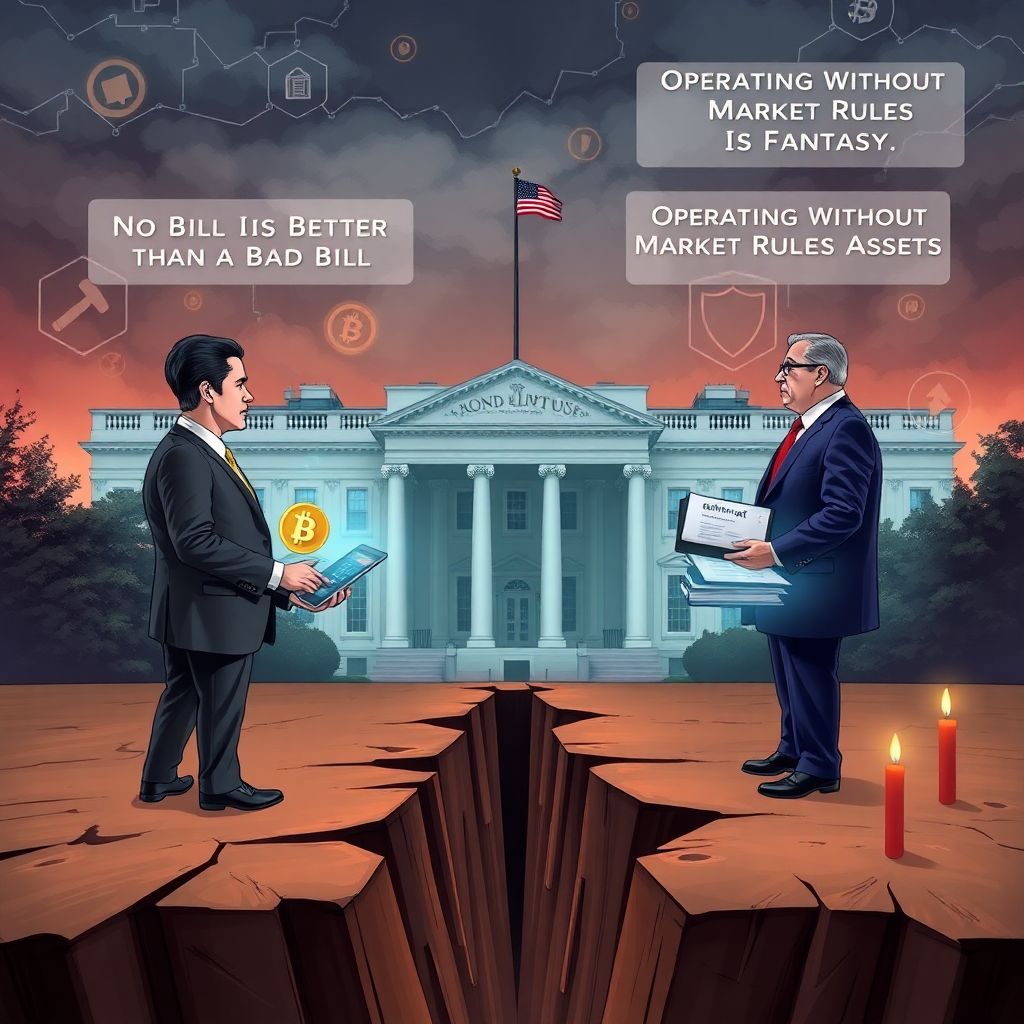
White House Crypto Council Director Says Operating Without Market Rules Is ‘Fantasy’
The simmering conflict inside the digital asset industry over how—and how fast—to regulate crypto burst into the open again this week, as a senior White House official sharply criticized Coinbase’s decision to walk away from a key market structure bill in the U.S. Senate.
Patrick Witt, executive director of the President’s Council of Advisors on Digital Assets, used a post on X on Tuesday to directly challenge Coinbase CEO Brian Armstrong’s stance that “no bill is better than a bad bill.” The phrase has become a rallying line for parts of the industry that prefer to block or slow imperfect legislation rather than accept compromise now.
Witt argued that such a posture is unrealistic for a sector that increasingly sits at the center of global finance. According to him, the idea that crypto can flourish indefinitely without a comprehensive market framework is “fantasy,” especially as digital assets mature beyond a niche technology and move deeper into mainstream capital markets.
His critique came just days after Coinbase abruptly withdrew its support for the Senate’s CLARITY Act—a legislative proposal aimed at establishing clearer rules for how crypto assets are traded, custodied, and supervised. On January 14, Armstrong publicly announced that the exchange no longer backed the bill, joining several other industry actors who have grown wary of provisions they view as overreaching or incomplete.
In his X post, Witt framed Armstrong’s statement as emblematic of an industry that still believes it can pick and choose when and how rules apply. “What a privilege it is to be able to say those words thanks to President Trump’s victory, and the pro-crypto administration he has assembled,” Witt wrote, implying that the current political climate is more favorable to digital assets than in previous years—and that the industry is squandering a rare opportunity to shape regulation on relatively friendly terms.
The clash underscores a deepening split among crypto companies, investors, and advocates. One camp argues that accepting a compromise bill now—even with flaws—is strategically smarter than waiting for a future Congress or administration that may be more skeptical of digital assets. The other camp, which Coinbase has increasingly come to represent, insists that enshrining a weak or ambiguous framework into law could entrench bad precedents, stifle innovation, or expose firms to crippling uncertainty.
From the administration’s perspective, however, the time for indefinite delay appears to be over. Witt’s comments signal growing frustration in Washington with what many policymakers see as a pattern: intense industry lobbying for “clarity,” followed by resistance when concrete proposals finally move forward. Lawmakers and regulators are increasingly vocal that a multitrillion-dollar market cannot be left to operate in a gray zone forever.
The dispute over the CLARITY Act also illustrates a larger strategic dilemma for crypto firms. Accepting imperfect legislation now could stabilize the environment for exchanges, stablecoin issuers, and DeFi-adjacent businesses, enabling them to scale with more predictable compliance obligations. At the same time, the wrong wording on issues like asset classification, custody standards, or stablecoin reserves could lock in regulatory burdens that are difficult to unwind later.
For companies like Coinbase, whose long-term business model depends on the U.S. staying competitive as a crypto hub, the stakes are high. Armstrong has repeatedly argued that the U.S. risks pushing innovation offshore if it adopts rigid or hostile policies. His withdrawal from the CLARITY Act appears to be a bet that the industry can still negotiate a better deal, rather than settling for a framework he sees as flawed.
Witt’s counterargument is that this strategy underestimates political and regulatory momentum. In his view, there is now bipartisan recognition that digital assets interact with consumer protection, financial stability, and national security concerns. That makes some form of comprehensive regulation inevitable—and delays may only invite harsher responses if future crises, hacks, or fraud scandals occur under today’s patchwork rules.
For market participants, the debate has practical consequences. Institutional investors have repeatedly cited regulatory uncertainty as a key barrier to broader adoption. Traditional financial firms are more likely to expand into tokenization, custody, and crypto trading when they can rely on stable, well-defined legal obligations. Retail users, too, benefit when disclosure standards, listing rules, and protection mechanisms are not left to exchange policies alone.
At the same time, crypto’s original ethos—decentralization, openness, and resistance to centralized control—makes many builders deeply wary of broad regulatory mandates. They fear that poorly designed laws could criminalize core activities like self-custody, privacy-preserving tools, or permissionless smart contracts, even if unintentionally. This philosophical tension continues to shape how the industry reacts to every major legislative proposal.
The current confrontation between Coinbase and the White House advisor therefore extends beyond one bill. It reflects a fundamental question: Is crypto still a fringe alternative to the existing system, or has it grown into such a critical part of that system that it must submit to similar levels of oversight? Witt’s assertion that operating without market rules is a “fantasy” clearly leans toward the latter view.
Looking ahead, several scenarios are possible:
– If industry players maintain a hard line against anything they consider a “bad bill,” Congress may struggle to pass any comprehensive framework in the near term. That would likely leave regulators to continue enforcing existing securities, commodities, and banking laws in a piecemeal fashion—exactly the situation many firms say they want to escape.
– If major exchanges and issuers decide that predictability outweighs ideological purity, they may return to the negotiating table, accept compromises on issues like disclosures and registration, and push for amendments later rather than blocking the entire package.
– A third path is incremental: narrower bills focused on specific areas such as stablecoins, custody, or anti-money laundering, which could build a mosaic of rules over time rather than a single sweeping statute.
Whichever route prevails, the tone coming from the administration, as reflected in Witt’s comments, suggests that an era of improvisation is closing. The message to the industry is that the window to shape rules from a position of relative strength will not stay open indefinitely. As digital assets become more intertwined with pensions, treasuries, and global payment flows, regulators are less likely to treat them as an experimental niche.
For builders, investors, and users, this moment demands clear strategic thinking. Pushing back against legislation may protect short-term commercial interests or ideological positions, but it may also increase the risk that the next wave of rules is drafted with less input from those who understand the technology best. Conversely, embracing compromise carries its own dangers if the resulting laws fail to reflect the nuances of decentralized systems.
In that sense, the clash between Brian Armstrong’s “no bill is better than a bad bill” and Patrick Witt’s “operating without rules is fantasy” captures the core tension of crypto’s transition from insurgent technology to established financial infrastructure. The industry is being forced to decide not only what kind of regulation it can live with, but what kind of role it wants to play inside the broader economic system in the years ahead.