
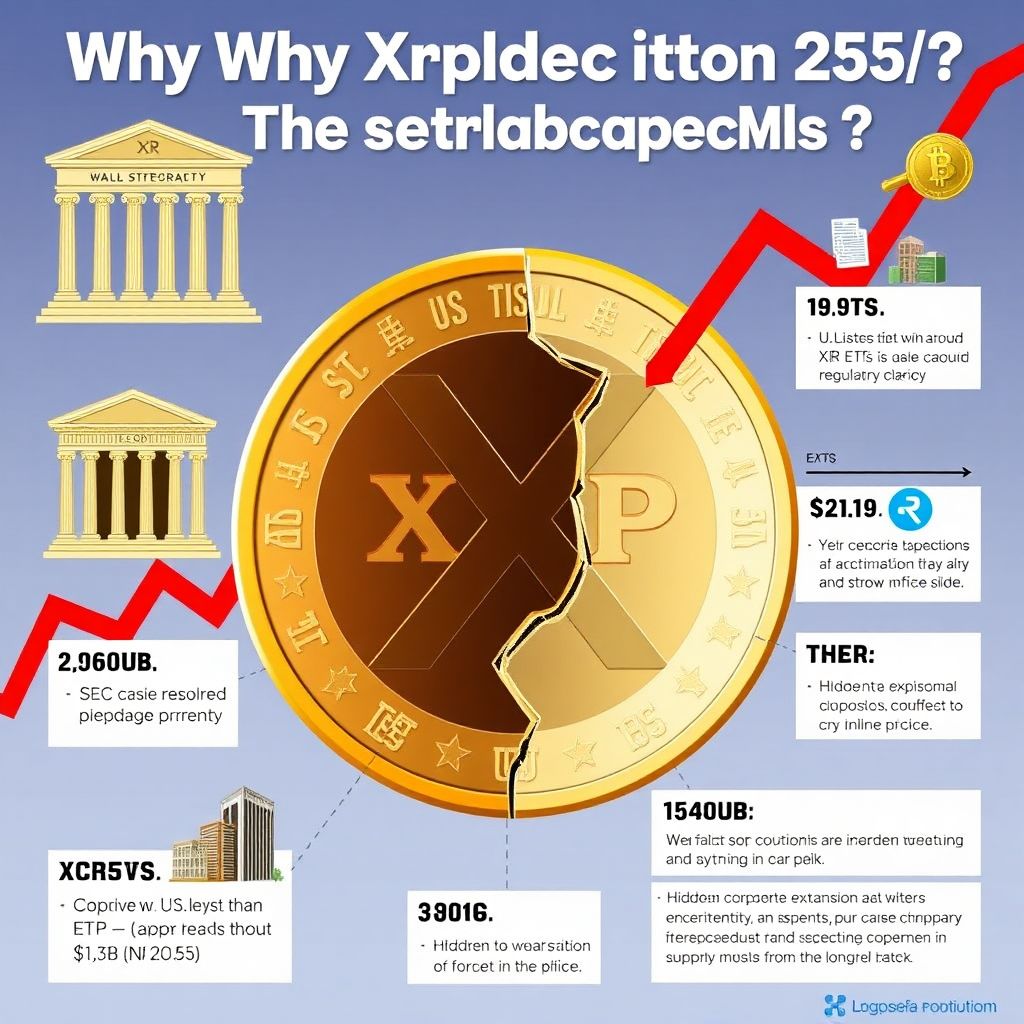
Why XRP plunged ~25% in 2025 despite its “best year ever” on paper
XRP’s 2025 price action has been a brutal reminder that strong fundamentals and positive news do not always translate into rising token prices. While Ripple notched major legal, regulatory, and business milestones, XRP collapsed by almost 25% during the year and is down around 50% from its 2025 peak.
By late December, XRP had slumped to about $1.85, wiping out more than $50 billion in market value compared with its local highs. This reversal came in spite of what many investors considered the most constructive year for the Ripple ecosystem since the token’s launch.
Below is a breakdown of what went right for Ripple – and why XRP still crashed.
—
A landmark legal victory that didn’t save the price
One of the headline events of 2025 was the conclusion of Ripple’s long-running legal battle with the U.S. Securities and Exchange Commission (SEC). The regulator, led by Chair Gary Gensler, had accused Ripple of raising roughly $1.33 billion through unregistered securities sales.
The end of this multi‑year lawsuit was widely expected to remove a major overhang on XRP. For years, uncertainty around whether XRP could be treated as a security in the U.S. weighed on institutional adoption, listings, and long-term confidence.
When the case finally wrapped up, many traders assumed that regulatory clarity would trigger a sustained rerating of XRP. In the short term, that view looked correct: the token rallied sharply into and immediately after the resolution.
However, that optimism proved fleeting. Once the legal outcome was fully priced in, the market shifted from “relief mode” back to macro reality: a broader crypto environment that was deteriorating, and a technical setup that was flashing warning signs.
—
XRP ETFs: strong inflows, weak price
Another major bullish development was the approval and launch of several U.S.-listed XRP exchange-traded funds (ETFs). These products quickly gathered more than $1.3 billion in inflows after going live in November, a pace that even surpassed Solana ETFs, which had received regulatory approval a few weeks earlier.
From a structural standpoint, this was a huge win for XRP:
– It opened the door for more traditional and regulated investors to gain exposure.
– It created new on-ramps for capital, potentially increasing liquidity and depth.
– It signaled a degree of regulatory acceptance that would have been hard to imagine a few years ago.
Yet despite the strong ETF inflows, the spot price slid. This disconnect highlights an important nuance: ETF demand is just one flow among many. In a risk-off environment, selling pressure from existing holders and traders can overwhelm inflows from new products.
In other words, the ETFs likely softened the blow but could not fully counteract the broader market downturn and profit-taking behavior.
—
Aggressive expansion: acquisitions and a massive valuation
Throughout 2025, Ripple doubled down on building out its ecosystem through acquisitions and strategic investments. The company bought several firms, including:
– Hidden Road
– Rail
– Palisade
– GTreasury
These deals were aimed at strengthening Ripple’s position in institutional finance, payments, and treasury management. On top of that, Ripple secured a substantial $500 million funding round at a roughly $40 billion valuation – a strong vote of confidence from investors in the company’s long-term roadmap.
From a fundamentals perspective, this activity suggests a growing, well-capitalized business expanding into more segments of the financial system. However, equity-like growth in the underlying company does not automatically flow through to the token’s price in a clean, linear way.
Crypto markets often price narratives, expectations, and liquidity conditions more strongly than corporate moves that may take years to materially impact token demand or utility. As a result, even as Ripple the company strengthened, XRP the token continued to slide.
—
RLUSD: Ripple’s stablecoin quietly becomes a heavyweight
Another underappreciated bright spot in 2025 was the growth of Ripple’s U.S. dollar stablecoin, RLUSD. By the end of the year, the stablecoin’s assets had swelled to more than $1.4 billion, positioning it among the more significant players in the stablecoin sector.
The growth of RLUSD signals reputable demand for Ripple’s infrastructure. Stablecoins typically rely on robust rails, compliance, and integrations with financial partners. Ripple’s ability to attract this capital is a strong indicator of trust and product-market fit in certain niches.
However, the success of a stablecoin doesn’t automatically pump the native token. In some models, more on-chain activity and deeper liquidity around a stablecoin can indirectly increase demand for the base asset. But that transmission mechanism is complex, and in a bearish environment, it tends to be overshadowed by macro sentiment and speculative positioning.
—
A banking license that could reshape Ripple’s role – eventually
Late in the year, Ripple also secured a banking license in the United States. This authorization opens the door for the company to offer regulated financial services domestically, including:
– Custody solutions for RLUSD
– Services for portfolio companies like GTreasury
– Potential institutional products under the Ripple Prime umbrella
Securing a banking license is a huge barrier-to-entry achievement that could solidify Ripple’s position at the intersection of traditional finance and digital assets. Over time, this might create additional, more predictable demand for Ripple’s products and services.
Still, markets tend to ask a simple question: “What does this do for the token right now?” When the macro backdrop is deteriorating and traders are de-risking across the board, long-term structural wins often fail to support prices in the short term.
—
Macro headwinds: a red year for Bitcoin and altcoins
The single biggest factor behind XRP’s decline in 2025 was not Ripple news at all – it was the overall state of the crypto market.
Bitcoin dropped by nearly 10% over the year, and the altcoin complex fared even worse. The total cryptocurrency market capitalization fell from a peak of around $4.2 trillion to roughly $2.8 trillion, representing a deep and broad-based drawdown.
In such conditions, correlations move toward one. Even strong narratives and positive project-specific news struggle to break free from:
– Shrinking liquidity across exchanges
– Lower risk appetite from both retail and institutions
– Systematic unwinding of leveraged positions
– Rotations into safer or less volatile assets
XRP, as a large-cap altcoin, was not spared. Regardless of its unique catalysts, it was pulled down by the same gravitational forces dragging the rest of the market lower.
—
The “Trump trade” unwinds: buy the rumor, sell the fact
XRP’s path to its 2025 highs was tightly intertwined with U.S. political developments. After Donald Trump’s election victory in November 2024, the token surged as traders bet on a potentially more crypto-friendly regulatory environment.
Within weeks of the election, XRP exploded from about $0.49 to roughly $3.39 – an extraordinary move fueled by:
– Speculation that regulation would quickly ease
– Hopes for aggressive pro-crypto policy shifts
– Momentum traders piling into the rally
But what the market gave on rumor, it took away on reality. As regulatory change proved slower and more nuanced than hoped, and as macro pressures intensified, traders began to lock in profits. The classic pattern played out:
– Pre-event: Investors buy aggressively into the expected positive news.
– Post-event: Once the news materializes, the narrative loses its novelty; existing holders sell into late buyers, and the price adjusts to a less euphoric “new normal.”
XRP’s 2025 downturn was, to a large extent, the hangover from that election-driven euphoria.
—
Technical damage: a double top points lower
Beyond narratives and fundamentals, XRP’s chart also turned decisively bearish.
The token formed a large double-top pattern around the $3.39 zone, with a neckline at approximately $1.61. In classical technical analysis, this setup is often interpreted as a reversal signal: once price breaks below the neckline, it can trigger further selling, algorithmic activity, and stop-loss cascades.
The break of the $1.61 support reinforced the notion that the impulsive Trump-election rally had fully exhausted. This technical picture:
– Confirmed to many traders that the uptrend was over
– Encouraged short-sellers to be more aggressive
– Shook the confidence of late buyers who entered near the highs
Together with weak market-wide sentiment, the double-top structure acted as a roadmap for more downside in the weeks that followed.
—
Why fundamentals and token price can move in opposite directions
The XRP story in 2025 is a textbook case of how fundamentals and token price can temporarily decouple. Several forces contributed to this:
1. Timing mismatch
Legal clarity, licenses, and acquisitions tend to play out over years. Trading flows, however, can reverse in days or weeks.
2. Overcrowded narrative
By the time the SEC case ended and ETFs launched, much of the “good news” was already priced in after a huge rally from sub-$0.50 levels.
3. Macro overrides micro
When the entire asset class is selling off, even the strongest project-specific catalyst may only cushion, not reverse, the downtrend.
4. Speculative overhang
Rapid moves from $0.49 to $3.39 create large unrealized profits. In a risk-off climate, holders cash out, flooding the market with supply.
Investors who focus only on headlines – “lawsuit over,” “ETFs approved,” “banking license obtained” – without considering macro and positioning were especially vulnerable to this disconnect.
—
What could change XRP’s trajectory going forward?
Looking ahead, several factors may determine whether XRP continues falling, stabilizes, or begins to recover:
– Macro environment
A renewed uptrend in Bitcoin and a recovery in total market cap would likely benefit XRP, as correlations remain high.
– Real utility and flows
If Ripple’s products – RLUSD, institutional payment rails, treasury solutions – generate sustained, on-chain demand that structurally requires XRP, that could provide more fundamental backing over time.
– Regulatory follow-through
Post-lawsuit, clearer guidance and predictable rules in the U.S. and other major jurisdictions could help unlock new institutional adoption.
– Technical levels
Whether XRP can reclaim and hold key zones like the former neckline around $1.61 will be closely watched by traders.
– Investor sentiment reset
After a major boom-and-bust cycle, markets often need a period of consolidation where over-optimistic expectations are flushed out and long-term holders reaccumulate.
—
What XRP investors can learn from 2025
For both short-term traders and long-term holders, XRP’s 2025 performance offers several lessons:
– Positive news is not enough if the broader market is in a downtrend.
– Major rallies driven by “narrative hype” (like election trades) often end with sharp reversals.
– Legal victories and corporate growth are bullish, but their impact on token price is delayed and filtered through macro conditions.
– Technical structures, such as double tops at key resistance zones, should not be ignored, especially after parabolic moves.
In essence, XRP did not crash because 2025 was a bad year for Ripple as a company. It crashed because the token entered the year priced for perfection after a speculative surge, just as the crypto market turned lower – and because investors, after buying the rumor for months, finally started selling the fact.