
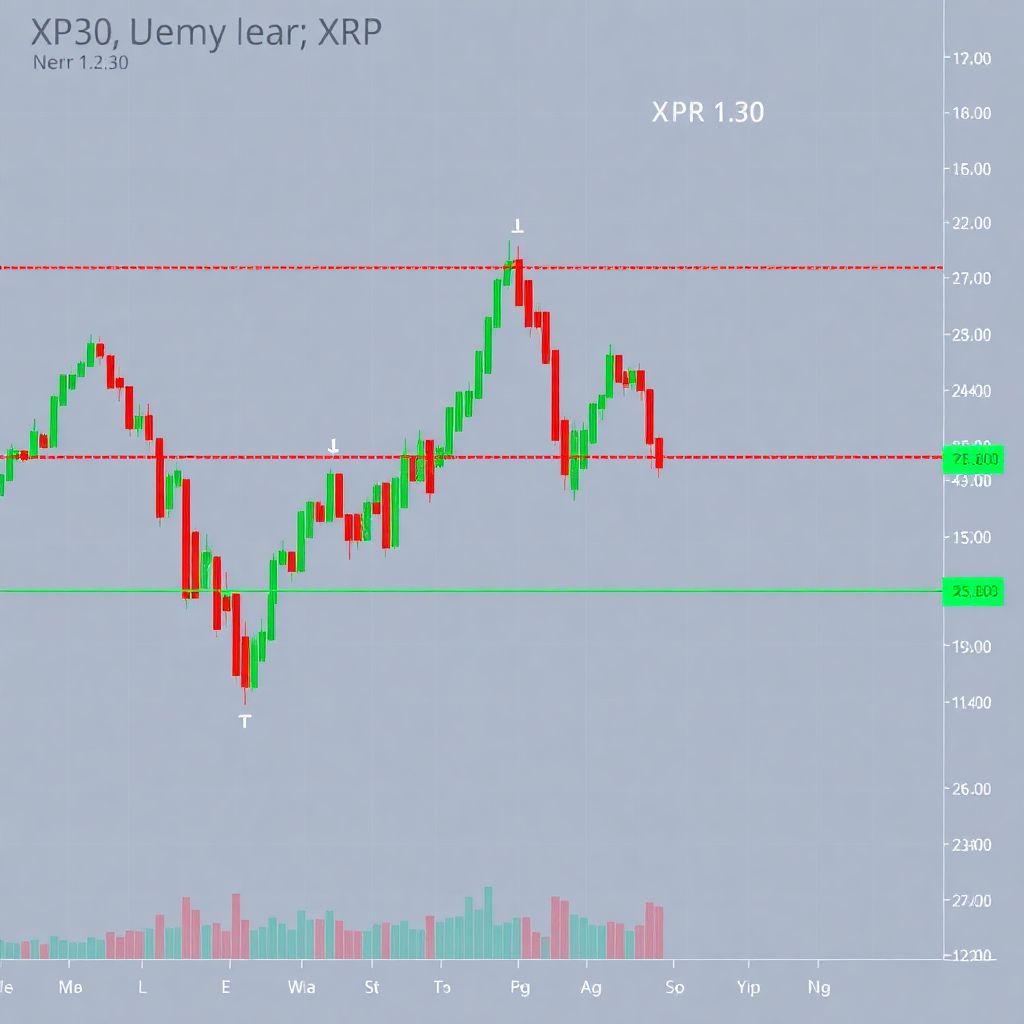
XRP price carves out Gartley pattern near $1.30: Is a bullish bottom taking shape?
XRP is currently sketching out what appears to be a classic Gartley harmonic pattern just above the $1.30 area, hinting that a medium‑term bullish base could be forming as price continues to churn within a broader sideways range.
After several weeks of back‑and‑forth trading between higher‑timeframe resistance around $1.80 and major structural support near $1.20, XRP is shifting from simple range rotation into a more structured, pattern‑driven consolidation. This kind of environment is often where harmonic formations, including the Gartley, tend to emerge and mature.
Key technical takeaways for XRP
– The developing Gartley pattern is anchored around support in the $1.20-$1.30 region.
– Defending this support is essential for keeping the bullish harmonic scenario intact.
– If the pattern completes, upside projections point toward a substantial leg D rally.
– Failure below $1.20 would invalidate the structure and open room for a deeper correction.
How the current range favors harmonic pattern development
For months, XRP has mostly traded sideways rather than trending aggressively. Price has repeatedly traveled between resistance near $1.80 and support near $1.20, creating a well‑defined horizontal range. Instead of clear trending momentum, the market has displayed a rotational character: sellers step in near the top of the range, buyers emerge near the bottom, and price oscillates between these zones.
This type of rotational action is fertile ground for harmonic setups because it creates multiple measured swing points. Instead of a one‑way impulsive move, you get a series of controlled advances and pullbacks, each reacting around Fibonacci retracement and extension levels. These reactions help outline the X, A, B, C, and eventually D legs of a Gartley structure.
Fibonacci reactions supporting the Gartley scenario
The latest corrective phase in XRP saw price reject the 0.618 Fibonacci retracement of a prior upswing, a textbook level for harmonic traders watching for Gartley formations. After this rejection, XRP slipped under a local Fibonacci support band but has not yet broken the key macro support near $1.20.
The way price has respected these Fibonacci levels is important. Harmonic patterns are not based on arbitrary swings; they rely on proportion and symmetry derived from Fibonacci ratios. Recent XRP moves – including the reaction at the 0.618 level – fit the profile of a market tracing out the internal legs of a Gartley.
Breaking down the Gartley structure on XRP
In harmonic analysis, a standard Gartley pattern unfolds across five key points: X, A, B, C, and D. The structure typically consists of:
– An initial impulse from X to A
– A corrective pullback from A to B
– A secondary push from B to C
– A final retracement from C to D, where the high‑probability reversal zone is anticipated
XRP appears to be progressing through the later stages of this framework, with multiple clear pivots already in place. These pivots show strong reactions at Fibonacci retracement zones, giving additional credibility to the idea that a structured harmonic pattern, rather than random noise, is forming.
The market now seems to be working through leg C, an important phase that often sets the stage for the eventual drive into leg D – the area where bullish traders typically expect a more impulsive move higher.
Why $1.20-$1.30 matters so much
For the bullish Gartley thesis to remain valid, XRP needs to defend the broader support cluster around $1.20. This zone is serving as the critical line in the sand:
– Staying above $1.20 maintains the pattern symmetry and preserves the bullish reversal potential.
– A decisive breakdown and acceptance below $1.20 would undermine the harmonic structure and greatly increase the odds of a deeper correction.
In other words, the $1.20 region is not just another support level – it is the technical invalidation point for the developing setup. As long as price continues to react constructively around this region and the nearby 0.618 Fibonacci area, the case for a bullish bottom scenario holds.
Market psychology behind the pattern
Harmonic patterns such as the Gartley tend to form when the market is uncertain and range‑bound. During these phases, both bulls and bears repeatedly test key liquidity zones and technical levels, searching for directional conviction.
XRP’s repeated responses around Fibonacci retracements suggest that market participants are paying close attention to these zones. Buyers are attempting to establish a floor near the lower boundary of the range, while sellers are active closer to resistance. This ongoing tug‑of‑war creates the measured swings needed for harmonic structures to develop.
The formation of a potential bullish bottom at $1.30 is therefore as much about market psychology as it is about geometry: it reflects a gradual shift from fear and profit‑taking toward accumulation and risk‑taking by buyers willing to step in at support.
Bullish scenario: Path toward leg D and potential upside
If XRP successfully completes leg C while maintaining support in the current technical region, the probability of a bullish push toward leg D increases significantly. Based on common Gartley projections, a completed pattern from these levels could imply an advance of around 60% from the current price zone.
This projected move aligns with the upper boundaries of the existing range, including the resistance band near $1.80 and possibly slightly beyond. Importantly, the bullish outlook does not require an explosive breakout through the range immediately. Instead, it suggests a structured, step‑by‑step recovery characterized by:
– Higher lows forming above $1.20
– Gradual expansion in trading volume on rallies
– Ongoing respect of key Fibonacci retracements during pullbacks
If these conditions are met, they would indicate that buyers are gaining confidence and positioning ahead of a potentially larger, trend‑defining move.
Bearish scenario: What invalidation would look like
Traders should also be prepared for the alternative. If XRP fails to hold the $1.20-$1.30 region and begins to accept lower prices with growing volume, the harmonic narrative weakens considerably. Invalidation signs could include:
– A daily or weekly close well below $1.20 followed by continued downside follow‑through
– Failure of rebounds to reclaim broken support, turning it into resistance
– Breakdown of the recent swing structure, with lower lows and lower highs dominating
In such a case, the assumed bullish bottom would be negated, and the market could shift into a more aggressive corrective phase, potentially targeting lower historical support zones. For traders relying on the Gartley thesis, this would be the signal to reassess risk exposure.
How traders and investors might approach this setup
Different market participants may react to the developing Gartley in different ways:
– Short‑term traders might look for intraday entries around the $1.20-$1.30 support area with tight invalidation below the key zone, aiming to capture the early stages of leg C or the start of leg D.
– Swing traders could wait for clearer confirmation, such as a strong bounce from support accompanied by higher volume and a break of recent minor highs, before positioning for a potential 60% move.
– Longer‑term investors may simply view the pattern as an indication that the downside risk is becoming more defined, potentially using this range as an accumulation area if they believe in XRP’s broader fundamental story.
Regardless of strategy, risk management remains crucial. Harmonic patterns, even when well‑defined, can fail if broader macro conditions or sentiment shift abruptly.
Role of broader market conditions
While the Gartley formation is a compelling standalone technical structure, XRP does not trade in isolation. Broader crypto market behavior, risk appetite in traditional markets, and regulatory headlines can all influence whether this potential bullish bottom actually holds.
– A risk‑on environment across digital assets could provide the liquidity and momentum needed to power XRP through leg D and back toward range resistance.
– Conversely, a sharp risk‑off episode or negative sector‑wide news could short‑circuit the pattern, dragging price below critical support regardless of how clean the harmonic structure appears.
Traders should therefore view the Gartley as one piece of a larger puzzle, integrating macro context, sentiment, and volume dynamics into their decision‑making.
Signs that the bullish bottom is truly developing
To gauge whether a sustainable bullish bottom is actually forming near $1.30, several confirming factors would be helpful:
1. Consistent defense of $1.20 support with multiple rejections of lower prices.
2. A sequence of higher lows on the daily chart, suggesting accumulation.
3. Increasing volume on upswings, with selling pressure weakening on pullbacks.
4. Respect of Fibonacci retracements during corrections, preserving harmonic symmetry.
5. Improving momentum indicators, such as RSI moving from oversold toward neutral or bullish regions.
If these elements begin to align, it would strengthen the argument that the developing Gartley pattern is not only technically valid, but also being supported by real buying interest and improving sentiment.
Conclusion: A constructive structure, but confirmation still needed
From the standpoint of technical structure, price action, and range behavior, XRP’s developing Gartley pattern suggests that a bullish bottom could be taking shape around the $1.30 zone. As long as the market holds above the higher‑timeframe support at $1.20 and continues to honor the 0.618 Fibonacci region, probabilities lean toward the eventual completion of leg C followed by a calculated advance toward leg D.
However, until confirmation arrives in the form of sustained higher lows, stronger volume, and a more decisive push away from support, the setup remains a potential rather than a guarantee. Traders and investors tracking XRP should therefore balance the attractive upside of a completed Gartley pattern against the necessity of disciplined risk control if the pivotal $1.20 support ultimately fails.