
Before we even talk about APY, APR and “real yield”, it’s worth admitting one thing: most people in DeFi don’t lose money because of malicious smart contracts, they lose it because they misunderstand how returns are calculated. Numbers look huge, buttons are green, and suddenly that “safe” 120% APY pool quietly bleeds you out via token emissions, impermanent loss or hidden lockups. Let’s unpack the signposts of DeFi returns так that you can read them like an expert, not like a victim of marketing copy.
—
Why DeFi Return Metrics Confuse So Many People
APY vs APR: the core misunderstanding
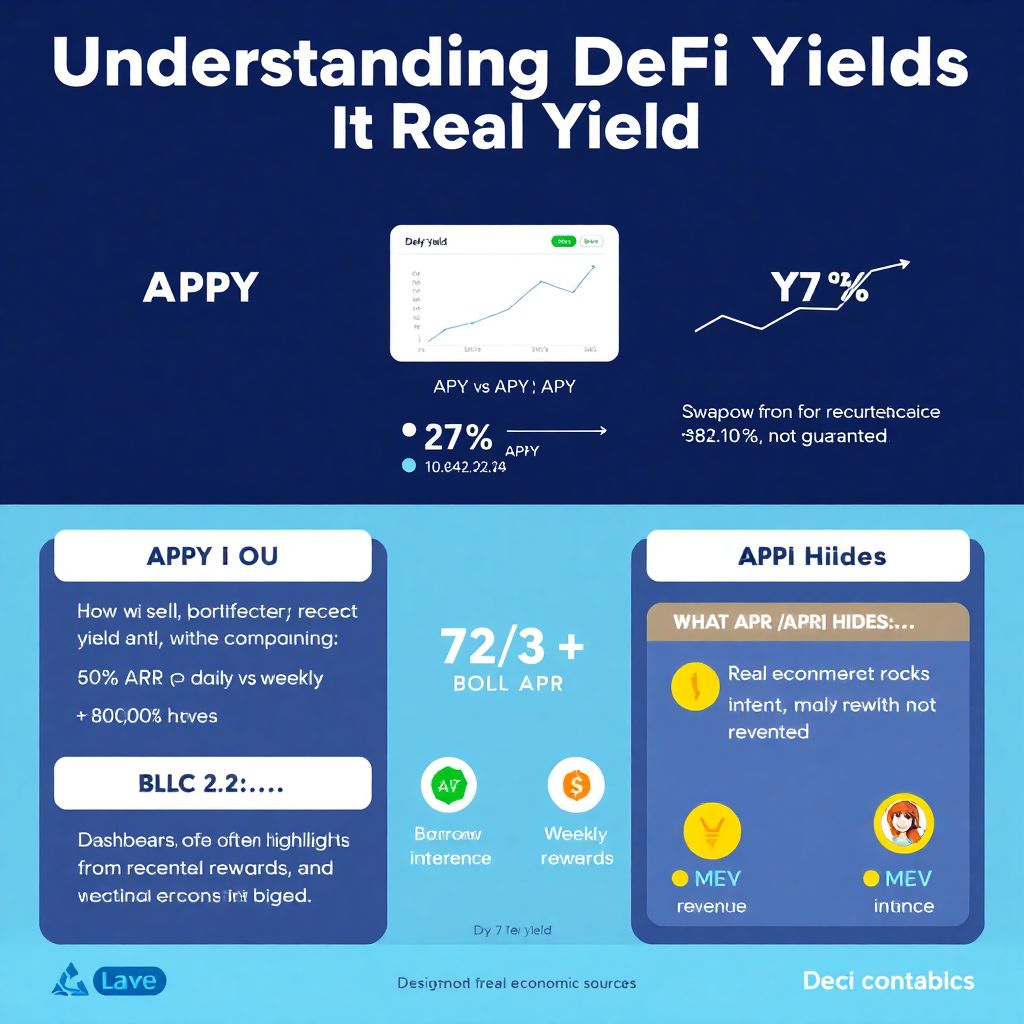
In traditional finance, APR and APY are boring bank words. In DeFi, they are weaponized attention-grabbers. APR (Annual Percentage Rate) measures the yearly rate *without* compounding. APY (Annual Percentage Yield) shows the effective yearly return *with* compounding of earned rewards. Many dashboards mix them up or purposely highlight whichever number looks bigger.
Newcomers see “300% APY” and assume that if they just click “stake”, their balance will triple in a year in any market condition. In reality, that number often assumes you continually reinvest rewards, token prices stay flat, emissions don’t change and there is no impermanent loss or slippage. As soon as one assumption breaks, your real-life result diverges sharply from the advertised APY, which is why blindly chasing the best defi yield farming rates apy apr is one of the fastest paths to disappointment.
—
Quick technical breakdown: APR vs APY
> Technical block — APR to APY math
> If a pool offers 60% APR and compounds rewards daily, the rough APY is:
> APY = (1 + 0.60 / 365)^(365) − 1 ≈ 82.1%
>
> Change compounding to weekly:
> APY = (1 + 0.60 / 52)^(52) − 1 ≈ 80.0%
>
> Same APR, different APY. Many DeFi dashboards quietly assume *continuous* or *daily* compounding, which inflates the displayed APY compared to what most users actually do (manual compounding once in a while).
—
What APR Really Tells You (And What It Hides)
APR as a snapshot, not a promise
APR in DeFi is usually calculated from *recent* rewards divided by total value locked, then annualized. For instance, if a staking pool paid out 0.2% over the last day, the UI might show ≈73% APR (0.2% × 365). That doesn’t mean this rate is sustainable for a year; it just means “if *today’s* pace somehow lasted all year, you’d get 73%”. Users commonly misread that as a guaranteed annual coupon.
Another nuance: a lot of yield is paid in the native token of the protocol. If that token drops 70% in price after a hype phase, your nominal APR looks the same in the dashboard but your *dollar* return collapses. This is especially dangerous in pool farms where rewards come from aggressive emissions that inevitably get sold by farmers, pushing price down over time. APR numbers don’t show that reflexive loop at all.
—
Technical block — APR sources in DeFi
> Where APR usually comes from:
> 1. Swap fees (e.g., 0.3% per trade on AMMs like Uniswap or SushiSwap).
> 2. Borrow interest paid by traders (lending protocols).
> 3. Token emissions (protocol printing its own token as incentives).
> 4. Arbitrage / MEV revenue sharing (in advanced designs).
>
> Only (1), (2) and (4) are grounded in real economic activity. Emissions (3) are inherently dilutive and tend to be temporary.
—
APY: The Marketing Darling of DeFi Dashboards
Why APY numbers look absurdly high
When you see APYs of 200–500% on some farms, they’re typically calculated by assuming that all rewards are reinvested as fast as possible and that the underlying incentive schedule never changes. For example, a pool paying out 1% *per day* in rewards can legitimately show a >3,600% APY if it assumes daily compounding for a full year.
In practice, the emissions schedule usually decays, liquidity flows in (shrinking your share of the pool), price of the reward token dumps as farmers sell, and you might compound only weekly or monthly because of gas fees. Consequently, your personal APY may end up at 70–100% instead of the advertised 3,600%. Still solid, but drastically different. This gap between “display APY” and “lived APY” is the trap many beginners fall into when they chase the highest real yield crypto farming strategies on aggregators without reading the details.
—
Newbie mistake #1: Treating APY as fixed income
The first classic mistake is psychological: newcomers think APY is like a bank deposit. They anchor on the big number and ignore the fine print: variable rates, changing liquidity, token price risk, smart contract risk. If you treat a DeFi farm with 150% APY like a 150% guaranteed bond, you’ll usually discover after a few months that the APY has dropped to 20%, the reward token is down 60%, and early exit fees or unlock schedules limit your flexibility.
Instead of anchoring on a single APY label, look at *rate history* when possible, and ask: “What is generating this yield? Fees? Borrow demand? Emissions? Are there strong reasons to believe this income stream can last?”
—
Real Yield: Buzzword or Serious Metric?
What “real yield” actually means
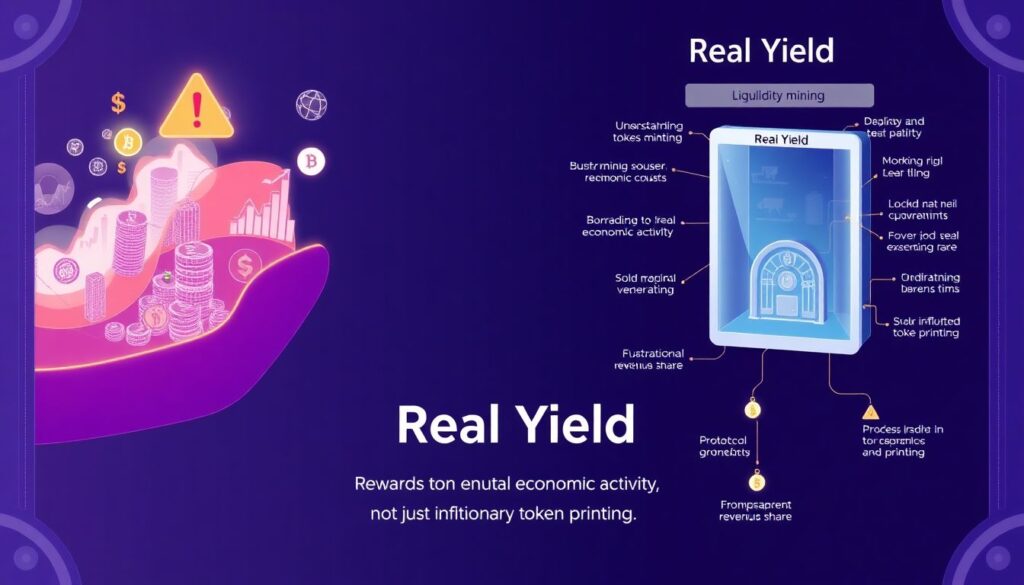
“Real yield” became a buzzword in 2022–2023 when protocols started distancing themselves from unsustainable liquidity mining. In simple terms, real yield is yield that comes from real economic activity — trading fees, borrowing costs, liquidations, revenue share — *not* just inflationary token printing.
Protocols like GMX, dYdX, or some options and perp platforms share a portion of trading fees with token stakers, often denominated in ETH, USDC, or other blue-chip assets. Here, your APY might be “only” 8–25%, but it’s based on actual fees paid by traders, so it tends to be more durable than a 400% APY farm funded by emissions. When you evaluate top crypto staking platforms high apy claims, it’s worth asking how much of that APY is “real yield” and how much is subsidized by the treasury.
—
Technical block — Real vs nominal yield
> How to sanity-check real yield:
> 1. Identify the reward asset: is it ETH/USDC or the protocol’s own token?
> 2. Check fee revenue: does the protocol publish dashboards on Dune, TokenTerminal, DefiLlama? Look for consistent monthly fees.
> 3. Compare rewards to protocol revenue: if rewards far exceed fees, you’re being subsidized, not earning real yield.
> 4. Adjust for inflation: a 30% APR paid entirely in a token inflating at 40% annually can mean negative real return if demand doesn’t grow.
—
Comparing Yields Across DeFi Products Correctly
When it makes sense to compare APRs and APYs
Comparing APR and APY only works when you’re dealing with similar risk buckets. For example, it’s reasonable to compare defi lending protocols interest rates on blue-chip collateral like ETH and USDC: here, risk profiles and mechanisms are somewhat comparable, and you can focus on utilization, oracle design, and liquidation mechanics.
By contrast, comparing a 7% APY ETH staking derivative to a pool promising 400% APY on an illiquid micro-cap token is apples to grenades. Yes, both are labeled “APY”, but the second one may carry smart contract risk, small-cap liquidity risk, governance risk, and reflexive tokenomics. A smarter approach: define your risk budget first, then compare protocols *within* that budget rather than chasing the numerically highest APY overall.
—
Newbie mistake #2: Ignoring denominator risk
Many beginners obsess over the reward stream and forget the asset they’re denominated in. Getting 50% APR in a risky governance token that can drop 90% during a bear market is usually worse than 5–7% APY on stablecoins in a robust money market.
A common horror story: a user enters a farm because it offers insane APY paid in a new token. They provide, say, $5,000 of liquidity, collect 200% APY for a couple of months, but the reward token price goes from $10 to $0.60. On paper, they might have doubled the number of tokens, but in dollars they’ve lost 70–80% of initial value. Yield is not free; it is compensation for risk. If the APY looks unreal, the risk you’re taking probably is, too.
—
Where APY Comes From in Practice: Concrete Examples
Example 1: Stablecoin lending
Imagine a mature money market where you lend USDC and earn 6% APR from borrowers, mostly leveraged traders. If you manually reinvest interest monthly, your APY is around 6.17%. Platforms compete, so you’ll often see aggregators showing the best defi yield farming rates apy apr for similar low-volatility pools in this 3–10% APR range, depending on market conditions.
The key insight is sustainability: borrowers pay those rates because they’re making trades they expect to be profitable. If market leverage dries up, demand for borrowing falls, and so do your returns. That’s natural and much healthier than yield glued to 200% via token emissions.
—
Example 2: Liquidity providing on a DEX
Now take a volatile pair like ETH/USDC. You might see 20–40% APR from swap fees during a busy market. On top of that, the protocol might offer an additional 30–60% APR in its token as an incentive. Combined, the UI may show 60–100% APR, and if you auto-compound the incentives, you see an even bigger APY.
However, you also take on impermanent loss. If ETH pumps or dumps strongly relative to USDC, your LP position may underperform simply holding ETH. Many newcomers never learn this and wonder why their “100% APY LP” barely beats holding spot, or even underperforms after a big move. Impermanent loss is not a bug; it’s the risk you’re paid to take when providing liquidity.
—
“Savings Accounts” in DeFi: Reality vs Illusion
DeFi “savings” and risk-adjusted thinking
Some protocols market themselves as a defi savings account with highest apr, often quoting stablecoin yields in the 8–15% range. That sounds like a futuristic version of a bank account, but under the hood those yields may come from leveraged strategies, rehypothecation of collateral, or complex looping positions.
Newcomers sometimes park their entire net worth in such products assuming “savings” equals low risk. Then a depeg, liquidation cascade, or smart contract bug wipes out a chunk of those “safe” yields. Experienced users treat any yield above what you might get from blue-chip lending or LST (liquid staking token) staking as risk premium, not a free lunch. Before you deposit, ask: what exactly is my capital doing to earn this number?
—
Technical block — Stress-testing “savings” yields
> Checklist for “savings-like” products:
> – Is the underlying asset a reputable stablecoin or a riskier token?
> – Is the protocol audited by multiple firms and battle-tested?
> – Does the product use leverage or looping strategies (e.g., borrow against collateral to buy more collateral)?
> – Can you track real-time health metrics: collateralization, exposure, protocol revenue?
> If you can’t answer these questions, treat the product as speculative, not as a savings account.
—
Staking Platforms and the Mirage of “Risk-Free” Yield
PoS staking vs DeFi staking
When people search for top crypto staking platforms high apy, they often mix two very different things: protocol-level staking (e.g., ETH, SOL, ATOM) and DeFi-level staking of governance tokens or LP positions. Protocol-level staking yield typically comes from block rewards and transaction fees, and long-term ranges can be reasonably predictable (e.g., Ethereum’s base staking yield often fluctuates between ~3–5% plus MEV, depending on validator participation and network activity).
DeFi-level staking, such as locking a DEX’s governance token for 40–120% APR, usually depends heavily on token emissions and market cycles. In bull markets, these can feel like magic money machines; in bear markets, they can turn into slow-motion exit liquidity for early participants. Treat any governance-token staking farm promising double- or triple-digit APY as high risk unless it has strong, proven fee-sharing mechanics.
—
Real-World Pitfalls: Common Mistakes Newcomers Make
Mistake #3: Ignoring gas and operational friction
Many APY calculations silently assume frictionless compounding. On chains where transactions cost several dollars, compounding daily might eat a large share of your yield. Beginners often auto-compound tiny positions and discover that half of their “gains” have gone to validators or sequencers.
If you’re farming modest amounts, strategy matters more than headline APY. Sometimes a boring 8–10% APY with minimal interactions beats a 60% farm that requires frequent compounding and complex steps. Always consider net return after gas, slippage, and time.
—
Mistake #4: Over-diversifying into junk farms
Another frequent pattern: new users split a small portfolio across ten different farms because they think more pools mean more safety. In reality, they multiply contract risk, cognitive load, and fees while chasing a handful of obscure tokens with no real demand. Even seasoned DeFi users rarely farm more than a few protocols seriously at the same time; depth of understanding beats breadth of random positions.
When you choose between two or three serious, audited protocols versus a dozen anonymous yield farms promising four-digit APY, the slower but transparent route often wins over a full cycle. Discipline in saying “no” to a farm you don’t understand is an underrated DeFi skill.
—
Building a Framework for Evaluating DeFi Returns
From chasing numbers to reading mechanisms
To move from newbie behavior to professional-level decision-making, focus less on “how high is the APY?” and more on “how is this APY created?” Is the yield backed by trading fees, real borrowing demand, or protocol revenue? Is it heavily subsidized by token emissions? What happens to returns if token price halves or if utilization drops?
Also consider liquidity: can you exit quickly without massive slippage? In small-cap pools, a 200% APR is meaningless if selling your rewards crashes the price 30%. Treat your portfolio as a set of experiments with defined hypotheses and exit rules, not as a casino wallet where you follow the loudest number on Twitter.
—
Final mental model: Net, sustainable, risk-adjusted yield
In the end, the real question isn’t “What’s the highest APY I can find today?” but “What’s the best combination of net, sustainable, risk-adjusted yield for my situation?” For some, that might be simple ETH staking plus a conservative stablecoin lending position. For others, it could involve a mix of GMX-style fee-sharing, blue-chip LPs, and a small, consciously speculative allocation to experimental farms.
If you learn to compare defi lending protocols interest rates intelligently, distinguish between APR and APY, and prioritize real yield over emissions hype, you’ll already be ahead of most market participants. The marketing banners won’t get less flashy, but your ability to decode them will turn DeFi from an opaque casino into a toolkit you can use with intention — and that’s where the compounding really starts to matter.