
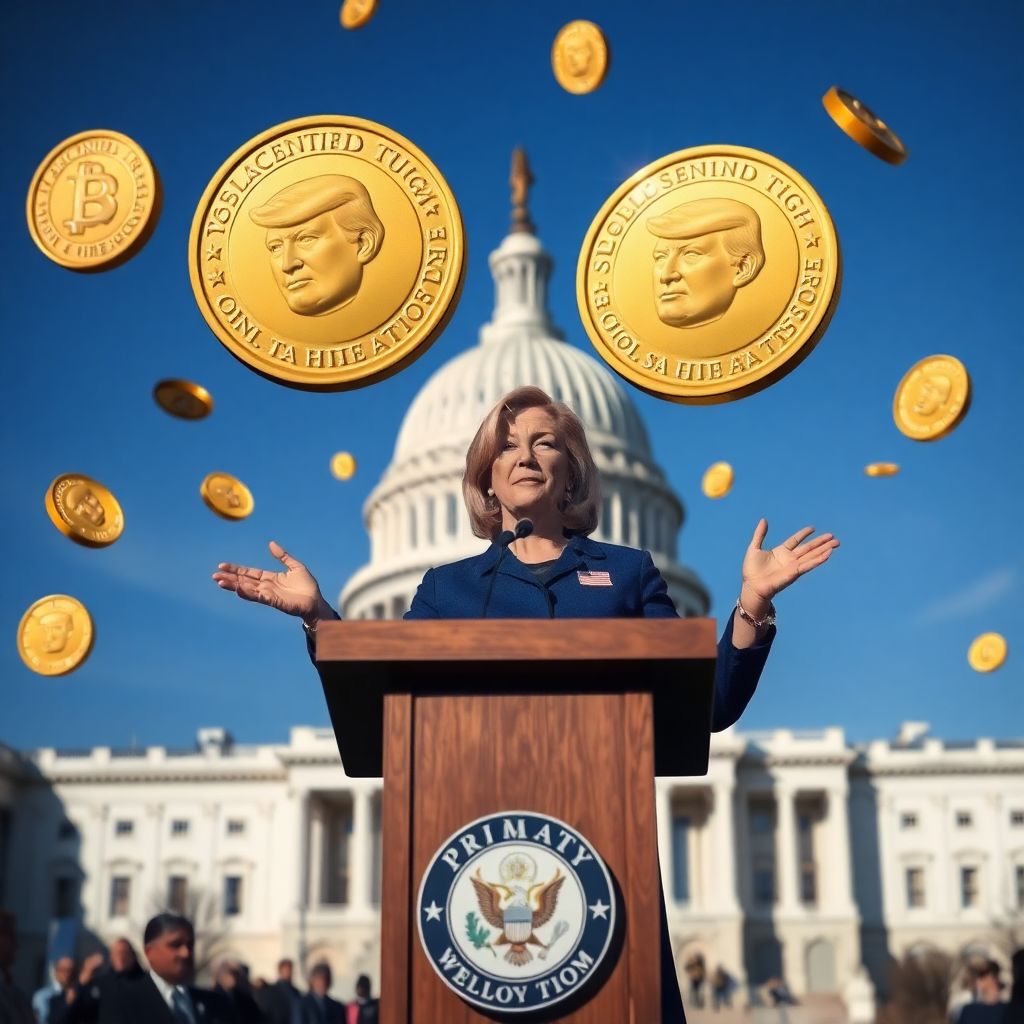
Senator Kirsten Gillibrand is pushing a new ethics crackdown aimed squarely at the booming world of political meme coins-one that could bar Donald Trump and other elected officials from launching or promoting their own cryptocurrencies.
Her renewed call comes after recent financial disclosures showed that former President Trump earned more than $1.2 billion from crypto-related ventures in the past year alone. A significant portion of that windfall reportedly came from a Solana-based meme coin associated with his name and brand, which is said to have generated more than $635 million for him personally. First Lady Melania Trump has also reportedly profited from similar token projects.
Gillibrand, a Democrat from New York who has long positioned herself as a crypto-focused legislator, now argues that the convergence of politics, personal branding, and speculative digital assets is crossing an ethical red line. She wants to prohibit federal officeholders-and their spouses-from issuing or aggressively promoting cryptocurrencies, particularly meme coins that are often marketed around internet culture, personalities, or hot-button political themes.
According to Gillibrand, allowing politicians to mint and market their own tokens invites conflicts of interest on a scale Washington has never seen before. When a sitting or aspiring officeholder can personally profit from a coin whose value is driven by public hype, social media visibility, and political fandom, she warns, every public statement and campaign event risks becoming an undisclosed pump for a private financial asset.
“This is a commonsense requirement that should get broad bipartisan support-public officials and their spouses should not be issuing meme coins,” she said in a statement. She added that the real danger is self-dealing: “We cannot let self-dealing destroy an opportunity to strengthen consumer and investor protections in the digital asset market.”
Meme coins, once a quirky niche within crypto markets, have evolved into a potent fundraising and attention-generating tool. Tokens inspired by public figures, political movements, or satirical slogans can rocket in value overnight, fueled largely by social media, online communities, and celebrity endorsements rather than traditional fundamentals. That speculative frenzy, Gillibrand argues, becomes especially problematic when the “celebrity” attached to the coin is an elected official shaping policy, regulation, and public messaging.
Trump’s crypto earnings underscore just how lucrative that combination can be. His Solana-based meme coin, branded around his image and political persona, not only rewarded early buyers who rode the hype but also directed enormous value back to the former president himself. To critics, it looks less like a passive investment and more like a personally branded financial instrument that monetizes political loyalty.
The senator’s proposal would not outlaw cryptocurrencies or meme coins for the general public. Instead, it would draw a clear ethical boundary for people in positions of public trust. Under her approach, lawmakers and their spouses could still own digital assets, subject to existing disclosure rules, but they would be barred from launching, issuing, or actively promoting tokens in which they have a direct financial interest.
Gillibrand frames her initiative as part of a broader effort to build a comprehensive regulatory framework for digital assets while avoiding a new wave of scandals. In her view, the crypto market already struggles with fraud, market manipulation, and insider advantages; letting high-profile politicians effectively operate as token issuers or promoters only magnifies those risks.
Supporters of stronger ethics rules note that traditional finance has long recognized similar concerns. Members of Congress face limits and disclosure requirements on stock trading, for instance, precisely because they can access sensitive information and influence markets through legislation. In the same way, they argue, a politician who can move markets with a tweet, a rally speech, or a policy announcement should not be simultaneously profiting from a token that depends on that public influence.
The rise of politically themed meme coins is also blurring lines between campaign fundraising, fan merchandise, and speculative investing. Some tokens are pitched as a way for supporters to “back” a candidate or ideology, but they are traded in volatile secondary markets just like any other crypto asset. That raises thorny questions: When does buying a meme coin count as a political donation? Are buyers adequately warned that their “support” could lose most of its value overnight? And who is legally responsible when the hype inevitably fades?
Gillibrand’s stance suggests that, at minimum, politicians should not be the ones orchestrating that hype. She has emphasized that her goal is not to kill innovation in blockchain technology but to draw a bright ethical line between public service and personal enrichment. For her, the Trump meme coin saga is a preview of what could happen if those lines remain fuzzy: a marketplace where political fandom is financialized, and elected officials become de facto token entrepreneurs.
Critics of such a ban are likely to argue that it infringes on free expression or unfairly singles out a new asset class. They may contend that as long as disclosures are made and existing campaign finance and securities rules are followed, politicians should be allowed to participate in the same markets as everyone else. Some within the crypto industry also worry that aggressive restrictions targeting high-profile figures could spill over into overly broad regulations that stifle innovation and entrepreneurial experimentation.
Yet the sheer scale of Trump’s reported crypto profits is reshaping that debate. When a single political meme coin can generate hundreds of millions of dollars for its namesake, it is no longer easy to dismiss such projects as harmless internet gimmicks. For many ethicists and policy analysts, it looks more like a parallel financial ecosystem orbiting around individual politicians-one with minimal guardrails and outsized potential for abuse.
The controversy also highlights a deeper challenge for regulators: crypto assets are not just money or investments; they are also media, branding tools, and social identity markers. A meme coin linked to a political figure can operate simultaneously as speculative asset, digital collectible, campaign symbol, and status badge in online communities. That multidimensional nature makes it harder to regulate using old categories like “security,” “commodity,” or “campaign contribution” without leaving dangerous gray zones.
Gillibrand’s proposal can be read as an attempt to at least close one of those gray zones: the direct commercialization of political office through personalized tokens. By focusing specifically on issuing and promoting coins, rather than mere ownership, her approach targets active self-dealing rather than passive investment. In practice, that would mean politicians could not lend their name or likeness to a new coin offering or act as the public face of a token that enriches them or their families.
If such a ban gained traction, it could reshape the emerging intersection of politics and crypto. Campaigns might still accept donations in well-established coins or stablecoins, but the era of candidate-branded meme tokens could be cut short. Political strategists would have to rethink how they tap into online crypto communities and digital-native supporters without crossing into ethically fraught territory.
For everyday investors and voters, the debate serves as a timely reminder: when a coin is built around a person rather than a product, service, or technology, the primary value driver is often attention and loyalty, not long-term fundamentals. Gillibrand’s warning about self-dealing is also a warning about risk: the same people setting the public agenda should not be quietly profiting from speculative assets that they themselves help to hype.
Whether Congress will embrace her “commonsense requirement” remains uncertain. But the numbers disclosed from Trump’s crypto ventures-and the rapid proliferation of politically flavored meme coins-are ensuring that the question can no longer be ignored. As digital assets move deeper into mainstream finance and culture, the boundary between public duty and private gain is set to become one of the most contentious battlegrounds in crypto regulation.