
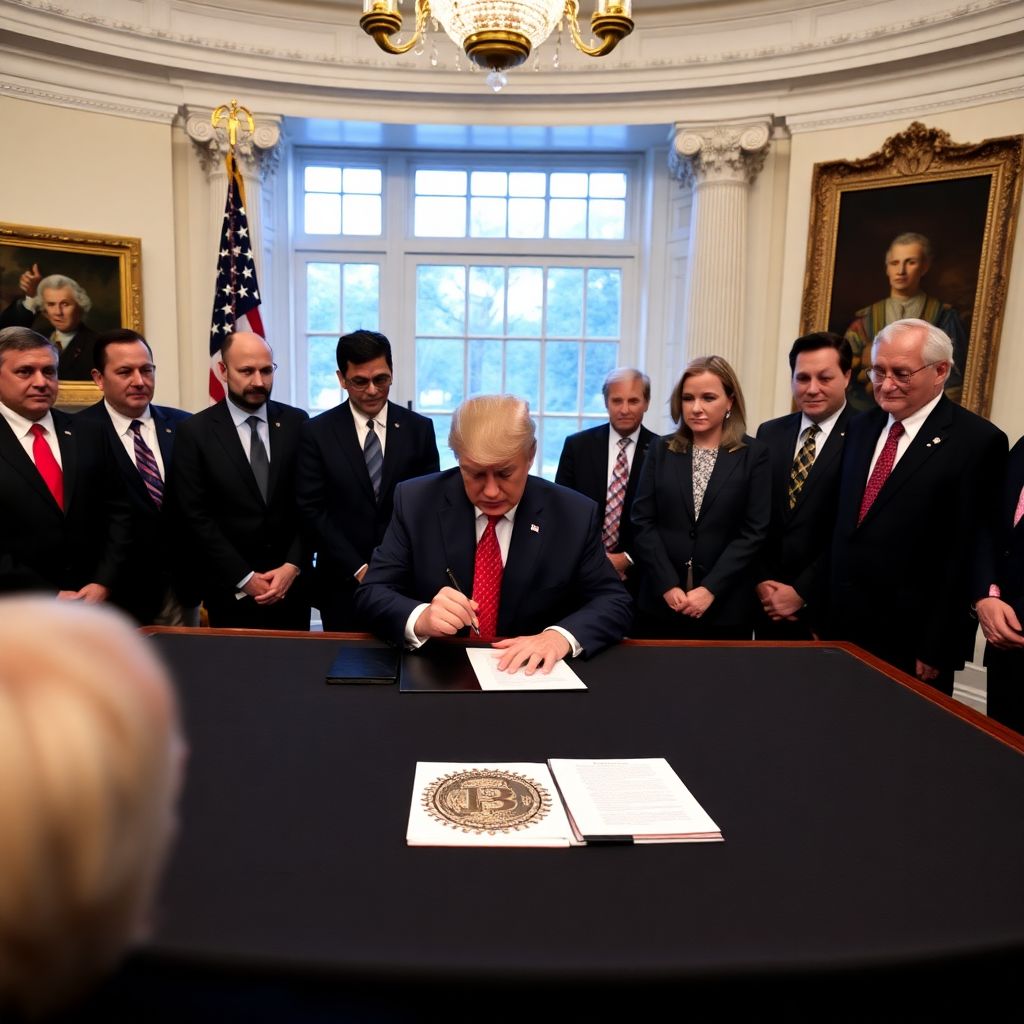
Trump signs onto strict crypto ethics rules in bid to salvage CLARITY Act
The White House has agreed to sweeping new ethics restrictions around cryptocurrency in a last‑minute push to win over skeptical Democrats and rescue the Digital Asset Market Clarity (CLARITY) Act in the Senate.
According to officials involved in the talks, the administration has accepted what it describes as the toughest federal ethics framework ever drafted for digital assets, a concession meant to clear one of the largest remaining obstacles to the bill’s passage.
The deal reportedly emerged from negotiations between senior White House aides and Republican Senators Cynthia Lummis and Bernie Moreno, who have been leading talks on the legislation. While the exact language has not yet been released, the new provision is expected to reach all the way to President Donald Trump’s own crypto holdings and related interests – a central concern for many Democrats.
A White House official characterized the compromise as “the most comprehensive and wide‑ranging ethics provision in history,” insisting the administration had “bent over backward” to address Democratic objections. Yet despite this significant move, there is still no guarantee the bill will secure the 60 votes needed to clear a filibuster in the closely divided Senate.
Ethics dispute no longer the main roadblock – but not a done deal
The agreement appears to remove one of the most contentious sticking points that had stalled the CLARITY Act for months. However, the Senate has not published final bill text, nor scheduled a floor vote, and lawmakers are running up against a tight timeline before the August state work period. If the measure is not brought up before that recess, its path forward could become even more complicated.
Several Democratic senators had drawn a red line around ethics protections, arguing that any serious attempt to regulate digital assets must include explicit limits on political entanglements with the industry. Senators Elizabeth Warren, Chris Murphy, Jeff Merkley and Chris Van Hollen had previously warned that a market structure bill would be “worthless” if it failed to address Trump’s financial and political ties to crypto.
Their worries center on Trump’s namesake memecoin and his family’s involvement with World Liberty Financial, as well as other investments and relationships in the digital asset space. Some Democrats also demanded formal congressional hearings into the president’s crypto portfolio and business connections before they would even consider supporting the legislation on the Senate floor.
Open questions: who is covered and who enforces the rules?
While the White House has agreed in principle to far‑reaching ethics language, many of the most critical details remain opaque. It is not yet clear whether the restrictions will explicitly extend to the president’s family members, close advisers, or entities in which they hold indirect interests.
Equally unsettled is the question of enforcement. Some Democrats, according to reporting cited in the negotiations, are uneasy about the possibility that oversight could be concentrated solely in the Trump‑controlled Department of Justice. They have pushed for additional enforcement mechanisms, such as giving state attorneys general or independent federal watchdogs authority to pursue violations.
Earlier this year, Patrick Witt, executive director of the President’s Council of Advisors for Digital Assets, outlined the administration’s broad philosophical stance: it was willing to accept rules that apply “from the president all the way down to the brand new intern on Capitol Hill,” but rejected what he described as provisions tailored to single out one individual or one family. The latest ethics compromise appears to test that line, and how it is ultimately drafted will determine whether Democrats believe it goes far enough.
Democrats extract stronger consumer protections
While ethics dominated headlines, Senate negotiators quietly resolved or narrowed several other disputes over the bill’s core regulatory architecture. Industry voices involved in the process say Democrats successfully pushed for more robust investor and consumer safeguards, giving the Senate’s version of the CLARITY Act sharper teeth than earlier drafts.
Coinbase vice chair Ryan VanGrack has said that Democratic negotiators strengthened oversight provisions designed to protect retail customers, arguing that the current legal vacuum offers too few protections and too little clarity for everyday users of crypto platforms. In his telling, Democrats seized the moment to make sure “customers were first and foremost” in the bill’s final structure.
Key areas of contention have included:
– How stablecoin rewards and yield‑style products are treated under federal law
– The breadth and design of anti‑money‑laundering controls applied to digital asset intermediaries
– The treatment of tokenized securities and the division of oversight between securities and commodities regulators
– Protections for software developers and open‑source contributors so that innovation is not chilled by overly broad liability
Negotiations over these elements have been slow and technical, but they are crucial for defining how exchanges, issuers and developers operate in the United States in the coming years.
Committee vote shows bipartisan glimmers – but floor math is tight
The Senate Banking Committee advanced the CLARITY Act in May with every Republican member voting in favor, joined by Democratic Senators Ruben Gallego and Angela Alsobrooks. The 15-9 committee vote gave supporters a symbolic boost and demonstrated that some Democrats are open to a compromise framework.
However, both Gallego and Alsobrooks stopped short of endorsing the final bill sight unseen. They made clear their committee votes did not guarantee support for whatever version eventually reaches the Senate floor, emphasizing that key negotiations – including ethics and enforcement – were still ongoing.
To hit the 60‑vote threshold, Republicans must hold their conference together, retain Gallego and Alsobrooks, and convince additional Democrats that the combination of ethics rules, consumer protections and regulatory clarity is strong enough to warrant support. That remains an open question, especially for progressive lawmakers who view Trump’s crypto dealings with suspicion.
House already passed its own CLARITY blueprint
On the other side of Capitol Hill, the House of Representatives passed its version of the CLARITY Act in July 2025 during a themed “Crypto Week” focused on digital asset legislation. The House bill would formally divide oversight of cryptocurrencies and related products between federal market regulators and create clearer standards for deciding when a token is treated as a security versus a commodity.
This division is central to the industry’s long‑running complaint that the United States lacks a transparent, predictable framework. Under the proposal, tokens that meet specified criteria would fall under one agency’s jurisdiction, while others would be overseen by a different regulator, theoretically ending years of uncertainty and conflicting enforcement actions.
For the CLARITY Act to become law, however, the Senate must pass its own version, and any differences between the two chambers will need to be reconciled in a conference process or through further negotiation.
Markets cheer ethics deal while odds of passage stay below 50%
Crypto‑linked assets rallied on news of the White House ethics concession. Bitcoin climbed above 66,000 dollars on Tuesday, hitting a seven‑week high as traders interpreted the agreement as a sign that Washington could be inching toward a workable regulatory regime. Shares of major exchange operator Coinbase jumped around 10%, while stablecoin issuer Circle saw gains of roughly 7%.
Yet prediction markets showed far less enthusiasm. A contract tracking the probability that the CLARITY Act would become law in 2026 priced the odds at about 48%, with substantial trading volume. That implied that, in the eyes of many speculators, passage remains no better than a coin flip despite the breakthrough on ethics.
This disconnect underscores a key point: while the ethics compromise removed a major barrier, the bill is still vulnerable to partisan disputes, time constraints on the Senate calendar, and the possibility that any last‑minute controversy could prompt wavering senators to walk away.
Trump’s political push and symbolism around the bill
Trump himself has repeatedly prodded senators to move the CLARITY Act across the finish line. He has urged lawmakers to approve the legislation “in honor of” the late Senator Lindsey Graham, whom he has portrayed as one of the measure’s earliest and strongest champions.
Industry leaders, including top executives from large crypto firms, have likewise pressed Congress to deliver a durable framework after years of regulatory uncertainty. Their argument is that without clear rules, innovation will drift offshore, US companies will face competitive disadvantages, and consumers will remain exposed to opaque practices and regulatory gaps.
Why the ethics provisions matter for the broader crypto landscape
Beyond the immediate Senate vote count, the ethics component of the CLARITY Act carries significant symbolic and practical weight. By subjecting the president and other senior officials to explicit restrictions on crypto holdings, trading and conflicts of interest, the White House is attempting to counter the perception that US crypto policy might be shaped by personal financial incentives.
If the final language is robust and effectively enforced, it could become a template for future rules governing public officials’ involvement in emerging financial technologies. It might also help reassure skeptical Democrats and independents that the push for “clarity” is not merely a vehicle to legitimize the president’s own ventures or those of his allies.
However, if the provisions are perceived as toothless or overly reliant on agencies directly controlled by the White House, they could have the opposite effect, deepening partisan mistrust and making future crypto legislation harder, not easier, to pass.
Potential impact on investors, companies and developers
For individual investors, the CLARITY Act’s most important contribution would likely be the creation of a more predictable regulatory environment. Clear rules around what counts as a security, how exchanges must handle customer assets, and how stablecoins are supervised could reduce the kinds of sudden enforcement shocks that have roiled markets in recent years.
For companies, especially exchanges and token issuers, standardized federal guidelines could lower legal risk and compliance uncertainty. Firms that currently operate in a patchwork of state and federal expectations might gain a more unified framework, even if it is stricter in some respects.
Software developers and open‑source contributors are closely watching how liability provisions are drafted. Strong protections could encourage innovation and experimentation, while poorly calibrated rules might deter developers from building in the US or even from publishing certain types of code.
What to watch next
In the coming weeks, several developments will determine whether the CLARITY Act advances or stalls:
– Publication of the final Senate text, including the precise ethics language
– Whether Senate leadership decides to schedule a floor vote before the August recess
– Public reactions from key Democratic holdouts once they see the finalized enforcement and consumer protection provisions
– Any further movement in crypto markets, which have been reacting quickly to legislative signals
– Signals from the White House about how aggressively it intends to implement and police any new ethics rules
If the bill clears the Senate, a new round of negotiations will follow to harmonize the House and Senate versions. If it fails, lawmakers may not revisit such comprehensive crypto legislation for some time, leaving regulators and courts to continue shaping the landscape piecemeal.
For now, Trump’s acceptance of sweeping crypto ethics restrictions has changed the political dynamics around the CLARITY Act – but it has not removed the fundamental uncertainty over whether Congress is truly ready to lock in a federal rulebook for digital assets.