
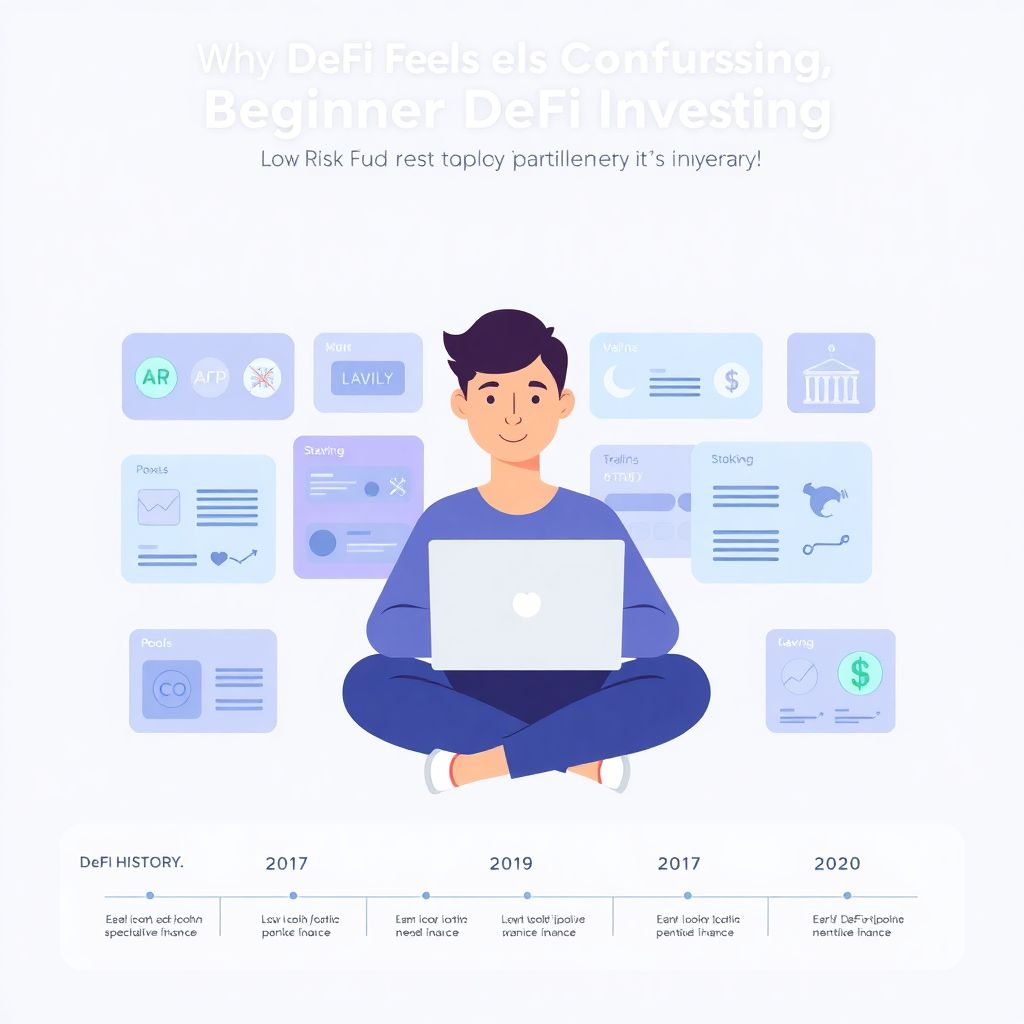
Why DeFi Feels Confusing (And Why It’s Worth It Anyway)
If you’ve opened a DeFi app in 2025 and thought, “What on earth is all this?”, you’re not alone. The screens are full of APRs, pools, vaults, bridges, and weird vegetable-themed tokens. It’s noisy, risky, and sometimes straight-up scammy.
But under all that chaos sits something useful: a way to earn on your money without asking a bank for permission.
A beginner DeFi portfolio doesn’t have to be wild, degenerate, or stressful. You can stick to low‑risk trails, move step by step, and treat it more like learning online banking in 2005 than gambling in a casino.
—
A 5-Minute History of DeFi (So You Don’t Repeat Old Mistakes)
Very quick rewind.
– 2017–2018: ICO boom. People throw money at anything with a token. No real DeFi yet, mostly speculation and vaporware.
– 2019–2020: Early DeFi on Ethereum: Compound, Aave, Uniswap show up. Lending, borrowing, and swapping without banks. It’s clunky but real.
– 2020–2021 “DeFi Summer”: Token incentives go crazy. Yields hit triple digits. Protocols fork each other overnight, security is an afterthought. Plenty of folks get rich; plenty lose everything.
– 2022: Reality check. Major collapses (Terra/LUNA, Celsius, FTX—yes, centralized, but deeply tied to crypto). “Risk-free yield” turns out to be marketing. Regulators wake up.
– 2023–2024: Mature phase. Audits, insurance, better UX, bigger players. Yields drop, but overall risk (when you stick to solid platforms) gets more manageable.
– 2025: DeFi is less shiny, more boring—and that’s perfect for beginners who just want sustainable, low‑risk defi investment strategies.
Knowing this timeline matters. Almost every big failure came from the same pattern: chasing high yields on complex products you didn’t fully understand, on platforms that hadn’t been battle‑tested.
Your beginner portfolio should be the opposite of that.
—
Step 1: Decide What “Low Risk” Actually Means for *You*
DeFi risk isn’t a single thing. It’s a mix of:
– Smart contract risk: Bug in the code, funds drained.
– Platform risk: Team mismanages keys or treasury, or just disappears.
– Market risk: Token prices crash; “safe” yields suddenly aren’t.
– Stablecoin risk: The coin you thought was $1 breaks its peg.
In traditional finance, you usually worry most about market risk and maybe bank failure. In DeFi, smart contracts and platforms are front and center.
So before you learn how to build a beginner defi portfolio, define your *personal* boundaries:
– Are you okay with volatility in token prices, or do you want mostly stablecoins?
– Are you prepared to leave funds in a protocol for months, or do you want the ability to exit quickly?
– How much money can you fully afford to lose without impacting your life?
Write those answers down. Seriously, on paper or in a note. That’s your “personal risk policy,” and it’ll keep you from clicking the shiny 120% APR later.
—
Step 2: Choose the Right Playground (Chains and Wallets)
To access the best defi platforms for beginners, you need two things: a wallet and a chain.
Short version:
– Wallet: A non‑custodial wallet (you hold the keys), like MetaMask, Rabby, or a hardware wallet such as Ledger or Trezor.
– Chain: A well‑established network with deep liquidity and lots of audited protocols—Ethereum mainnet, or a top layer‑2 like Arbitrum, Optimism, or Base.
Longer, practical guidance:
1. Set up a wallet.
– Install a well-known browser wallet.
– Back up your seed phrase offline (paper or metal, not screenshots, not cloud drives).
– Add a small test amount of crypto first to get used to it.
2. Fund your wallet with “gas” and stablecoins.
– For Ethereum or most L2s, you’ll need ETH for gas fees.
– Convert part of your starting capital into a reputable stablecoin (USDC and, with some caution, USDT or others).
3. Stick to one main chain at first.
Don’t start bridge-hopping across five networks as a beginner. Bridges add another failure point. Learn one environment well before you expand.
Remember: custody is the main difference versus centralized exchanges. When you use DeFi, you’re your own bank—and your own IT department.
—
Step 3: Pick a Simple, Low-Risk Strategy Before Touching Anything
Instead of chasing everything at once, choose one primary low‑risk track for your new portfolio:
1. Stablecoin parking (lowest volatility).
You park stablecoins in a conservative lending protocol or a stablecoin-only pool to earn modest yield. You avoid price swings but still have smart contract and stablecoin risk.
2. Blue-chip staking (moderate, long-term).
You buy a small amount of a major asset (like ETH) and stake it via a reputable platform to earn network rewards, accepting price volatility but using relatively secure infrastructure.
3. Combination approach.
A bit of both: mostly stablecoins + a smaller allocation to staked ETH or another blue-chip asset.
For a true starter, option 1 or 3 usually makes sense. You have a smoother ride while you learn the ropes.
—
Step 4: Build a Simple, Structured Beginner Portfolio
Let’s walk through one possible framework. You can adjust the numbers, but keep the logic.
Imagine you’re starting with 1000 units of capital (dollars, euros, equivalent).
1. Decide your split
A reasonable “training wheels” structure:
1. 60–80% in stablecoins in conservative protocols.
2. 10–30% in staked blue-chip crypto (e.g., ETH).
3. 0–10% for experiments and learning (newer platforms, test strategies).
This keeps the core of your beginner DeFi portfolio focused on capital preservation, not max yield.
2. Implement the stablecoin portion
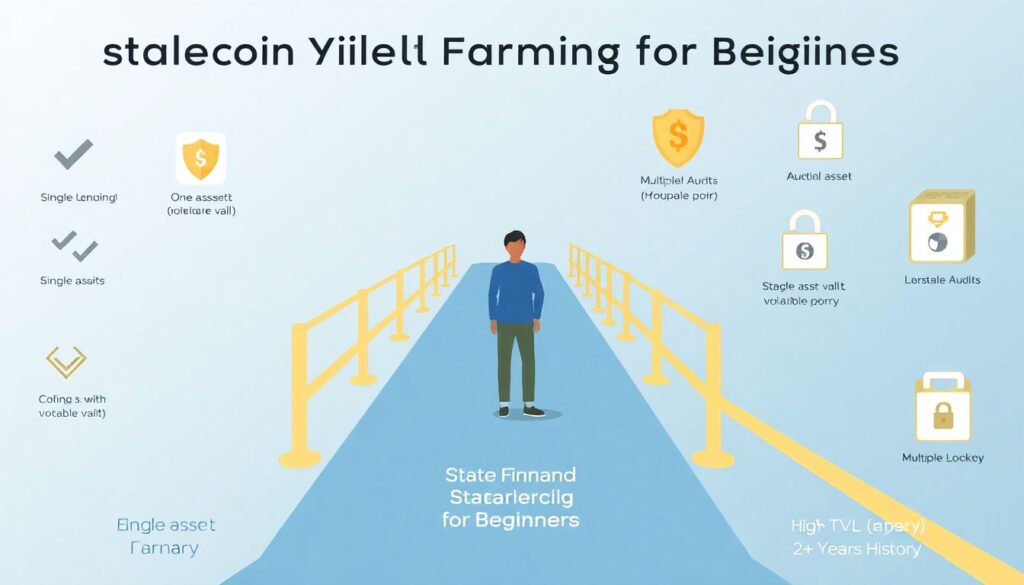
This is where stablecoin yield farming for beginners comes in, but with guardrails:
– Use single-asset lending or single-asset vaults first (you supply one stablecoin, not a volatile pair).
– Favor protocols with multiple audits, significant TVL (total value locked), and at least a couple of years of clean history.
– Ignore anything that requires leverage, complicated “re-staking loops,” or promises unrealistically high returns.
Think yields in the 2–8% APY range as normal for lower-risk stablecoin lending in 2025. If something offers 40% on the same stablecoin with no obvious extra risk, assume you’re missing something.
3. Add a blue-chip staking element
Next, allocate your 10–30% to something like ETH:
– Buy ETH on a reputable exchange.
– Move it to your wallet.
– Use a staking solution that’s been through multiple cycles and audits.
You’re looking for safe defi staking platforms with low risk, meaning:
– Transparent on how staking works and where funds go.
– Non-custodial or heavily distributed validator setups.
– Clear history of uptime and responsiveness during network issues.
Don’t chase “exotic” staking derivatives right away. Start with basic staking yield, get comfortable, and only later consider more advanced restaking or LSD (liquid staking derivative) strategies.
4. Keep your “experiment bucket” small
With 0–10% of your capital, you can:
– Try a new chain or emerging protocol.
– Test a slightly more complex yield strategy.
– Join a governance process and learn how DAO voting works.
But treat this as tuition, not “profit center.” This money is what you’re willing to lose while learning.
—
Step 5: Choose Platforms Like a Skeptical Auditor
Now, how do you actually pick the protocols to plug this plan into?
Here’s a practical checklist:
1. Age and track record.
Has the platform been live for more than a year? Longer is better. Look for how it handled past market stress (2022, 2023, sharp drawdowns).
2. Audits and bug bounties.
– Multiple audits from reputable firms.
– Public bug bounty program showing they *expect* to find issues and pay researchers to do it.
3. TVL and reputational signals.
– Billions in TVL doesn’t guarantee safety, but a few thousand is a red flag.
– Check if major funds or well-known DeFi builders publicly use or back the protocol.
4. Documentation and support.
A serious protocol explains risks, mechanisms, and edge cases clearly. If their docs feel like hype instead of explanation, walk away.
5. Regulatory and jurisdiction hints.
DeFi is global, but teams that completely hide behind anonymity and dodge any legal questions are a different risk tier than transparent, doxxed teams with clear entities.
When you search for the best defi platforms for beginners, treat every list and ranking site as marketing, not gospel. Cross-check protocol names with independent sources, crypto security researchers, and multiple communities.
—
Step 6: Execute Your First Positions (Slowly and Deliberately)
When you’re ready to move from theory to action, go one step at a time. Don’t set everything up in a single adrenaline-fueled evening.
A simple execution flow:
1. Start with a tiny test transaction.
– Deposit the minimum allowed amount of a stablecoin into your chosen lending pool or yield vault.
– Confirm the interface, gas fees, and withdrawal process all behave as you expect.
– Withdraw it back out successfully.
2. Scale gradually.
– If the test goes well, increase your deposit in stages (e.g., 10%, then 30%, then full target allocation).
– After each change, double-check balances and positions in both the app and an independent block explorer.
3. Repeat the process for staking.
– Stake a small amount of ETH or your chosen asset.
– Learn how rewards accrue, how unbonding or unstaking works, and how long exits take.
– Only then grow the position toward your planned 10–30%.
The goal isn’t just to deploy capital; it’s to train your muscle memory and build confidence.
—
Step 7: Build a Simple Monitoring Routine
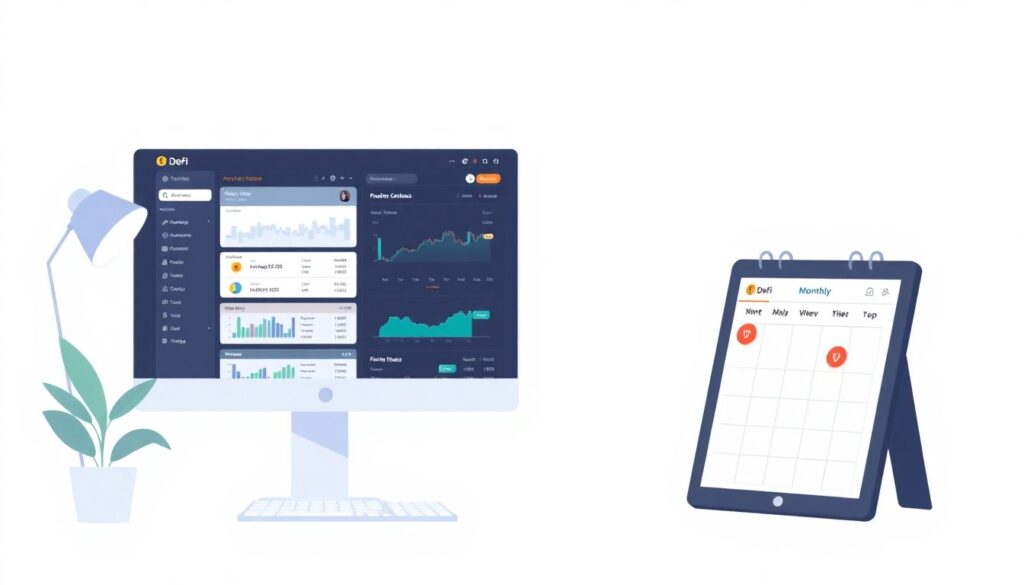
DeFi doesn’t send you monthly paper statements. You have to be proactive.
Set up a minimal system:
1. Portfolio tracker.
Use a reputable DeFi dashboard to see all your positions on one screen. Don’t grant unnecessary permissions—read‑only views are enough.
2. Calendar check-ins.
Once a week or once every two weeks:
– Log in to your wallet and each protocol.
– Check APYs, collateral ratios (if any), and stablecoin pegs.
– Confirm you recognize every token and position.
3. News filters, not doomscrolling.
– Follow a few trusted DeFi researchers or newsletters.
– Set alerts for the specific protocols you use.
– Ignore random influencers shilling “next 100x” tokens.
If something major changes—a protocol gets hacked, a stablecoin depegs, or a platform announces big contract upgrades—your default should be: reduce exposure first, analyze later.
—
Common Beginner Mistakes (And How to Dodge Them)
To keep your “low-risk” strategy actually low risk, avoid these classic traps:
1. Chasing APR instead of understanding risk.
If you can’t clearly explain *in plain language* where the yield comes from, don’t use the product.
2. Overusing leverage.
Leveraged yield strategies multiply both gains and losses. For your first year in DeFi, you don’t need them at all.
3. Mixing too many strategies too soon.
Stick to 1–2 core strategies until you can explain them confidently to a friend without notes.
4. Ignoring gas and transaction costs.
On some chains, frequent small moves can quietly eat into your returns. Batch operations where possible and avoid micro‑tweaking.
5. Sloppy key management.
Seed phrase in your email? Screenshots in your phone gallery? That’s a ticking time bomb. Hardware wallet + offline backup is the standard to aim for.
Your edge as a beginner isn’t secret knowledge; it’s the discipline to *not* do what broke so many people in 2020–2022.
—
A Simple 7‑Step Checklist to Build Your Beginner DeFi Portfolio
To tie it all together, here’s a streamlined roadmap:
1. Define your risk boundaries.
Decide your maximum capital at risk, your tolerance for volatility, and your minimum time horizon (think 6–12 months, not 6 weeks).
2. Set up and secure your wallet.
Install a reputable wallet, write down your seed phrase offline, and test a tiny transaction.
3. Pick one main chain and fund it.
Choose Ethereum or a leading L2, get native gas tokens + stablecoins into your wallet.
4. Design your allocation split.
For example: 70% stablecoin yield, 20% blue-chip staking, 10% experiments. Adjust numbers to fit your comfort.
5. Select 1–2 conservative protocols.
Use your platform checklist: age, audits, TVL, documentation, and reputation.
6. Deploy in stages with test amounts.
Start tiny, confirm deposits/withdrawals, then scale gradually to your target allocations.
7. Establish a monitoring habit.
Weekly check-ins, portfolio dashboard, a few trusted news sources, and a default response of “de‑risk first, ask questions later.”
Follow this, and you’ll have a clear, low‑drama answer to the question of how to build a beginner defi portfolio without getting sucked into hype cycles.
—
Final Thoughts: DeFi as a Skill, Not a Lottery Ticket
In 2025, the wild promises are mostly gone from the front page, but the underlying tools are better than ever. You can lend, borrow, stake, and swap 24/7 with transparent rules written into code.
Treat DeFi like a skill you’re developing over years, not a one‑time bet.
Start small. Stick to boring, robust protocols. Let your first goal be not losing money rather than doubling it. As you learn, you can always graduate from “training wheels” strategies to more advanced ones—but you only get that chance if you survive your rookie season.
And that’s exactly what a well‑built, low‑risk beginner DeFi portfolio is designed to help you do.