
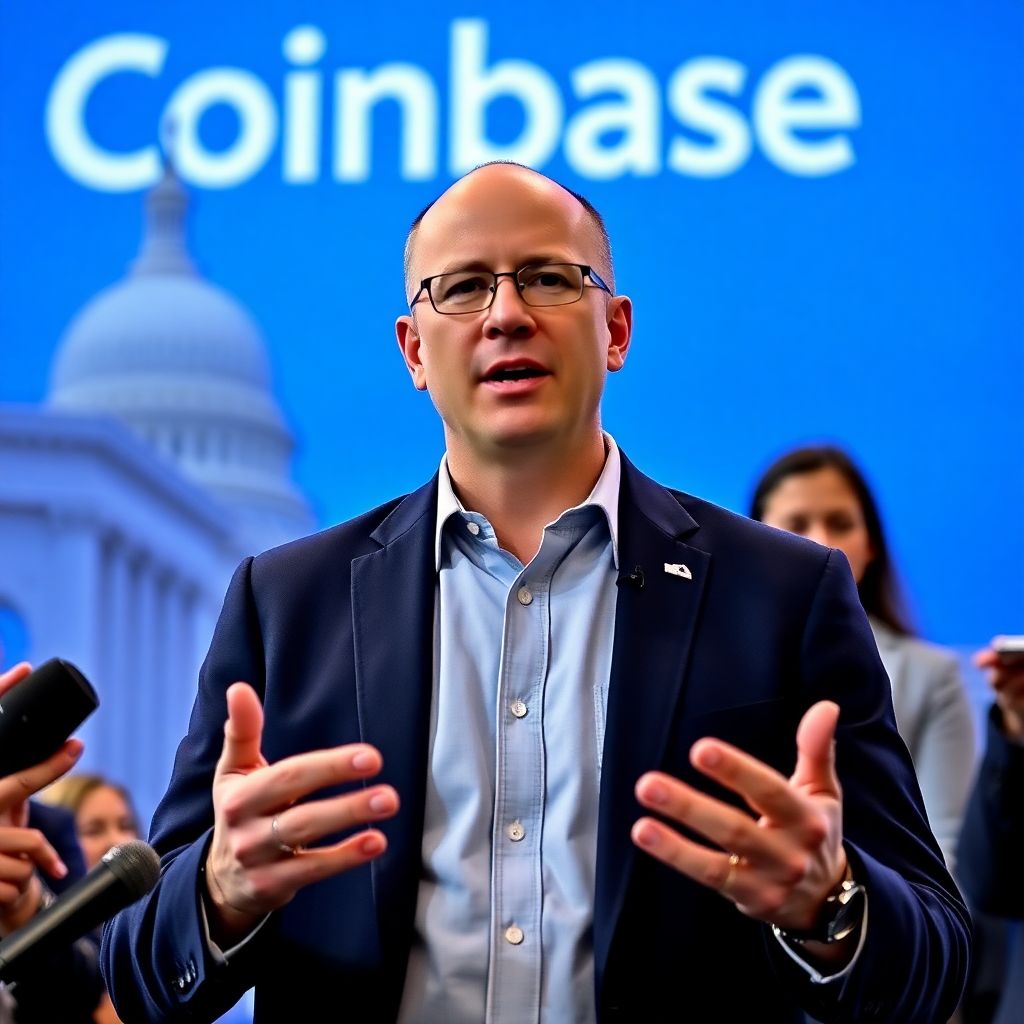
Coinbase CEO Brian Armstrong insists that Washington’s delays will not derail crypto’s long‑term trajectory. Even as the U.S. Senate pushed a vote on the CLARITY Act into September, Armstrong argues that adoption is marching ahead on several fronts: stablecoins, tokenization of real‑world assets and the growth of global digital asset markets.
According to Armstrong, the Senate’s decision to leave town for its August recess without advancing the bill was a setback, but not a breaking point. He characterized the move as frustrating, yet ultimately secondary to what is happening in the market itself. Businesses and individual users, he stressed, are still integrating digital assets into everyday financial activity regardless of congressional timing.
In a post on X dated Aug. 7, the Coinbase chief highlighted concrete signals of progress. He pointed to surging stablecoin usage worldwide, a rapidly expanding ecosystem for tokenized real‑world assets such as Treasuries and money‑market instruments, and widening access to perpetual futures products. In his view, these developments show that regulators and industry participants are already finding ways to move forward, even as lawmakers debate details in Washington.
“The momentum behind this technology keeps growing with or without a congressional calendar,” Armstrong wrote, underscoring his belief that innovation cycles do not pause simply because legislation is stuck in procedural limbo. His comments consciously separated the pace of commercial growth from the Senate’s legislative schedule.
From Armstrong’s perspective, companies do not need to wait for new laws to continue building under existing regulatory frameworks. However, he nonetheless emphasized that Congress remains central to shaping a coherent national policy. A clear and unified federal regime, he argued, would bring major benefits: more capital investment in the U.S., more jobs tied to digital asset innovation and stronger, more predictable protections for American consumers.
The CLARITY Act itself is designed to bring order to a fragmented oversight landscape by dividing responsibilities between the Securities and Exchange Commission and the Commodity Futures Trading Commission. The bill also aims to set nationwide standards for crypto exchanges, brokers, dealers, investment advisers and qualified custodians handling digital assets. For large platforms like Coinbase, that type of clarity could reduce legal uncertainty and make long‑term planning easier.
Procedurally, the bill faces an uphill path in the Senate. Majority Leader John Thune has said the legislation will be taken up once lawmakers return from the August recess and has pledged to keep it in the queue. But to overcome the chamber’s cloture hurdle, the measure needs 60 votes. Assuming full Republican backing, that still requires at least seven Democrats to cross the aisle.
Democratic lawmakers have used the delay to push for tougher provisions. They want stronger language on potential political conflicts of interest, tighter consumer protection standards, more robust safeguards against illicit finance and clearer tools to preserve market integrity. One of the most contentious points involves proposed restrictions related to former President Donald Trump’s crypto holdings and business ties, which some Democrats see as a key test of the bill’s anti‑corruption credibility.
Senator Elizabeth Warren has emerged as one of the most vocal opponents of the current draft. She maintains that the CLARITY Act, as written, does not go far enough in addressing national security concerns, systemic risks to consumers or the possibility of corruption within the digital asset space. Her criticism underscores a broader divide in Washington between those who view crypto as a strategic technology and those who see it primarily through a risk‑management lens.
One of the most sensitive sections of the bill deals with stablecoin rewards-an issue that touches directly on Coinbase’s business model. The latest version of the legislation would generally bar companies from paying interest or yield simply for holding payment stablecoins. At the same time, it leaves room for incentive programs linked to specific activities such as making payments, sending remittances, providing liquidity, staking or participating in loyalty schemes.
Armstrong previously signaled support for this compromise, arguing that both banks and crypto firms had secured their core priorities: traditional finance would be shielded from direct competition on plain deposit‑like interest, while digital asset companies could still innovate around use‑based rewards. Several banking trade groups, however, have warned that even activity‑linked incentives could siphon deposits from the conventional banking system and weaken their funding base.
The stakes are significant for Coinbase, particularly in relation to its partnership around USD Coin (USDC). An analysis of the company’s financials suggests that Coinbase currently generates roughly $1.35 billion in annual revenue from its USDC rewards structure. Any changes to what counts as a permissible reward program could materially affect that income stream and force the company to adapt its product design.
Beyond stablecoins, Armstrong is betting heavily on tokenization as a long‑term driver of adoption. Recent moves by large financial institutions lend weight to his optimism. Asset management giant BlackRock has launched tokenized money‑market offerings that hold cash, short‑term U.S. Treasuries and Treasury‑backed repo agreements, making traditional money‑market exposures accessible through blockchain‑based tokens. For Armstrong, such products are a clear sign that mainstream finance is beginning to embrace crypto infrastructure rather than compete with it outright.
The Depository Trust and Clearing Corporation, a cornerstone of U.S. financial plumbing, is also preparing to roll out a tokenization platform. Slated for launch in October, the service is backed by an industry consortium that now includes more than 100 members and partners. Among them are household names like Nasdaq, Charles Schwab, BlackRock and Circle, underscoring that tokenization is no longer a niche experiment but a strategic initiative for major market players.
Recent pilot programs show how deep that integration could go. In July, DTCC executed live production transactions involving tokenized Treasuries, equities, collateral, securities lending and margin workflows. These tests did not rely on exotic new instruments; instead, they used existing securities embedded in the current U.S. market infrastructure. The exercise demonstrated that tokenization can be layered into the traditional system without tearing it down, potentially delivering faster settlement, better transparency and more efficient collateral management.
Public markets appear to be tracking this broader narrative. Coinbase shares climbed alongside the growing adoption story, with COIN closing a recent Friday session at $153.60, up around 5.7% on the day. While that move cannot be directly pinned on Armstrong’s comments or expectations around the CLARITY Act, it reflects investor perceptions that the company could benefit from a world where tokenization, stablecoins and regulated exchanges play bigger roles in global finance.
For everyday crypto users, the delay around CLARITY raises practical questions: Does it change how they should approach digital assets now? Armstrong’s answer is essentially no. He suggests that individuals can continue using established stablecoins for payments and savings, participate in regulated platforms for trading and yield‑generating activities and explore tokenized products offered by reputable institutions. Regulatory uncertainty remains, but it has not frozen the core functions that make crypto useful.
Institutional investors are taking a similar stance. Many have shifted from asking whether to engage with digital assets to working out how to do so within their own risk and compliance frameworks. For them, the CLARITY Act represents a potential simplifier-a law that could harmonize federal oversight and reduce the patchwork of rules. Until then, they are relying on existing securities and commodities regulations, as well as guidance from agencies and courts, to structure their products.
From a policy standpoint, the debate around the bill highlights a critical inflection point for the U.S. If lawmakers manage to craft a credible compromise, the country could reinforce its role as a hub for crypto innovation while strengthening consumer safeguards and national security screening. If negotiations break down, there is a risk that more entrepreneurs and capital will shift toward jurisdictions that already offer clearer regulatory pathways.
Armstrong’s key message is that technology adoption rarely unfolds in a straight line with legislation. He sees stablecoins becoming standard tools for cross‑border payments and everyday commerce, tokenized assets transforming capital markets infrastructure and regulated crypto platforms acting as gateways between traditional and digital finance. In that context, the CLARITY Act is important but not decisive-it can shape the environment, but it cannot stop the underlying momentum.
As the Senate heads through its recess, attention now turns to whether negotiators can hammer out a version of the bill that satisfies both pro‑innovation Republicans and security‑focused Democrats. Thune has pledged to prioritize the legislation once lawmakers return, yet a firm floor vote has not been locked in. Until a final deal emerges, the regulatory future of U.S. crypto will remain uncertain on paper-but, if Armstrong is right, the market will keep moving forward anyway.