
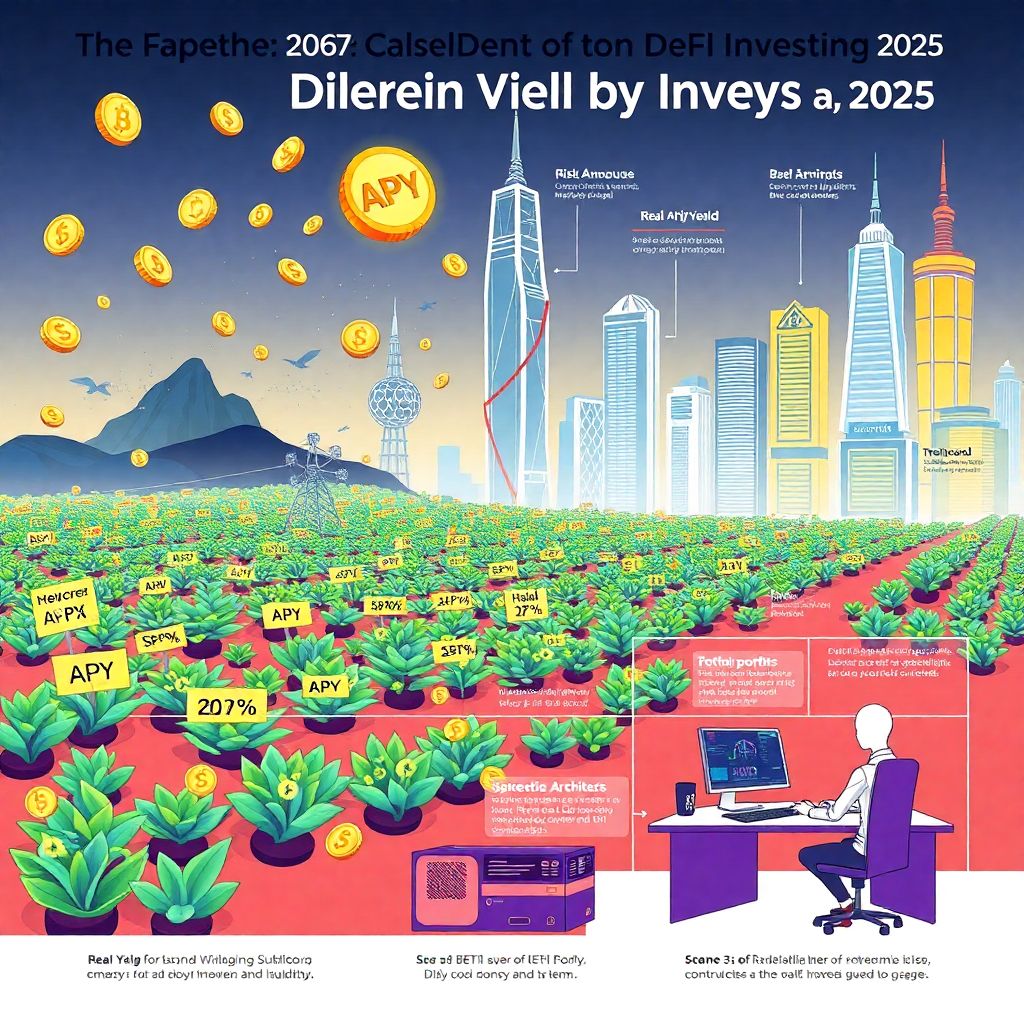
From Food Farms to Sustainable Systems: Brief History of DeFi Yield

In crypto time, “long term” is anything beyond a single cycle, but if you zoom out from 2020 to 2025, a pretty clear evolution of DeFi yield emerges. The first wave of “yield farming” on Ethereum in mid‑2020 was essentially a chaotic liquidity mining experiment: protocols like Compound and then Uniswap and SushiSwap bootstrapped TVL by printing governance tokens at unsustainably high rates. Most of those APYs assumed perpetual token inflation and mercenary liquidity, not real fee revenue. By 2021, blue‑chip primitives and stablecoin pools dominated, while cross‑chain bridges and sidechains multiplied opportunities along with attack surfaces. The 2022–2023 bear market and multiple bridge exploits exposed structural fragility, forcing a pivot from “max APY now” to “can this survive a full cycle without blowing up users’ capital?”
The post‑crash years up to 2025 pushed the ecosystem toward risk‑aware design and more realistic expectations around “passive income.” Regulators began circling, token incentives shrank, and users started asking not “What’s the highest APY today?” but “Which sustainable defi investment platforms for stable returns are likely to be around in five years?” L2s matured, real‑yield models linked rewards to on‑chain fees, and risk frameworks became standard for serious treasuries. That’s the context in which it even makes sense to talk about best long term defi yield farming strategies: not as a degen sprint, but as a portfolio construction problem with regime changes, smart‑contract risk, and chain‑level risk treated explicitly instead of hand‑waved away.
Core Principles of Low‑Stress, Long‑Horizon DeFi Yield
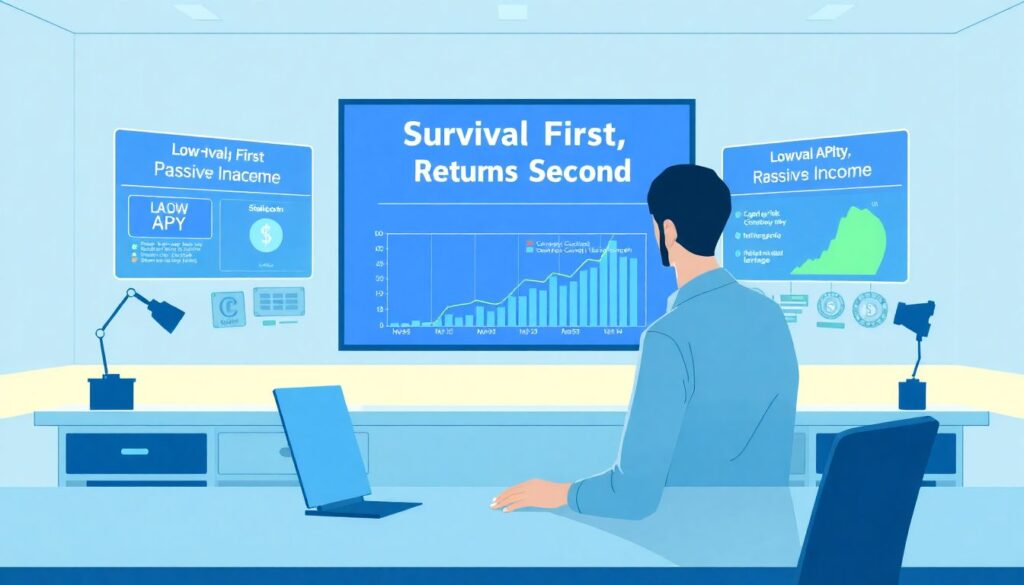
Designing a low risk defi yield strategy for passive income starts from a boring but crucial premise: survival first, returns second. In practice this means capping protocol risk, contract complexity, and leverage before even looking at APYs. Long‑horizon investors treat DeFi positions as part of an overall balance sheet, sizing them relative to liquid reserves and off‑chain assets, then planning around worst‑case drawdowns instead of best‑case yields. A sustainable design typically favors large, audited, battle‑tested protocols, plain‑vanilla primitives such as overcollateralized lending and spot DEXs, and conservative collateral factors. On top of that, you want rate volatility management: stablecoin‑denominated yields, diversified rate sources, and explicit rules for rebalancing when APRs or market regimes shift hard.
At a high level, a long‑term framework answers three questions: what risks am I paid for, how do they correlate, and what happens if multiple things break at once? That’s where the idea of how to build a diversified defi portfolio for yield becomes more about orthogonal risk factors than about chain count. Exposure can be split across interest‑bearing stablecoins, staked base assets, and real‑yield fee streams, but also across teams, auditor sets, and execution environments (L1 vs different L2s). The aim is not just smoothing returns; it’s making the strategy psychologically tolerable so you’re not doom‑scrolling dashboards every time gas spikes or a new exploit trends on crypto Twitter.
What “Long‑Term DeFi Yield” Looks Like in Practice
In 2025, top defi protocols for long term staking and yield tend to share certain design traits: clear revenue models, transparent on‑chain accounting, and reasonably mature governance. Think major L2 staking derivatives secured by protocol fees and MEV, blue‑chip lending markets with dynamic interest curves, or DEXs whose LP returns are heavily fee‑driven rather than purely incentive‑driven. A typical “core” allocation might park stablecoins in conservative lending markets and low‑volatility stable pools, while base assets like ETH or BTC‑wrapped tokens are staked via liquid staking tokens, optionally paired in concentrated liquidity ranges only if you actively manage price risk. On top of that, you can add a thinner layer of actively monitored strategies—structured vaults or re‑staking—bounded by strict size limits.
Concrete implementation usually unfolds in tiers instead of a single monolithic bet. A defensive base layer could be stablecoin lending plus a broad ETH staking allocation you’re prepared to hold through multiple cycles. A middle layer can add protocol‑level real‑world‑asset credit or delta‑neutral basis strategies managed by reputable vault builders. A small, clearly ring‑fenced satellite layer can chase experimental yields but is mentally pre‑written to zero. What differentiates best long term defi yield farming strategies from opportunistic farming is the presence of predefined exit rules: caps per protocol, triggers for pulling liquidity after oracle incidents or governance drama, and scheduled reviews rather than emotional reactions to APY spikes or Twitter threads.
Common Misconceptions and Mental Traps

One persistent myth is that “passive” DeFi income is truly set‑and‑forget. In reality, even a low‑touch portfolio needs periodic monitoring for contract upgrades, governance changes, and shifting risk‑free benchmarks. Another misconception is that diversification automatically de‑risks you; in DeFi, many protocols share dependencies—same oracles, same bridges, similar codebases—so nominally diverse holdings may still be exposed to common‑mode failures. People also routinely underestimate smart‑contract and governance risks relative to market risk, assuming that if an asset is “stable” the position must be safe; historically, more wealth has been vaporized by contract exploits and bad tokenomics than by simple price volatility inside blue‑chip assets.
Investors also misread headline APYs, ignoring whether rewards are paid in a reflexive governance token with unclear value accrual or in assets with real demand. Long‑term stability usually favors fee‑driven or externally funded flows over pure emissions, but this nuance gets lost when dashboards highlight only the aggregate percentage. Finally, many participants still chase “risk‑free yield” narratives around new primitives or chains without mapping the underlying trust assumptions—sequencer upgrade keys, multisig admin powers, opaque off‑chain components. A genuinely low‑stress, long‑horizon setup accepts that no yield in DeFi is risk‑free; it’s about choosing which risks you understand, can monitor, and are actually being compensated to take over a multi‑year horizon.