
Context: Why Staking Strategy Matters in 2025
In 2025 staking is no longer a niche activity for hardcore DeFi users; it has become a core yield primitive for anyone holding proof‑of‑stake assets. Validators secure networks such as Ethereum, Solana and emerging L2s, while retail users face a practical dilemma: lock capital into solo validator setups or delegate to pooled services with abstracted infrastructure. This shift explains why a nuanced crypto staking platforms comparison is now essential: yields are compressing, regulatory pressure is rising, and smart‑contract risk is more visible after several high‑profile incidents. Against this backdrop, choosing between solo staking and pools is less about chasing maximum APR and more about optimizing a personal risk‑return profile, operational effort, liquidity needs and alignment with decentralization goals of the underlying protocol.
Core Differences: Solo vs Pool Architectures
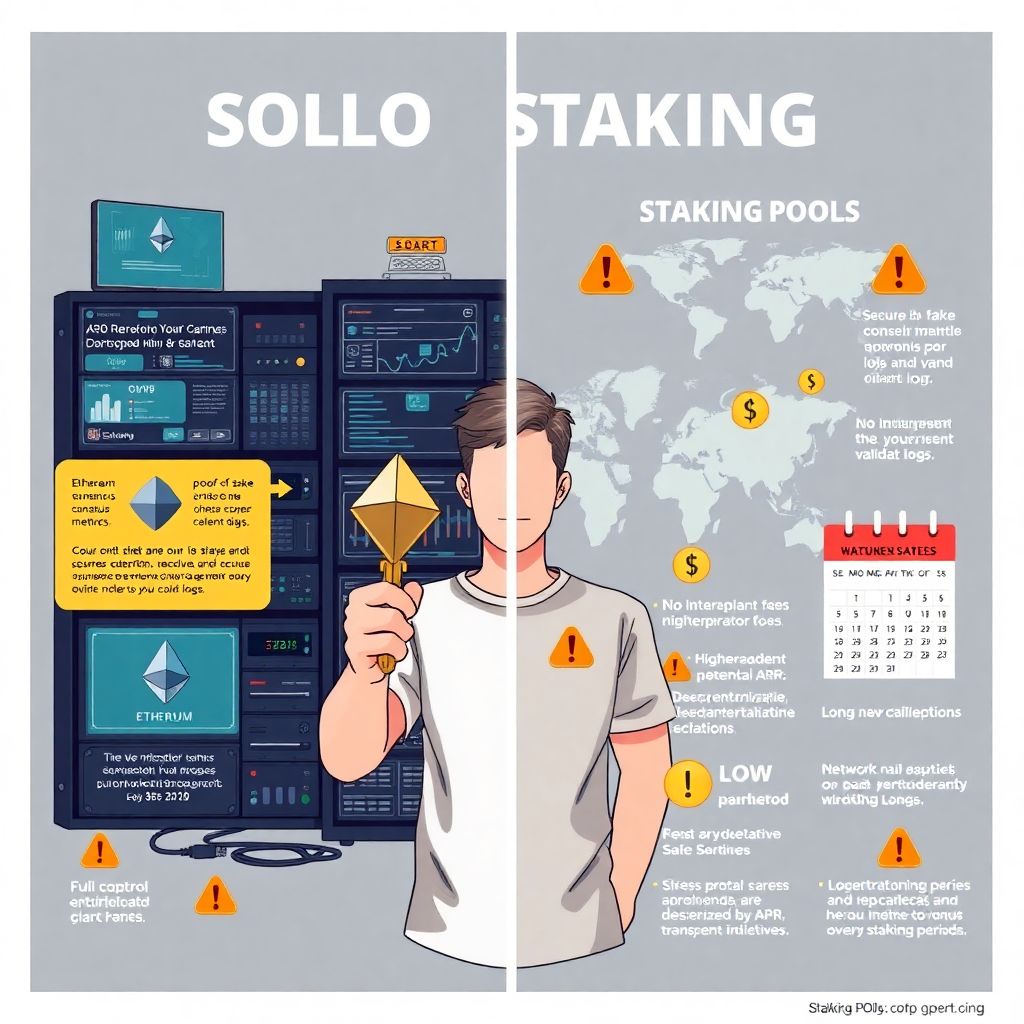
Solo staking means you run your own validator or set of validators, manage keys, maintain uptime, and directly interact with the consensus layer, typically with a fixed minimum stake (32 ETH on Ethereum mainnet). You earn protocol rewards minus penalties, without delegating power or fees to intermediaries. By contrast, staking pools aggregate many users’ deposits and operate validator infrastructure on their behalf, distributing rewards pro‑rata via on‑chain accounting tokens or off‑chain ledgers. From an architectural standpoint, solo staking concentrates operational complexity at the user level, while pools externalize it to specialized operators and smart contracts. When you ask solo staking vs staking pool which is better, the technically accurate answer is that they optimize different constraints: solo maximizes sovereignty, pools maximize convenience and capital efficiency.
Pros of Solo Staking: Sovereignty and Clean Incentives
Solo staking appeals to users who prioritize protocol‑level purity and trust minimization. You keep full control over withdrawal keys, avoid custodial layers, and minimize exposure to smart‑contract bugs and governance capture. Because there is no intermediary fee, your effective APR can be higher than many pooled solutions, especially during periods of elevated network activity. You also directly contribute to network decentralization: a growing long‑tail of independent validators reduces systemic reliance on a handful of operators. From an incentive design view, solo validators experience transparent slashing and reward mechanisms without opaque revenue‑sharing models. For technically inclined investors, running a validator also provides operational insight into consensus mechanics, useful for evaluating highest yield crypto staking platforms without relying exclusively on marketing metrics or aggregated dashboards.
Cons of Solo Staking: Operational and Capital Barriers
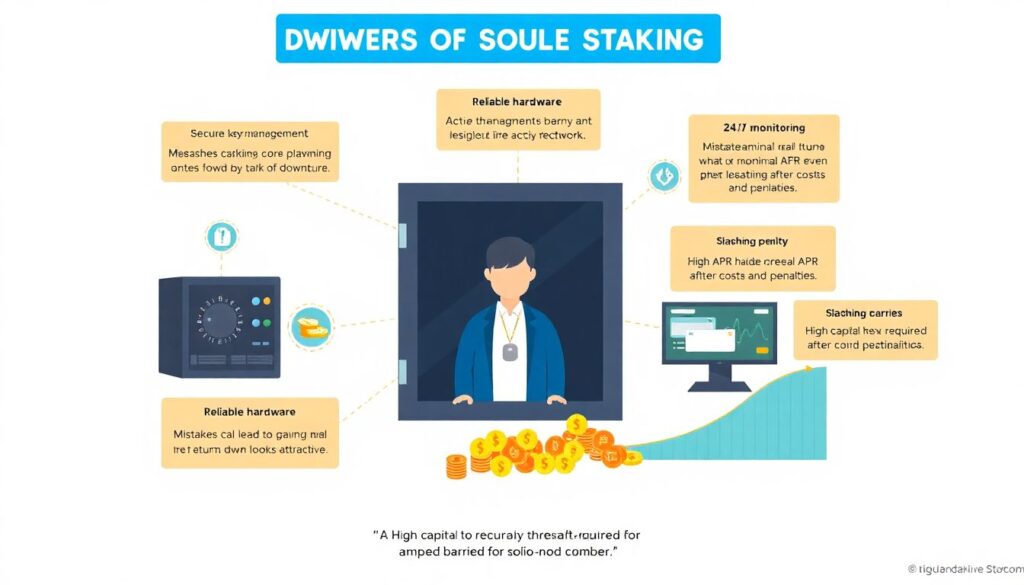
The downside is that solo staking is unforgiving of mistakes. You need secure key management, reliable hardware, and monitoring to avoid downtime and potential slashing. Underestimating these requirements can lead to negative real returns even if nominal APR looks attractive. Capital thresholds are another issue: many networks require substantial minimum stakes, blocking smaller portfolios from direct participation. Liquidity is also constrained; exiting a validator can involve unbonding delays and queuing, which complicates tactical asset allocation. Furthermore, there is an opportunity cost in time: maintaining infrastructure, applying client updates and monitoring chain health is non‑trivial, especially if your core competency is trading or research rather than DevOps. Expert validators often stress that the question is not how to start solo staking crypto in theory, but whether you can commit to continuous operational discipline over a multi‑year horizon.
Pros of Staking Pools: Accessibility and Liquidity
Staking pools were designed to flatten these barriers by abstracting infrastructure and pooling smaller stakes. Users can stake fractions of the minimum requirement, often via a single transaction through an exchange, DeFi protocol or dedicated middleware. Many liquid staking tokens (LSTs) can be used as collateral in DeFi, adding a composability layer that solo stakers typically lack. This makes pools particularly attractive for funds and active on‑chain investors who want yield plus leverage or basis‑trading opportunities. In a modern crypto staking platforms comparison, pools often score higher on UX, liquidity and capital efficiency, especially when integrated across L2s, money markets and DEXs. For non‑technical holders, delegating to a reputable pool can provide exposure to staking rewards without the cognitive overhead of learning validator operations or managing redundant infrastructure in multiple regions.
Cons of Staking Pools: Smart Contract and Centralization Risks
Pooling introduces additional risk vectors beyond protocol‑level consensus. Smart‑contract vulnerabilities in staking derivatives, oracle failures, or misconfigured withdrawal logic can lead to systemic losses even if the base chain is functioning correctly. Governance centralization is another concern: if a small number of pooled operators control a large validator share, they can potentially influence MEV policies, censorship behaviors, or protocol votes. Custodial pools on centralized exchanges add further counterparty and regulatory exposure; funds can be frozen or rehypothecated depending on jurisdictional pressure. Experts also warn about correlated slashing risk when many validators run homogenous client stacks under one operator. While marketing often highlights best staking pools for Ethereum by raw APR, due diligence should weigh these latent tail risks, because they materialize precisely when markets are stressed and liquidity is most needed by participants.
Risk Profiles: Matching Strategy to Investor Archetypes
From a portfolio‑construction view, solo staking aligns with low‑leverage, long‑horizon investors who value censorship resistance and are comfortable with infrastructure tooling. Their risk is idiosyncratic (e.g., personal misconfiguration) rather than correlated smart‑contract failure. Pool staking better serves users optimizing for liquidity and composability, often layering leverage or derivatives on top of staked positions. Their main risk lies in contract exploits, governance failures and operator concentration. Risk‑adjusted returns depend on how these vectors correlate with the rest of the portfolio: exposure to DeFi protocols, CeFi venues, and jurisdictional threats. In practice, many sophisticated allocators blend both approaches, assigning a “core” allocation to solo validators and a “satellite” tranche to liquid staking pools, thereby diversifying validator‑level risk while preserving optionality for on‑chain strategies across multiple chains and client ecosystems.
Expert Recommendations: Practical Selection Framework
Analysts and validator operators in 2025 increasingly suggest treating staking like any other infrastructure investment. First, assess your operational capability: if you cannot monitor nodes 24/7 or manage key‑rotation policies, solo may only be viable via managed services with shared control models. Second, run your own crypto staking platforms comparison beyond APR: include fee structures, slashing records, client diversity, audits, and jurisdictional footprint. Third, avoid concentration: even when chasing the highest yield crypto staking platforms, cap exposure to any single pool, especially those tightly coupled to centralized exchanges. Finally, when evaluating solo staking vs staking pool which is better for you, map each option to clear goals: long‑term protocol alignment, tactical yield farming, or simply passive income. Experts emphasize that clarity of intent matters more than squeezing an extra 20–30 basis points of nominal APR.
Trends 2025: Restaking, Modular Security and Regulation

By 2025, the line between solo and pooled staking is blurred by restaking frameworks and modular security markets. Validators can now opt‑in to secure additional services, earning extra yield but accepting new slashing conditions, while pools package these opportunities into user‑friendly products. This multiplies the importance of transparent risk disclosures and stress‑testing. On Ethereum, competition among liquid staking providers has intensified, fragmenting what were once seen as the best staking pools for Ethereum into a more diversified set of operators with stricter decentralization commitments. Regulatory scrutiny is rising, especially around pooled products that resemble securities, pushing some platforms to adjust reward mechanics and disclosures. For new entrants exploring how to start solo staking crypto, this environment offers better tooling, guides and monitoring stacks, but also demands a more sophisticated understanding of cross‑protocol dependencies and correlated failure modes across the broader staking economy.